

Sir Humphrey Appleby popularised the concept of ‘Ministry Policy’, policies which the civil service sought to steadily proceed with, regardless of who was in power. More recently, former No. 10 adviser to Keir Starmer, Paul Ovenden, wrote of the ‘Stakeholder State’, ‘the gradual but decisive shift of politics and power away from voters and towards groups with the time, money and institutional access to make themselves too important to ignore.’1
As someone who has worked through multiple changes of minister and Secretary of State, I’ve seen first hand how, after a transition - even within the same government - policies the civil service doesn’t like are quietly deprioritised or recommended for termination, while those it favours are presented again and again, until a minister can be found who will agree to take them forward.
So it was no surprise to see, despite having played a part in blocking them in 2021,2 the new School Food Standards emerge this week, like a dead rat the cat refuses to stop bringing in, just as I had seen them in draft, five years before.
As if designed by a committee of health food aficionados, to suck all the pleasure of eating from the next generation3, the proposed new rules are full of killjoy sentences such as ‘Fried breads, pastries and croissants are not permitted’, ‘Restricting the use of cheese as a main ingredient,’ ‘Once a week fruit to be the only available dessert option in primary schools’ and ‘Allowing only plain water, semi-skimmed or skimmed milk, lactose free milk and some plant-based drinks in primary and secondary schools.’
The more one reads it, the more depressed one gets:
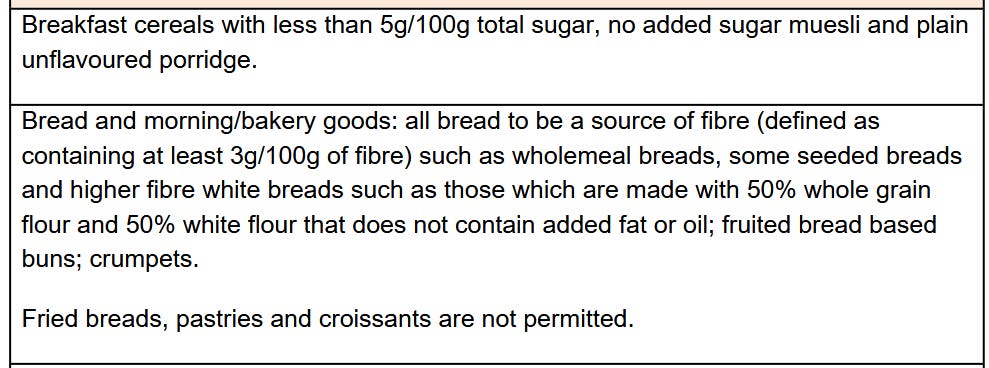
For drinks:
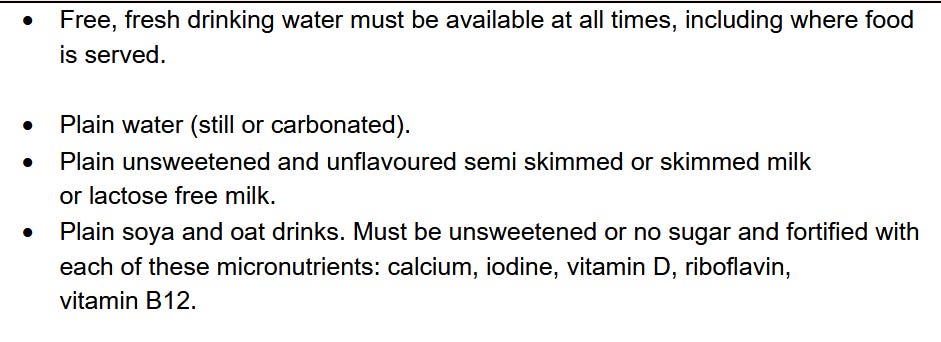
For whole-grain starch:

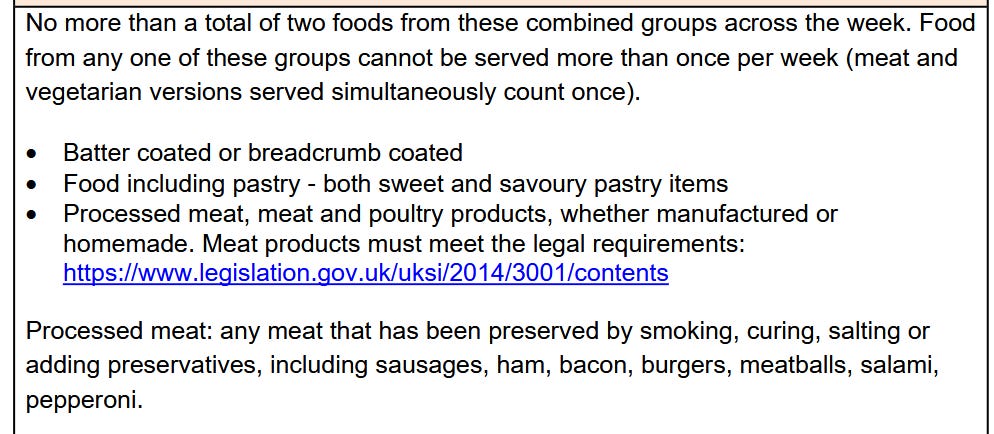
Cheese is in the firing line:

As are meatballs, sausages and bacon:4
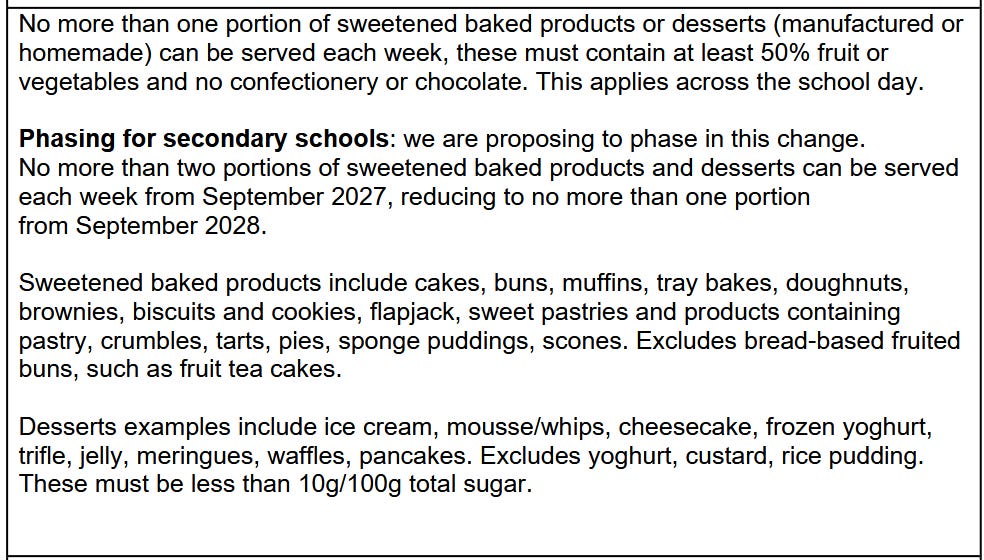
Traditional puddings such as crumbles, jam roly-poly and syrup sponge are almost completely eliminated - reduced to just once a week:
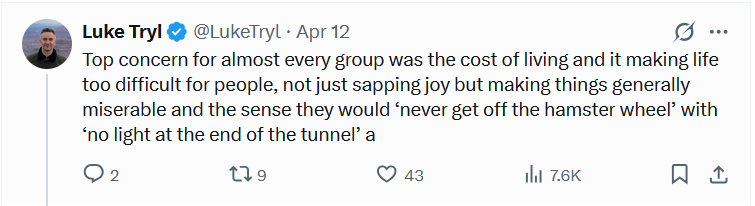
The Government’s announcement is supported - but of course it is! - by a host of charities, celebrities and assorted do-gooders. And quite possibly it polls well, if asked in the right way, to a population with dim memories of the Jamie Oliver ‘turkey twizzlers’ campaign from 2005. But in the real world, was this at the top of anyone’s priority list? In a world where the cost of living and the state of public services regularly top every poll and focus group,5 across voters from all parties, ages and locations, why do this?6
This is death by 1000 cuts, a never-ending stream of regulations that impoverish business, households and the public sector alike. It is not just the hundred million pounds bat tunnels and fish discos; not just the HS2 bridges to nowhere. It is the £1.8 billion cost of Martyn’s Law, requiring all premises such as church halls and larger pubs with over 100 capacity to take steps to mitigate the impact of terrorism; the £2.7 billion cost of requiring new higher buildings to have second staircases - both policies the Government’s own impact assessments assess to have minimal benefits.
It is the plethora of regulations which mean childcare costs have increased by 80% in real terms since 2000, why ever-longer regulatory codes choke our financial services, and why 20mph zones proliferate across our towns and villages. It is why Eldest’s year 8 school trip to France costs 33% more for 20% less time than mine did 30 years ago7 and behind the increasing requirements heaped upon pubs, restaurants, small businesses and charities. Nor is the public sector immune. It is why schools which used to have a couple of admin staff now have admin blocks, why the NHS needs more midwives to deliver fewer babies and why everything, from reservoirs to prisons, takes longer and costs more.
I am not saying any of these are unpopular in themselves - on the contrary, most are brought in to cheers and any attempts at abolition are met with howls of outcry.8 The British public loves banning things. Very few of these rules are entirely stupid, or have no benefit at all. But in aggregate they are immiserating, making life more expensive, less convenient and less colourful. The British people are facing the revealed consequence of their own actions.
What is more, those who push these regulations will never be satisfied. The school food standards were updated shortly after, and as a direct result of, Jamie Oliver’s campaign, updated again in 2014, with various smaller amendments since then. But still they cry for more. Whether it is alcohol, road safety, childcare, hygiene, health and safety or food, the ratchet only goes in one direction.9
As C. S. Lewis wrote:
“Of all tyrannies, a tyranny sincerely exercised for the good of its victims may be the most oppressive. It would be better to live under robber barons than under omnipotent moral busybodies. The robber baron’s cruelty may sometimes sleep, his cupidity may at some point be satiated; but those who torment us for our own good will torment us without end for they do so with the approval of their own conscience. They may be more likely to go to Heaven yet at the same time likelier to make a Hell of earth.”
This stuff makes me despair far more than major laws I disagree with, such as the Employment Rights Act. While the latter is individually more damaging, it is at least the result of a distinct political process: championed by a senior Cabinet Minister, included in a manifesto and passed with deliberate intent by a government strongly aligned with its measures. It can as easily be repealed - indeed, both the Conservatives and Reform have pledged to do so.
But how to deal with the torrent of regulation pouring, incessantly, from every department and quango? How to put the risk-aversion ratchet into reverse? St George marches out with shield and spear10 to face the dragon - but instead meets a plague of locusts which, sweeping past his clumsy efforts, strip the countryside bare.11
I have on occasion suggested that we should simply repeal every law and regulation passed since the mid-90s, with only a small grace period allowed to identify those we wished to keep.12 In reality this probably would not work - even if we could find a politician bold enough to do it.13 Other whimsical ideas, such as every law ceasing within 10 years unless an MP can be found to read it out, in full, in the Chamber, similarly belong more within the pages of a Heinlein novel than in real life.14
Nevertheless, there are measures that can be taken. The One In:Two Out mechanism imposed by the Coalition had some success, though too many measures were excluded from its scope to be effective. Sunset clauses could be applied routinely to new quangos and regulation (and even to older ones) and parliamentary approval required for regulators to impose new regulations which would have more than a minimal cost. An interesting idea I recently came across was for a standing committee tasked to systematically review regulation - primary, secondary and requirements from regulators - that could only recommend repealing (in whole or in part), not additions. Each quarter a package for repeal would be presented to a senior minister, who would then have the final decisions on whether or not to repeal, confirmed by a Parliamentary vote.
But all these mechanisms can only go so far. After years of stagnating living standards, to restore our prosperity, our freedom and our public services, we will need a Prime Minister and Cabinet who will tackle regulation with the same single-minded focus that Thatcher applied to privatisation, or Cameron and Osborne applied to deficit reduction.
“The Stakeholder State is not a single phenomenon. Instead, it is the gradual but decisive shift of politics and power away from voters and towards groups with the time, money and institutional access to make themselves too important to ignore. In this state, the government rows with muffled oars in order to appease a complex coalition of campaign groups, regulators, litigators, trade bodies and well-networked organisations. If the language of priorities is the religion of socialism, then consultations and reviews are the sacred texts of the Stakeholder State.
It isn’t a grand conspiracy. There aren’t secret meetings or handshakes. Rather, it is a morbid symptom of a state that has got bigger and bigger while simultaneously and systematically emasculating itself.” - Paul Ovenden, The Times
A process which included a conversation in which I was able to state, ‘The Prime Minister has clearly set out that this is a Government that is proudly for both having cake, and for eating it”*- perhaps the only time that cakeism has had a direct policy application.
*I should clarify that this was before Partygate, or at least before any of us were aware of Partygate.
And let’s not kid ourselves, for many children school lunch is the highlight of the day.
It’s worth noting that these restrictions are harsher than they look. Most schools have 2-3 lunch options per day, so ‘no more than twice a week’ is more likely to mean ‘2 out of 15’ than ‘2 out of 5’.
And, to an extent, immigration, but this is more polarised.
For the sake of transparency, the quote below is from a focus group in Wales, as it was the first one I found, but if one looks down Luke’s timeline one can find the same theme occurring repeatedly.
When I asked about this on X and Bluesky most people suggested the reasons were ratios, insurance costs and safety - all of which are entirely regulation driven.
Egged on by NGOs and charities screaming that to go back to the status quo of 10-20 years ago would expose people to intolerable dangers.
That is indeed how ratchets work.
Or chainsaw.
Prior to proof-reading I had the locusts emerging to ‘strip the countryside bear’.
In 2019, Idaho actually did revoke its entire legislature code by mistake, and after a rapid scramble to save the essentials ended up with 60% fewer laws than before the accident. It seems to have done fine, but this probably works better in a 2 million person state with the back-up of federal law than it would in the UK.
Such as Prof’s suggestion in The Moon Is a Harsh Mistress of a bicameral legislature in which the lower house can only pass laws, but needs a 2/3 majority to do so, while the upper house can only repeal laws, but only needs 1/3 of its members in support of a repeal for it to take place.
This seems to me to be the steelman of the inchoate but valid complaints about the ‘deep state’, the ‘blob’ etc. which are really about a culture rather than about individual bad things. And Ovendon’s point is important: it’s not a secret conspiracy, it’s about the effect of everybody behaving quite openly as the school foods standards people do.
"though too many measures were excluded from its scope to be excessive" features an excessive use of 'excessive'.
I get that there's an obesity crisis, but it really feels like this one skipped the step where they checked if school meals were the problem, and jumped straight to a plan of "Make children miserable -> ??? -> profit". I appreciate your framing the larger problem of how we're ratchetting ourselves into ruin.