

Note that this was a self-selected reader survey, not a representative sample of the population, and should not be quoted or referenced as if it were the former.
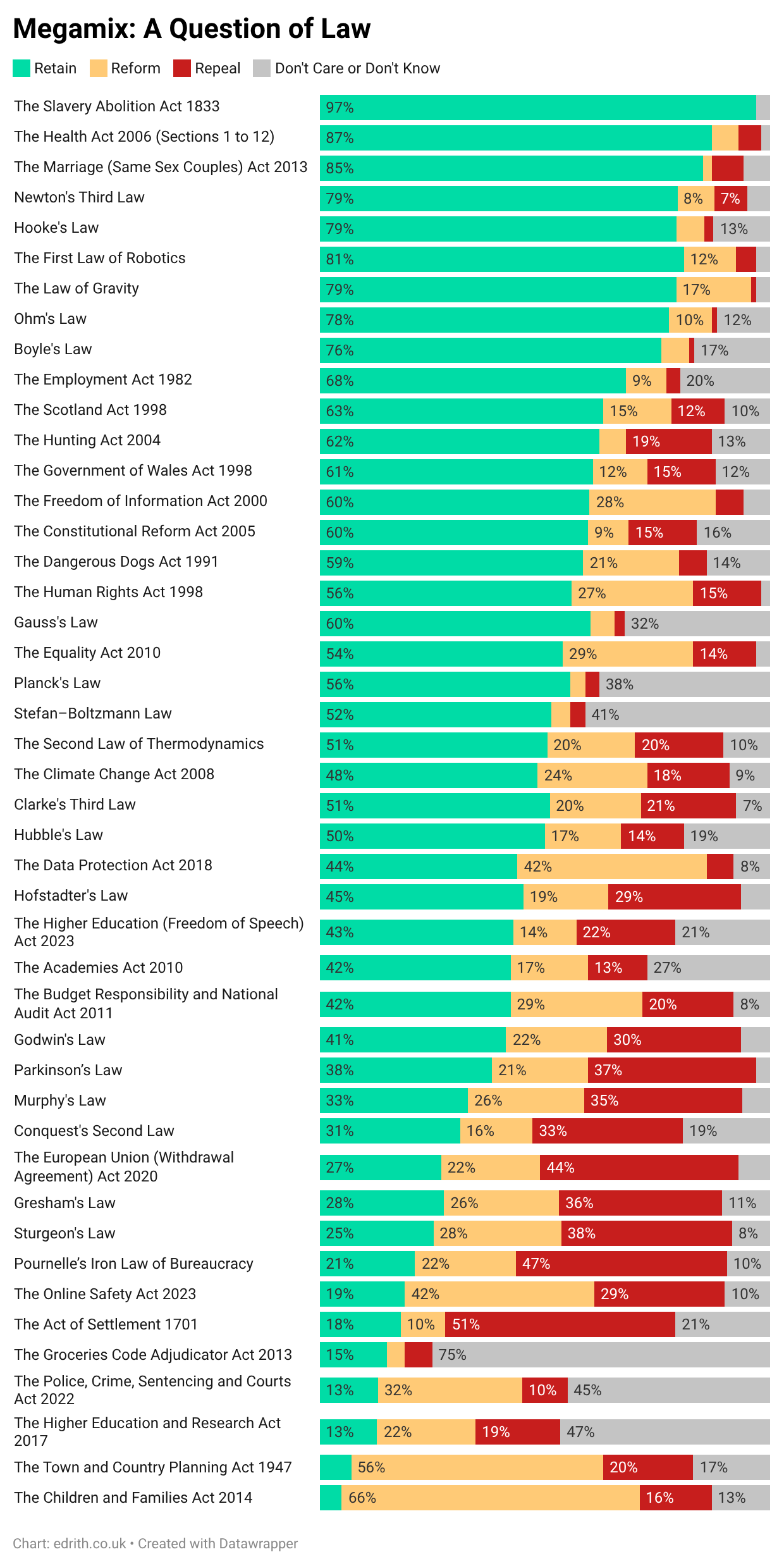
Thank you to the 289 people who completed the Question of Law Survey. Thanks to you we now know important facts such that gay marriage is more popular than gravity, and that my left wing readers would rather see the return of slavery than smoking in pubs.1
As several people commented, there was a level of vibes about this, because in reality ‘repealing’ an Act - particularly an older one - might not be so simple, as it will have become intertwined with many other laws. But vibes still tell us something interesting, particularly when comparing different groups.
The survey respondents were:
84% male and 14% female (the remainder preferring not to say);
26% considered themselves to be on the political right, with 65% on the political left and 9% unsure or preferring not to say.
Given they were filling in an internet survey about Acts of Parliament, it would also be safe to assume that respondents were more politically engaged than the typical population.
To start with the more serious part of the survey, Acts of Parliament.
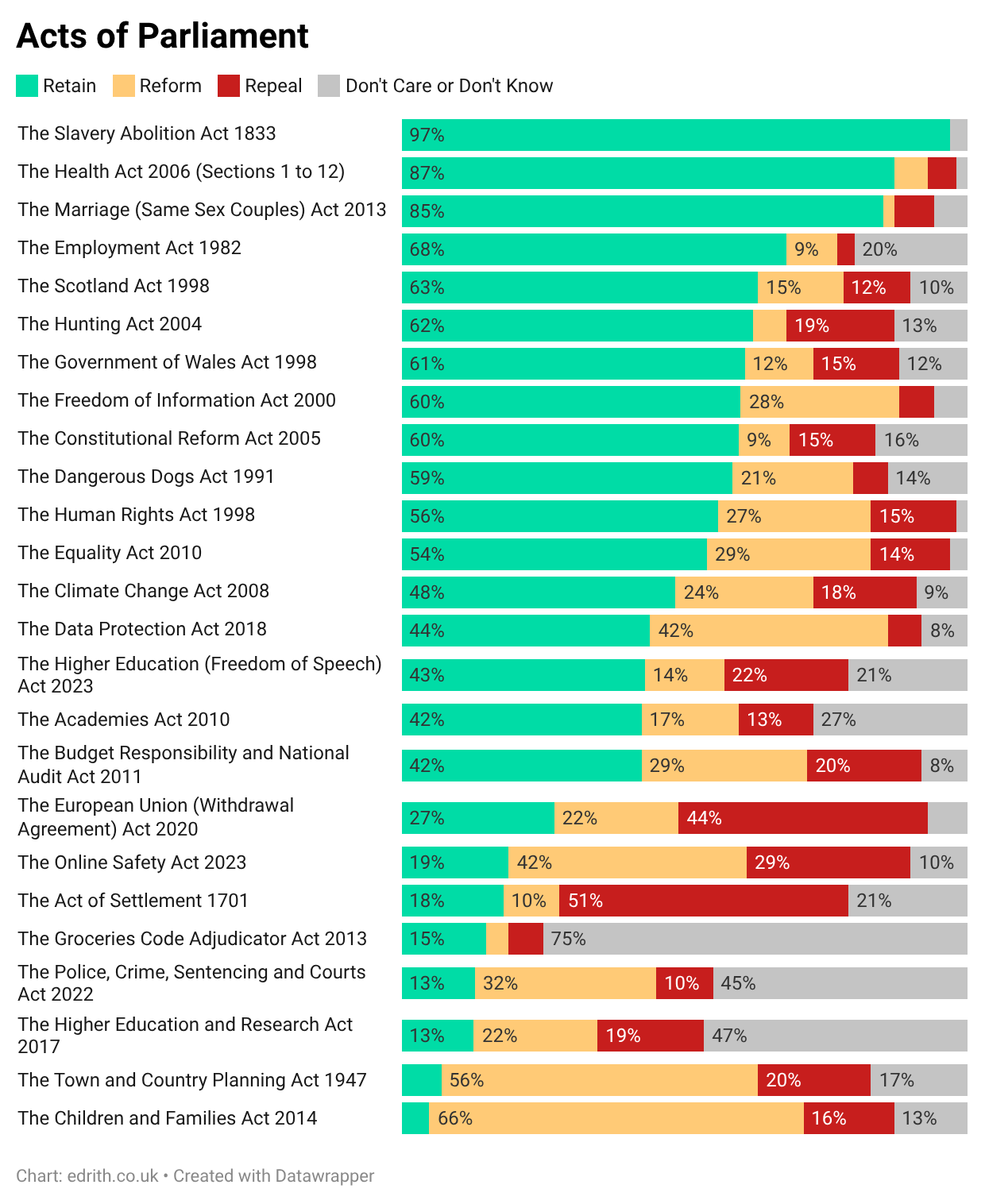
After the abolition of slavery, by far the most popular Acts to retain were same sex marriage and banning smoking in pubs - which is frankly quite astonishing given both were passed relatively recently to great controversy (including within the party that passed them). Both enjoyed very strong support from both right and left - a clear sign of rapid societal change.
Moving down, I was surprised to see such strong cross-spectrum support for banning the closed shop (Employment Act 1982). Reflecting the left-wing skew of respondents (see below) there was strong support for the Equality Act and Human Rights Act, though with a core of dissenters in each case. Digital-related bills such as the Data Protection Act and the Online Safety Act saw a strong desire for reform - while it was no surprise that the Groceries Code Adjudicator Act2 evoked the most indifference.
The Act of Settlement was the only Act which had an absolute majority for repeal - though almost as many, unsurprisingly, wanted to reverse Brexit. Worth mentioning also are a few Acts at the bottom which very few people who know about them think are working well, governing the planning system, the SEND regime, universities and the courts - each representing one of the more dysfunctional elements of the British state.
But how does the picture change when we only consider right-wingers?
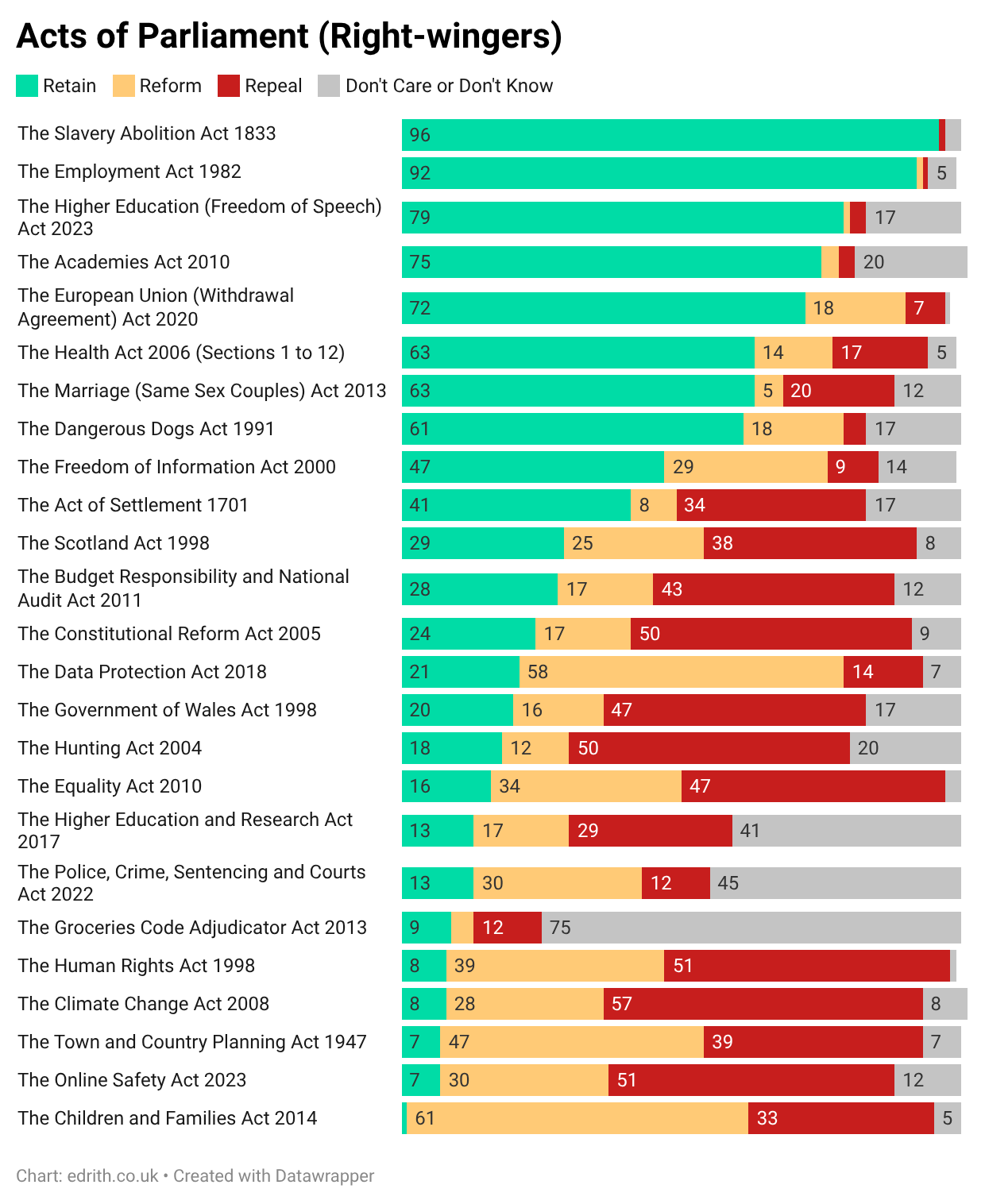
Abolition of slavery stays top of the ‘Retain’ list, but is followed by keeping the closed shop abolished and, to my delight, another of the Acts on which I worked,3 the Higher Education (Freedom of Speech Act). Gay marriage and the smoking ban slip down a little, but both still enjoy over 60% support with no more than 1 in 5 wanting them repealed. Brexit is unsurprisingly more popular than with the wider survey respondents, though there are unsurprisingly some right-wing remainers.
I was a little surprised to see so many right-wingers wanting to keep the Act of Settlement. My assumption is that this stems from support for the Church of England to remain established - and thus the monarch, as head, needing to be an Anglican - rather than any particular animus to Catholics.4
Most notable is a strong opposition to the core pillar of the New Labour constitutional settlement: The Equality Act, the Human Rights Act, the Climate Change Act and the Constitutional Reform Act. We see support for outright retention between 8% and 24% - and an absolute majority in favour of outright repeal for three out of four (the remaining one being 47% repeal). This is significant: these are hugely influential laws which were retained without significant amendment throughout the following fourteen years of Conservative-led government. Despite the small size and self-selection of this survey, I think this does reflect a broader mood shift on the political right - as indicated by both Reform and the Tories now being committed to leaving the ECHR - that is behind both the rise of Reform and a broader recognition that the right cannot substantively achieve any of its broader aims without substantive reform of the New Labour settlement.
Scottish devolution had some support, with Welsh less so. The Freedom of Information Act escaped the broader purge of New Labour legislation, while the Online Safety Act - despite being passed by a recent Tory Government - is deeply unpopular. A worryingly high proportion of right-wingers want to get rid of the OBR, while views on the SEND and planning regime track the broader sample’s very similarly.
And what about the left?
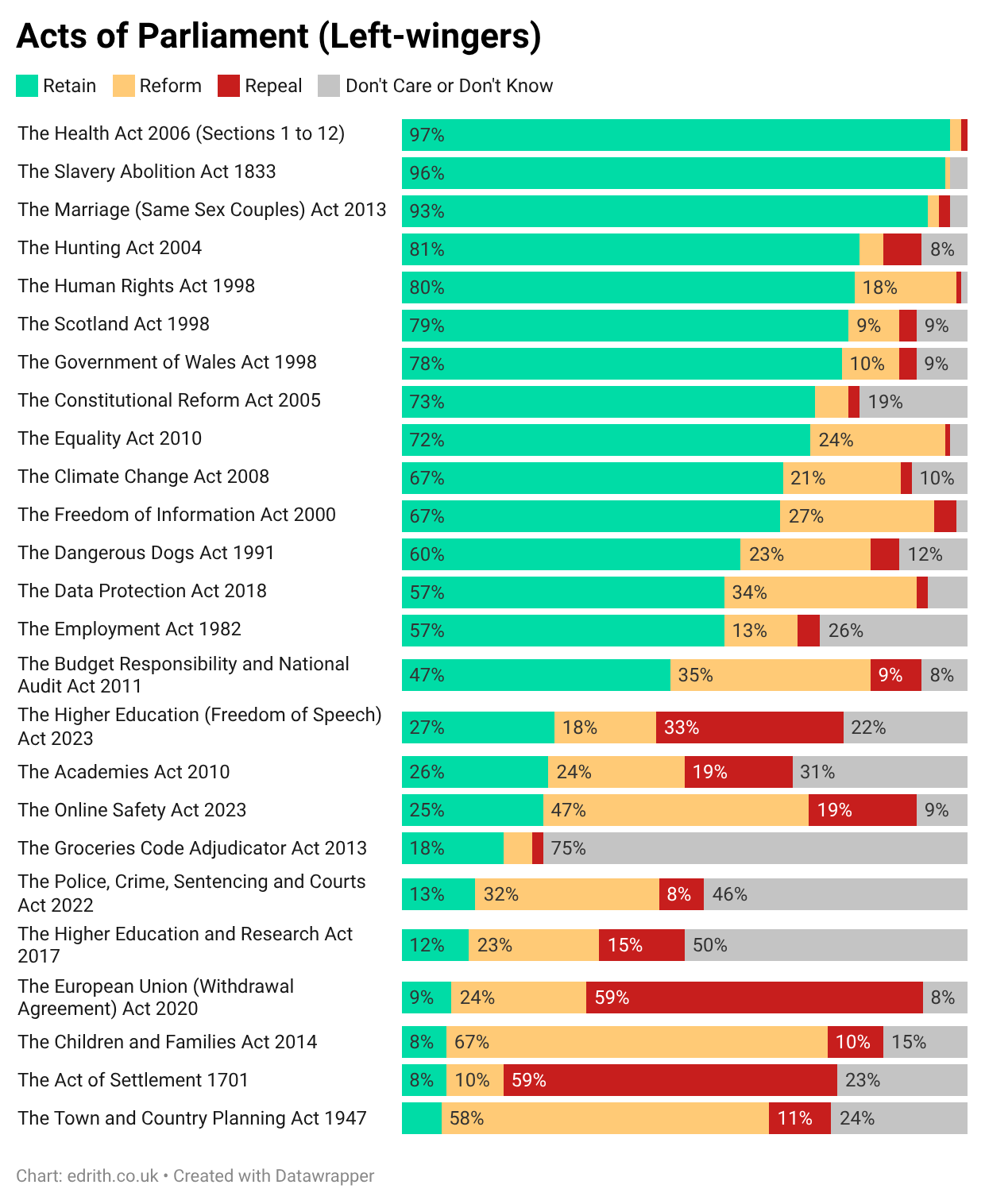
In contrast, the New Labour constitutional settlement enjoys huge support with left-wing respondents, with over 70% outright support for the Equality Act, Human Rights Act and Constitutional Reform Act, and only just under (67%) for the Climate Change Act. Dissenters in each case are almost all those favouring reform, not repeal. Devolution also enjoys very strong support.
Left-wing respondents also really really care that fox hunting remains banned5 while, unsurprisingly, over half wanted to reverse Brexit. Conservative legislation that did have more wanting to retain it than reform included the Academies Act and the Online Safety Act (though both with a big chunk for reform). There is no wish, however, to return to the days of the closed shop - it seems today’s employment rights battles are fought on different grounds.
Fully a third of left-wing respondents want to repeal the Higher Education (Freedom of Speech) Act - no doubt believing that because their views aren’t censored, there isn’t a problem.6 Though disappointingly for me on tribal grounds, my left-wing respondents are far more fiscally responsible than my right-wing ones, showing much stronger support for the OBR, so I have to give them points here.
One interesting point is that if you average across all Acts, the total for each category is notably different for right-wing and left-wing respondents:
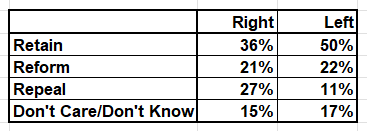
This suggests a country where the right - at least those who did this survey - is fundamentally less happy with the legal and constitutional settlement than the left. This makes a bunch of sense to me for two reasons:
Logically, in that New Labour made some very significant, broad and deep changes to our law, which impact almost every area of domestic policy and life, which have not been altered, while the Conservative Governments that followed did not (with the exception of Brexit).7
Observationally, on the right Reform is comfortably leading the Conservatives in the polls, whereas on the left, Labour and the Lib Dems are, together, still well ahead of the Greens,8 which suggests deeper dissatisfaction with the state of the country on the right.
Now time for some fun
But what about the other laws - of physics and of society?
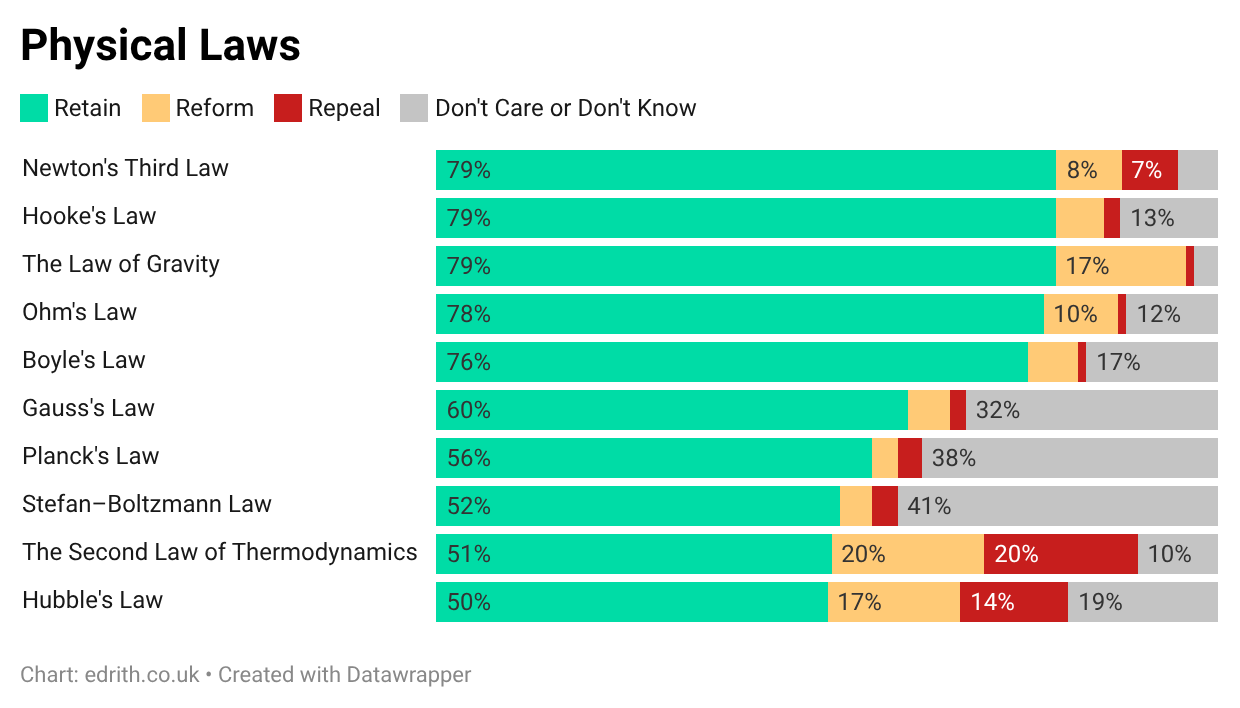
I’m honestly a bit disappointed by my respondents here. Sure, one wouldn’t want to actually repeal the law of gravity, but not to reform it? Even to make it easier to generate antigravity or artificial gravity? That would be great!9
I was a little surprised to see such strong opposition to Hubble’s Law,10 but glad to see the Second Law of Thermodynamics get some of the dislike it deserves (though still, an absolute majority for keeping it - astonishing!).
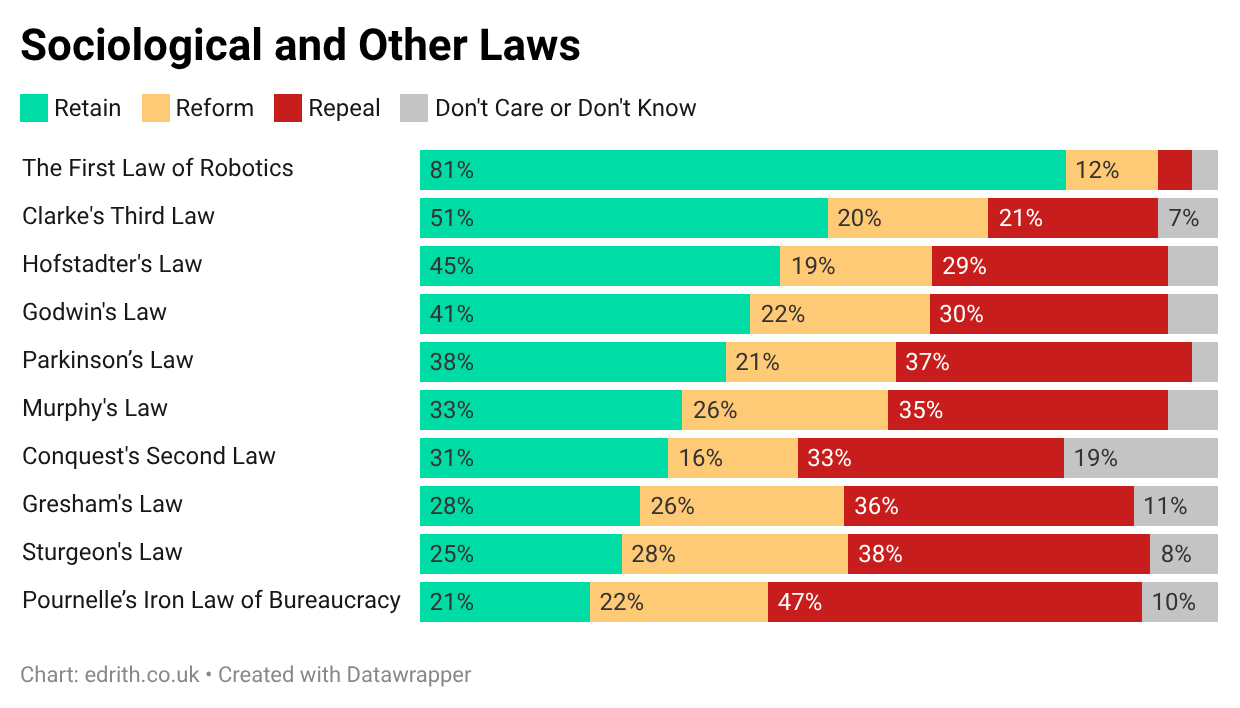
People were more willing to tamper with the sociological laws - with five seeing more votes for Reform than Retain. Gresham’s Law, Sturgeon’s Law and the Pournelle’s Iron Law all justly disliked. I was surprised to see how many people, even on the left, wanted to repeal Conquest’s Second Law11 (though more wished to retain, 32:24) and by the comparative lack of hate for Murphy’s Law (why do a third of you want to keep it?).12
Unsurprisingly, particularly with the rise of AI, The First Law of Robotics was top of the list to retain - though given how often it goes wrong in the books, perhaps we should not be complacent, and it should be reformed.13
And finally, the grand law megamix - thank you to everyone who took part!
It was a close run thing.
Proud legacy of myself and, um, Ed Davey, amongst others.
And on whose genesis and form I had more influence.
I was going to make the standard joke here about it being more possible for the monarch to be a Muslim than a Catholic, but having been pernickety enough to actually go read the Act of Settlement, I’m pretty sure you have to actually be a Protestant and in communion with the Church of England.
I didn’t think they’d actively support it back, I’m just surprised so many actively care - and equally surprised that 50% of right-wing respondents wanted it repealed.
Or just believing that while they have the upper hand they might as well use it.
This is admittedly a fairly big exception. But as film-Gimli would say, ‘It still only counts as one!’
My sense - though I’d welcome correction from left-wing readers - is also that those considering voting for populist parties on the left are often driven by economic grounds (levels of tax and spend, opposition to billionaires) or, in some cases, foreign policy (principally Gaza), neither of which would show up in this survey.
Or might make every star in the universe suddenly explode or collapse. But hey, it’s an internet survey!
Never let it be said my readers don’t take a long-term perspective on consequences.
I assume this is due to the (probably true) belief that it drives polarisation and the rise of bad organisations on the right, and an understanding that common institutions were good.
Also surprising support for Godwin’s Law.
Though I did vote for retain myself.
What makes you so strongly attached to the OBR (given it was established in 2010 and so is hardly part of the constitutional bedrock)? It's not my professional area -- perhaps I am missing something -- but as with many on the right I have a natural suspicion of bodies which seem to subcontract the proper democratic duty of government to take long-term decisions to some nebulous notion of all-knowing apolitical expertise.
More particularly: I do not believe that being (say) a Treasury economist gives anyone special insight into the political settlement required for long-term human flourishing. I would wager good money that if the equivalent of the OBR had been asked to predict the relative long-term economic impact of the American and Soviet revolutions, it would have got these spectacularly wrong -- and likewise with the economic divergence of North and South Korea after the Korean war.
Why should I trust the OBR to make better long-term judgements of the impact of Brexit, Covid lockdowns, the current war in Iran etc than the electorate who choose a government to take decisions?
I’m surprised you’re surprised about the results on the Office of Budget Responsibility.
I suspect that most people on the right (like me and you) are in favour of fiscal responsibility. (Actually I suspect that most people on the left - with some exceptions - are in favour of fiscal responsibility too.) But the OBR is a very New-Labour-shaped solution to the problem (‘let’s set up a quango and outsource good judgement to them’).
So although the OBR’s effect is probably directionally positive, it feels like an offensively unconstitutional feature (compared to our pre-Blair constitution). It fits with what I think is my criticism (probably a common one on the right?) of the Cameron governments: Tory ends but New Labour means. So I’m not surprised that your right-wing respondents want it away with the rest.