

Some philosophers have sought to resolve the problem of perception by positing a tiny observer in the brain, which in some way observes the thoughts, vision and other actions upon the brain, and acts as a bridge between matter and an immaterial consciousness.1 Other philosophers have pointed out that this would require the homunculus to have another homunculus in its brain, and so on, homunculi all the way down.2
Fortunately, in these enlightened days we know better. As a recent award-winning docu-drama that any parent of children of a certain age will be familiar with demonstrated, there is not one but rather a total of five homunculi that sit in our brain and control our actions:
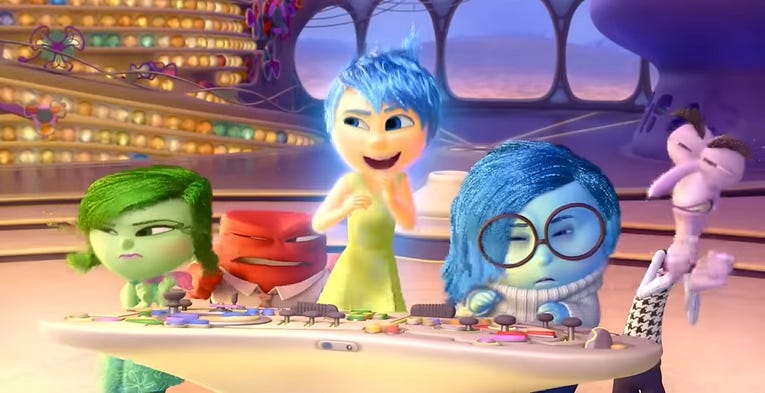
Even if you don’t accept the Inside Out hypothesis as literally true,3 it’s a useful metaphor. And when one considers the tussles over the future of the political right in the UK and in much of the Western world, homunculi can be equally helpful.
The Conservative Party, we are frequently told, is a broad tent. The right as a whole - constituting as it does not just the Conservatives, but Reform,4 as well as many commentators, thinkers and others not associate to any political party - is even broader. Indeed, rather like the Church of England, it can sometimes appear to be such a broad tent it have a difficult time fitting through a barn door. After the political whiplash of five very different Prime Ministers in 14 years, it is unsurprising that some people may say, ‘what do they even stand for’?
Some respond to this by asserting that certain views are ‘not actually conservative’. We get the ‘Conservative In Name Only’ label thrown at socially liberal, ‘One Nation’ Tories, or arguments that populists such as Reform, or MAGA Republicans are not actually on the right, due to their adoption of protectionist economic policies.
For a leader of a political party, of course, it is advisable - indeed, essential - to draw a ring around what a party will accept, and make clear what is beyond the pale. But in seeking to understand the political right, this has its perils: it leads one into ‘no true Scotsman’ arguments, or to the sort of contorted logic involved when one tries to claim that Islamist terrorism has ‘nothing to do with Islam’. Better, by far, to recognise that any broad movement or ideology, including the political right, has many currents within it, both savoury and unsavoury, and seek to understand how to maximise the good, and minimise the bad.
In the modern right, we can recognise at least five5 significant philosophies, or archetypes, that both have significant influence today, and that have a historical pedigree that gives them a legitimate claim to be part of the right. These pull and tug at the right’s currents, influencing its direction and shaping its policies. Sometimes, such as in a political party, we can see this very visibly, with specific MPs identifying themselves as clearly aligned with one or the other tradition. But in truth, these homunculi, or archetypes, should be thought of as fighting for control not just in any single party, but in the broader right as a whole - and in the mind of every individual within it.6
The Five Archetypes7
In no particular order:
The Free Marketeer
The Libertarian
The Social Conservative
The Traditionalist
The Nativist
The First Archetype: The Free Marketeer
The Free Marketeer is a champion of markets and free trade, a devotee of politicians such as Thatcher or Reagan and the writings of Adam Smith, Milton Friedman or Friedrich Hayek. She is typically one of the most powerful of the archetypes; some even seek to define her, not without reason, as the quintessential feature of the right.
She prioritises lower taxes, a favourable business environment and economic growth. She trusts the market to deliver the most beneficial outcome, with the role of the state being primarily to correct market failures, provide public goods8 and ensure the conditions for a competitive market. She worries about marginal tax rates and the national debt, believes industry should be privatised and distrusts industrial strategy or central planning.
In public services the Free Marketeer believes in freedom, choice and competition to drive the best results - even if they are publicly funded. She is in favour of school freedoms, vouchers and consumer agency in education, healthcare and childcare.
In the workings of the economy, her teachings provide the best, most fruitful and most reliable way to economic prosperity: even the Scandinavian social democracies, or authoritarian states such as China, have had to embrace the free market to grow rich. In the natural monopolies or in the public sector, her record is more contested, yet she continues to provide a powerful set of tools to improve services.
Yet the Free Marketeer can be heedless of the impact of the unfettered market upon communities, heritage or other things of non-monetary value, and has little to say about fairness, justice or belonging. The dark mirror of the Free Marketeer is corporatism and crony capitalism, where the wealth-creating power of the market becomes warped into support for rent-seekers with monopoly power or political connections.
The Second Archetype: The Libertarian
Unlike the Free Marketeer who supports low taxes for economic reasons, the Libertarian believes a small state is desirable in and of itself. He may cite Lewis’s proverb, that the most oppressive government is one conducted for people’s own benefit,9 have a row of Ayn Rand’s books on his book shelf or approvingly refer to politicians such as Ron Paul.
He will argue for less regulation, for businesses and individuals to be allowed to do what they wish, subject to the law of contract, and believes things are a matter of individual choice rather than the business of government. He will rail against health and safety, oppose the nanny state and argue the state has no business telling parents how to bring up their own children.
The Libertarian believes drugs should be legalised, porn available and that it is none of the state’s business whether two men wish to get married, or a person end their own life. He opposes censorship and is a staunch defender of our traditional liberties, including freedom of speech, freedom of religion and freedom of association.
The Libertarian’s actions defend individual choice, provide a check against overbearing governments and reduce the cost of bureaucracy and compliance. With the natural instinct of many people to ban things they disagree with, or shut down views or group’s they oppose, the Libertarian plays a vital role in keeping these illiberal urges in check.
Yet the Libertarian may also be blind to other sources of power that restrict individual power, such as that of large corporations and struggles to cope with actions that impose large negative externalities on others, or on society more broadly.The dark mirror of the Libertarian is anarchism, where all rules collapse, the strong do what they wish and life for the common man becomes ‘solitary, poor, nasty, brutish and short.’
The Third Archetype: The Social Conservative
Often, though not always, motivated by religion, the Social Conservative is a champion of the family, of traditional moral norms and conservative social structures. She looks to Mary Whitehouse in Britain, or Phyllis Schlafly in the USA, as role models.
The Social Conservative believes that marriage should be between a man and a woman, disapproves of divorce and opposes abortion and euthanasia. She is concerned with protecting the morals of children from pornography, obscenity and violent video games, opposes gambling and believes that government should censor films and broadcast for common decency. She is a strong supporter of the war on drugs.
She is a champion of the rights of parents over the state, a defender of home schooling and a sceptic of ‘children’s rights’. She believes that faith plays a valuable role in society10 and believes in the role of charities and community. She believes public figures should be morally upstanding and deplores incivility, misconduct and misconduct.
Many of the harms that the Social Conservative takes aim at are genuine ones, that wreak great harm in society, particularly amongst the most vulnerable. In other areas, the evidence suggests that living one’s life according to her principles is more likely to lead to positive outcomes.11 And she is a powerful defender of the family in an age where officialdom frequently sees no intermediate tier between the state and the individual.
Yet without the underpinnings of a shared faith, some of the Social Conservative’s principles appear arbitrary and unnecessary, and, even where her maxims lead to positive personal outcomes, the policies necessary to achieve them on a societal level can be coercive and cruel. The dark mirror of the Social Conservative is bigotry, where the choices of those beyond a narrow approved lifestyle are met with intolerance and persecution.
The Fourth Archetype: The Traditionalist
The Traditionalist puts the ‘conservative’ into conservativism. A devotee of order, institutions, tradition and hierarchy, he looks to Burke and Scruton for inspiration, and sits back each evening to watch Kenneth Clark’s Civilisation. With the Free Marketeer, he is one of those by which some seek to define the right.12
He believes in the importance of authority, in the streets, the classroom and in the home and considers the rule of law to be sacrosanct. He despises radicals and revolutionaries, and is a defender of the country’s institutions and structures. Where things must change, he believes it should be through incremental change rather than some great upheaval.
The Traditionalist has a deep sense of place, a love of nation, countryside and community. He is passionate about his country’s history and heritage and wishes it preserved, and sees tradition not as a stale relic, but a living, vibrant thing, Chesterton’s ‘democracy of the dead’. He believes that while the new may have things to offer, it should sit alongside, not displace, the old.
The Traditionalist’s values are a great source of stability and a bulwark against disruptive change or the foolish fads of the moment. He understands the high costs of destructive change and the underappreciated benefits of stability and strong institutions. He is a steward of the soul, not just the wallet, and his patriotism and love of community may inspire him to great endeavours in their service.
Yet the Traditionalist’s deference to institutions may become a slavish obedience to the status quo, stifling needed change, and his respect for authority may make him blind to its abuse. He struggles to cope with a situation where institutions are controlled by those he disagrees with, or where laws require change. The dark mirror of the Traditionalist is unthinking reaction and authoritarianism, where blind obedience to tradition replaces thought and power is allowed to substitute for what is right.
The Fifth Archetype: The Nativist
The Nativist believes that charity begins at home and that the principal duty of any government is to look after the welfare of its own citizens. From the Know Nothing Party13 of 19th century America through Enoch Powell to the many populist parties of today, his idols are shadowed by conflict and controversy.
He is a staunch opponent of immigration and, if it must occur, believes that citizens should systematically take priority over immigrants in public services and elsewhere. Illegal immigration is not to be tolerated, and most asylum seekers and refugees are viewed with suspicion.
He opposes both foreign military intervention and international aid, having no time for ‘do-gooders’ of either stripe. He is sceptical of international laws and multilateral organisations, believing that the country should govern itself, for the benefit of its own citizens. He believes government should avoid buying goods from abroad and should protect domestic industry with tariffs and subsidies.
The Nativist’s priorities can strike a chord on issues such as fairness, contribution and the social contract, and provides important push-back against the well-meant idealism of those who are frequently shielded from the consequences of their actions. His scepticism of foreign adventuring is a valuable check on those who like nothing better than to aggrandise themselves upon the world stage.
Yet the Nativist’s economic policies do real harm to those he claims to be helping, through more expensive goods and a less favourable business climate. Hostility to immigration may stoke the very societal tensions he sought to avoid, while isolationism also has its costs, for no country is an island, not even the most powerful. The dark mirror of the Nativist is xenophobia and ethnonationalism, when love of one’s countryman turns to hatred of the outsider, and those who look different are subject to persecution and violence.
Synergies and Tensions
No real individual will perfectly match any archetype - though some may be dominated by one. The depth of traditions to draw on can make the right flexible and able to reinvent itself to the challenges of the moment;14 however, it can also make it divided and fractious.
Some of the archetypes are natural allies. The Free Marketeer rubs shoulders easily with the Libertarian, to produce an economically liberal, socially liberal agenda. The Traditionalist can sit easily with the Social Conservative - and both can find some areas of agreement with either the Free Marketeer or the Nativist.
Other synergies are more situational. The Libertarian and the Social Conservative may fight shoulder to shoulder against progressive censorship, but let social conservatism gain ascendancy in society and their alliance will splinter.
Perhaps the greatest area of tension is between the Free Marketeer and the Nativist. The Nativist's tariffs, 'buy British' or national preference in procurement are anathema to the Free Marketeer, while opposing the free movement of people, so beloved by business, is central to the agenda of the Nativist. It is no wonder that many right populist parties end up adopting economic policies more traditionally associated with the left.
But perhaps the most important conflict at the moment is not between archetype, but the civil war within the Traditionalist.
In today's world, where much of the legal structure was laid down under the left, and the institutions and professional classes are dominated by progressives.15 Does he defer to the legitimate authority in schools - or champion parents to challenge it? Should he respect New Labour's constitutional settlement - or repeal it to return to an earlier order? This conflict within the Traditionalist has greatly weakened the influence of this homunculus, with some arguing that radicalism must be harnessed, or embraced in the service of tradition.
It is this tension, alongside the conflict between the Nativist and Free Marketeer, that explains much of the turmoil within the modern right - in Britain, America and much of Europe.
The Archetype Quiz
If you don’t know already, a friend, Wakefield Morys-Carter, and I have converted this into an internet quiz you can take to discover your archetypes.
My own results are below:
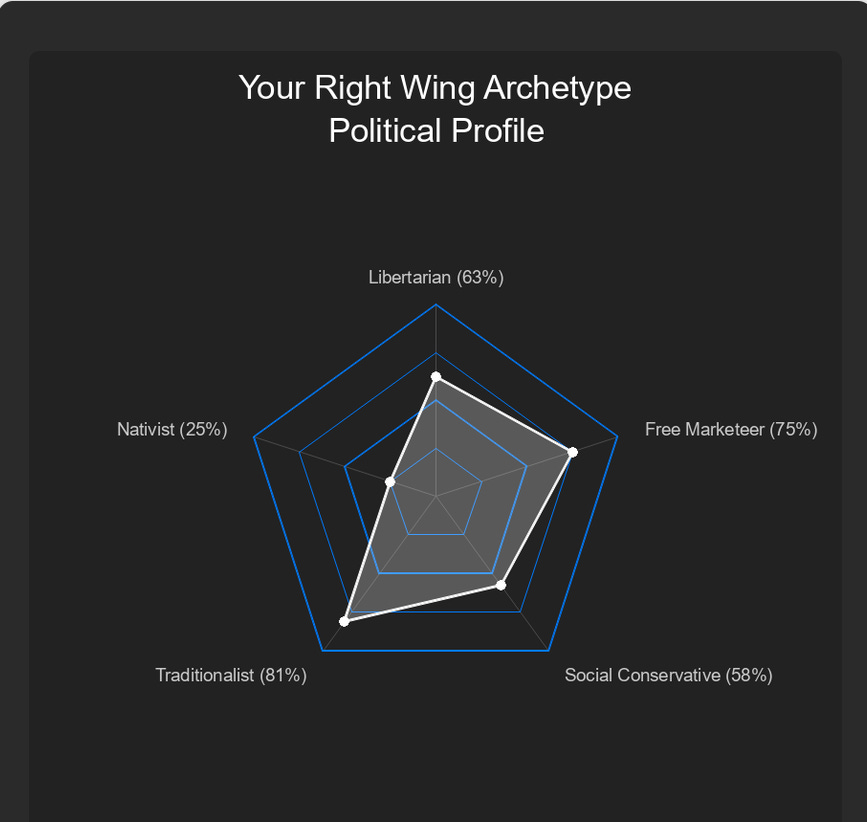
If you’re curious about the scoring, then, in a nutshell:
Each archetype has 10 questions associated with it.16
On these questions, then Strongly Agree = 2, Agree = 1, Not Sure = 0, Disagree = -0.5, Strongly Disagree = -1.17
Your percentage on each archetype is then calculated as: 0 if 0 or below; else score*10% if score 1-5; else 50% + (score-5)*5% if score 6-10; else 75% + (score -10)*2.5% if score 11-20..
The overall ‘right wing percentage’ is calculated as the mean square18 of each axis.
The reason for this scoring method is because the quiz is specifically exploring the right-wing part of the political spectrum, not the whole political space, which it would be inappropriate to model purely through right-wing archetypes.19 So it is not just possible, but likely, that some people will score 0% on some or all axes, and scores are scaled to appropriately fill the space.
If we’re being picky, very few, if any, philosophers have actually adopted the homunculus theory, and this is more an accusation thrown at them by their opponents, but bear with me.
This has nothing to do with the topic, but it would be a travesty to write about homunculi without recommending 72 Letters, the brilliant short story by Ted Chiang - found in Stories of Your Live and Others - with in which the ‘preformation’ theory, in which every sperm contains a tiny preformed homunculus, is literally true, and is taken to its logical conclusion.
I am told that some scientists have professed their doubts.
And, arguably, at least 10-15 years ago, some Orange Book Liberal Democrats, though I doubt many would accept the label now.
Other subdivisions are possible.
With sincere apologies to Solzhenitsyn.
And no, I will not be identifying each of them with one of the emotions from Inside Out.
“Of all tyrannies, a tyranny sincerely exercised for the good of its victims may be the most oppressive. It would be better to live under robber barons than under omnipotent moral busybodies. The robber baron’s cruelty may sometimes sleep, his cupidity may at some point be satiated; but those who torment us for our own good will torment us without end for they do so with the approval of their own conscience. They may be more likely to go to Heaven yet at the same time likelier to make a Hell of earth. This very kindness stings with intolerable insult. To be “cured” against one’s will and cured of states which we may not regard as disease is to be put on a level of those who have not yet reached the age of reason or those who never will; to be classed with infants, imbeciles, and domestic animals.”
Whether or not she possesses it herself.
It is very well established that, on average, children are likely to do better with two parents who are married, even accounting for other factors such as disadvantage - see here, for example.
Or at least Conservatism.
My second favourite name amongst US political parties, beaten only by the Bull Moose Party.
The real reason a conservative is socially liberal may be that he grew up watching Friends and has close friends who are gay. But the Libertarian tradition provides him with an authentically right-wing framework within which to defend same-sex marriage, by arguing it should be no business of the state who people love.
See for example More in Common's work on the massive over-representation of 'progressive activists' in the civil service, quangos and charities.
Yes, we could have made it more sophisticated, but this would have been at the price of much greater difficulty to balance.
Some questions are ‘reversed’, i.e. Strongly Disagree gets you 2 points and so on, in order to minimise the use of ‘nots’ and other convoluted question forms.
Not the root mean square.
The best description of someone who wants to permit 1 thing and ban 9 is not ‘a weak libertarian’ but ‘not a libertarian’.
I think that you missed one, which I will call the Pragmatist.
The Pragmatist recognises that any made by the government or by society will disadvantage some people, but that choices have to be made anyway, since doing nothing is itself a choice which will disadvantage some people (and for politicians or organisations "doing nothing" might involve procrastinating, or attempting to fix problems through "comms" (i.e. lies or censorship), or pretending there isn't a problem). The Pragmatist also recognises that there are multiple competing value systems, not just one.
I do think this is much more of a right-wing worldview than a left-wing one. From my point of view left-wingers are less likely to accept policies that create losers (unless the losers are seen as privileged), more likely to have a simple-minded ideological world-view, and more likely to try to ignore or explain away any problems created by their preferred policies. Of course, such attitudes exist on the right too (there are some people on the right who remind me of the woke left, just with opposite views).
I consider myself to be on the right, although I'm not a member of the Conservative Party or Reform UK. I'd describe myself as a liberal nationalist and give my personal scores as follows:
Pragmatist: 10
Nativist: 9
Libertarian: 8
Free Marketer: 7
Social Conservative: 5
Traditionalist: 5
I want to RETVRN, but my nostalgia is for the less diverse and less nannyish "Cool Britannia" Britain of 1995-2004, not the insular 99% white Christian Britain of 1945-1954.
It's not a perfect fit, but your division fits well with the Magic: the Gathering colour pie. The Social Conservative is White, The Libertarian is Black, The Traditionalist is Green, The Free Marketeer is Blue, and The Nativist is Red.