

Canonically speaking, this woman hatched from an egg.
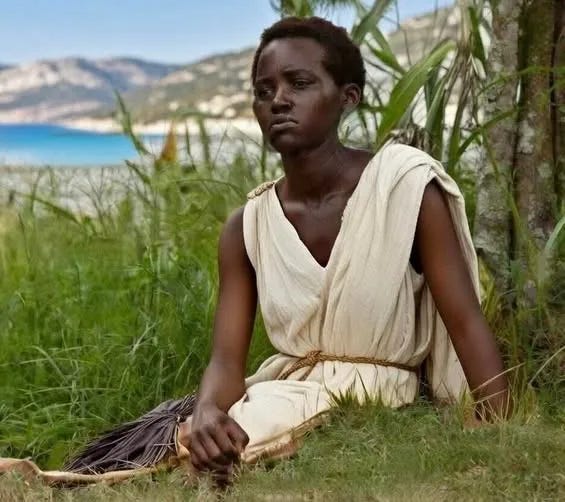
It is, of course, correct to say that the Ancient Greeks did not envisage her to look precisely like this. Homer describes her as ‘white-armed’, with other ancient writers similarly suggesting lighter colouring. But for anyone looking to precisely determine Helen of Troy’s ‘correct’ ethnicity, her semi-divine egg-born status should be a clue that they may be asking the wrong question.1
The Aegean of Greek mythology was far from an ethnically homogeneous arena, with the troops in defence of Troy coming from as far afield as Africa and the shores of the Black Sea - and other Greek adventurers ranging far afield, from Colchis to the Pillars of Hercules.
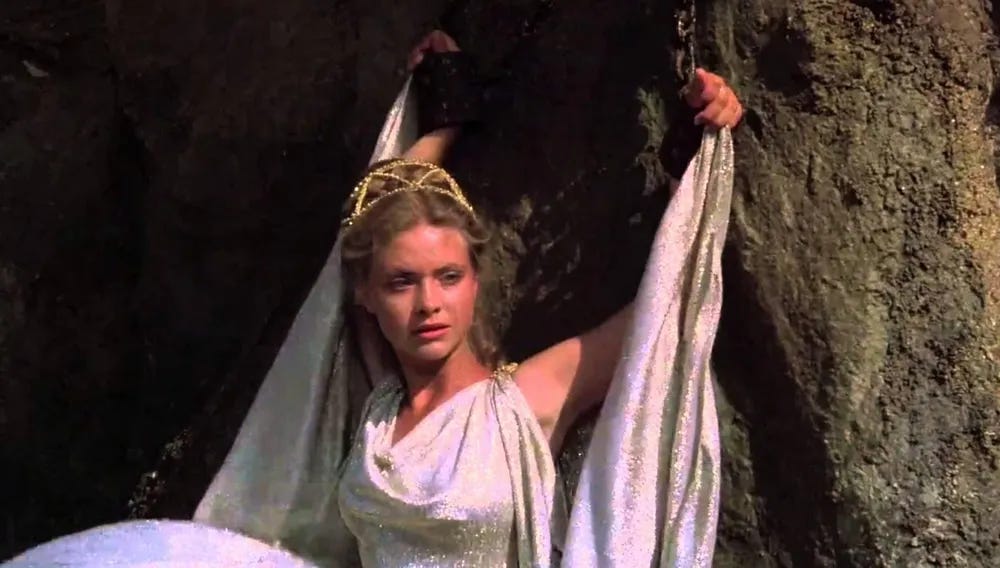
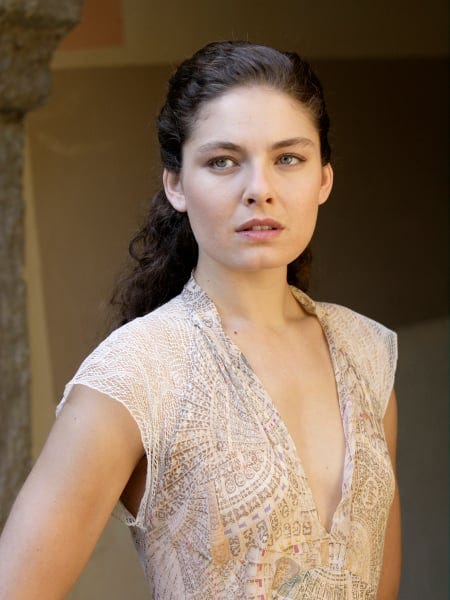
And while Helen was not black, there is at least one well-known Greek heroine who was canonically, explicitly, unambiguously black: Andromeda, daughter of Cassiopeia, bride of Perseus and Princess of Ethiopia.
Here’s how she was depicted in the 1981 film, Clash of the Titans.
And here’s how she was portrayed in the 2010 remake:
None of these casting choices matter - any more than it matters whether, when you go to see a production of Hamlet, he looks like an authentic Mediaeval Dane, or that Macbeth looks like an ethnically pure 11th century Scotsman.2 When it comes to Shakespeare or the great myths and epics, we’re not watching them for the realism, but for the archetypal stories and legends that have shaped our culture over the centuries.3
If you want the canon to survive and thrive, you have to reckon with the fact that the UK and the US today are multiracial societies. A third of the children in the UK are non-white. Do you think Shakespeare and Homer are going to remain cultural pillars if you tell a third of the class they can never play Hamlet, or Odysseus, or Helen, or Juliet?
The same goes for other things. If we want things to stay the same, some things are going to have to change. That means, in most cases, colour-blind casting becoming the norm. Both Miss Honey and the Master of Jordan College were white in the books, but there is no problem with them being black in the recent film / TV series. A black primary school teacher, or a black Master of an Oxford College, do not in any way break our suspension of disbelief. Dune did it brilliantly, with the broader Imperial society being - as one would expect - multiracial - and the Fremen broadly looking plausible for people who’d lived thousands of years in a desert. We should be relaxed, in most cases, about ahistorical proportions of non-white people in depictions of the New Victorians.
But if we’re going to embrace this as a society, we also have to be honest about the small number of circumstances when it doesn’t work - and not gush, coo and suspend all judgement just because a production has used a non-white actor. The approach of some identitarians, in which casting becomes an arena in which ethnic minority actors can do no wrong, while arbitrary guardrails are placed around what white actors can do, won’t wash either.
If a show is going for high levels of strict historical realism, then that has to include race, if our suspension of belief is not to be shattered.4 Shogun got it right here, with the Japanese characters looking Japanese and the European actors looking European. And we shouldn’t be afraid to say Wolf Hall got it badly wrong in its second season.
The same goes for realistic biopics of historical characters5, particularly recent figures, or those where race was essential to their lives, such as Nelson Mandela or Martin Luther King.6 (Theatre, as opposed to film and television, is and always has been far more flexible, and should remain so. The audience demand for verisimilitude is much lower).
And while I’ve praised some fantasy/sci-fi works such as Dune and His Dark Materials, the Wheel of Time did less well. Having Padan Fain and Siuan Sanche be black was fine,7 but for the Two Rivers, an isolated, rural area, to be highly multi-racial jarred. The characters from there are country bumpkins emerging into a much wider world;8 there’s a significant plot point about one of the characters looking as if he doesn’t come from there; and there’s even a story-arc in a later book in which the region takes in large numbers of immigrants and becomes more cosmopolitan! To compound it, having done the rest of the world with colour-blind casting, they then made Shienar homogeneously ethnically East Asian, a peculiar decision which made the previous incongruities stand out more.
Most importantly we need to stop the nonsense of calling out people for not being precisely ‘the right shade of black’, or Jasmine in Aladdin being Indian-origin rather than Arabic9, or a Jewish actress not being a good fit for a role that was canonically half-Mexican, half-Jewish.10 The idea that actors can only play someone with the same identity characteristics is nonsense and wrong - they’re actors, and that’s what they do: act.11 Most roles should be open to anyone, and where that’s not the case, what matters is avoiding suspension of disbelief for the audience.12
Ethnically gating the canon only serves the interests of the philistines who wish to tear it down. Those who are only too ready to declare great works ‘problematic’, or ‘Eurocentric’13; who speak of ‘decolonising’ the curriculum or the arts. There is a legion of such small-minded, small-souled, individuals, who have wormed their way into positions of influence in our schools, our universities, our government bodies and our cultural institutions.
But though they have had great success in seizing the commanding heights of our cultural establishment, the wreckers face one insuperable problem. New-fangled pap, selected for its ideological purity or the identity of its author, can’t hold a candle compared to the works the iconoclasts seek to denigrate.
There’s a reason why audiences still throng in their millions to see Shakespeare, why Hollywood has given a top director hundreds of millions of dollars to make a blockbuster, or why the remakes and retakes keep coming.
Natalie Haynes’ A Thousand Ships isn’t good only because she’s a great writer, but because she’s retelling, with both great faithfulness and originality, timeless myths that have been told again and again over two thousand years, such that most of us, going back generations, would have familiarity with.
Hamilton isn’t only good because Lin-Manuel Miranda is a musical genius, but because the ideals of the American Revolution are noble and inspirational, and the founding fathers, collectively, a set of brilliant, impassioned and heroic men with the courage to make their dreams a reality.14
These are songs to echo through the ages, sung and resung by voices anew.
I care about the Western canon not because it is necesarily better than any others, but because it is ours.15 Because it speaks timeless truths. Because old things that have endured should continue to do so. And because more than ever, in a society that is becoming more diverse, and buffeted by social and technological change, we need shared narratives, shared stories and shared culture that we can hold in common.
If you care about the canon, your problem shouldn’t be with those such as Nyong'o or Miranda who wish to seem themselves within it.16 We are all17 adoptive, not natal, heirs to the legacy of Greece and Rome, through the actions of those in the Renaissance and Enlightenment who chose to centre it.
Western Civilisation is an idea18, not an ethnicity - and it is open to all those who choose to embrace it.
It’s worth noting that in the 1990s, Helen of Troy was played by a black woman in Xena: Warrior Princess and the world managed not to go mad.
I have never actually watched Xena: Warrior Princess, but everything I’ve heard about it makes it sound so delightfully wacky that some day I may have to give it a go.
There really is no reason why a black Helen should break your suspension of disbelief any more than a white Andromeda.
The same is true for our modern archetypes, such as superheroes and James Bond. Bond’s key characteristics include the fact that he is British, upper class, a womaniser and a ruthless killer - none of which in to,day’s Britain, require him to be white.
I would caveat that you actually have to be delivering that realism. If you’re playing fast and loose with technology, clothing, social mores and anachronisms, that’s absolutely fine, but you don’t then get to insist on historically accurate casting.
What do I mean by ‘realistic biopics’? Well, this is a debatable point, but I’d find it very odd for Churchill in Darkest Hour or Michael Jackson in Jackson to be played by someone of the wrong race, but The Greatest Showman, with its highly elastic relation to the life of PT Barnum, might have been fine.
Unless you’re doing something like Hamilton, where you’re deliberately playing with race. If you want to produce a film where Nelson Mandela is white and de Klerk is black to try to communicate something, sure. But that’s not colour-blind casting, that’s very specific colour-conscious casting, in support of an artistic point.
Siuan should be olive-skinned, but that doesn’t matter much.
The Aes Sedai, of course, canonically are as multi-racial as they were depicted, even if individual characters didn’t fully align with their book descriptions.
Canonically, Jasmine should be Chinese.
Seriously, how many half-Mexican, half-Jewish actresses are there? I’m sure there are some, but you’re seriously limiting your candidate pool.
The idea that people have to have ‘lived experience’ to play certain roles is nonsense - as watching any film with top actors will rapidly demonstrate. This argument, in any case, blows the idea of colour-blind casting out of the water, and anyone who attempts to hold both at the same time is transparently acting as a tribune to advance the interests of a particular ethnic group, rather than holding any kind of coherently generalisable position.
In any case, modern conceptions of race frequently don’t map on to historical ones - and plenty of people who today would be classed as being from different ethnicities look extremely similar.
We are, as it happens, in Europe.
And who make most of our modern politicians seem like pygmies.
There are 1.5 billion Indians who will look after the Ramayana.
Admittedly, you occasionally get someone like that woman who played Snow White who appeared to hate everything about the original that had made it a classic.
Except for my four subscribers from Greece [waves at Greek subscribers].
OK, a set of ideas.
I try to be sympathetic to colour blind casting, for all the reasons you gave. My husband is less forgiving, especially in historical productions. There needs to be a coherent reason for the character to be black and for nobody to mention it. We had a debate about the casting of Merlin in the recent adaptation of The Winter King, an Arthurian story by Bernard Cornwell.
Me: Merlin can be black! He's the only one that's black and Merlin is supposed to be a weird half-demon magic guy, that's how they would have seen the one black guy they'd ever seen back then. Maybe he's a hold over from Roman Africa or something, that's why he's so wise.
Him: no, Merlin is Welsh
Me: wait a minute that random palace guard is black as well, I hate this
I did like this Tweet:
https://x.com/i/status/2018198275237556472