

Welcome to the over 100 new subscribers who’ve joined as a result of the science fiction post. I blog about all sorts of things, but if you’re looking for more content of that sort, you may like to check out my reviews of the Dune 2 movie and of The Stormlight Archive, my piece ranking Tolkien screen adaptations1, the post on George R R Martin’s other works. And the reception to that list means I’ll definitely be doing a fantasy ranking in a couple of months!
Thank you to everyone who submitted questions for the recent Ask Me Anything. This time we got questions on the national debt, climate change, AI, what would make me emigrate and blogging, amongst other things.
So without further ado:
Rachael: What are your thoughts on gilt yields being even higher now than after the mini-budget that ousted Truss? Is a 70s-style IMF bailout likely?
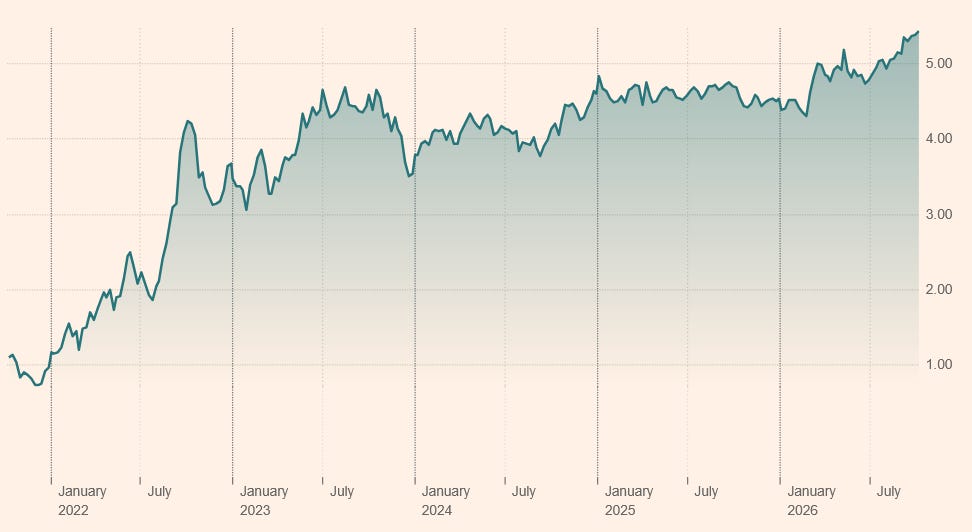
We should be a lot more worried than we are. The numbers are only creeping up - and both Government borrowing and the global economic situation should make us worry.
Since the Financial Crisis, we’ve systematically increased borrowing in crises, and then failed to pay it down afterwards.2 Debt now stands at 95% of GDP, the deficit at £115bn a year, of which debt interest accounts for around two-thirds. All kinds of international shocks - from the turmoil in the Strait of Hormuz to Trump potentially imposing a diesel export ban - could add further pressure.
There’s an international dimension to the yield increases, but the UK is now paying more to borrow than countries such as Greece, Italy and Spain.3 What’s worse, the Government shows little sign of being able to deal with this. The previous backbench rebellion on welfare puts hard limits on their ability to rein in those costs, most of which are exploding upwards.4 They’ve pledged not to put up the main taxes of income tax, VAT and NI. Public sector pay is going up at over twice the rate of private sector pay. And even the welcome announcement on the pensions triple lock is (a) delayed until 2030, after the next election; (b) will take years to have savings; and (c) was paired with the vastly more expensive policy of a National Care Service.
As to whether a 70s-style IMF bailout is likely - well, I’m not sure. As Adam Smith said, there is a great deal of ruin in a nation. My central prediction is no: that Burnham and Healey are level-headed enough not to spook the bond markets in the way Truss did.5 But this shouldn’t be taken as optimism. I think we’ll simply continue to see the rates grind non-monotonically but inevitably upwards, with more and more of our taxes spent on interest payments until we learn to recognise that we’ve been living beyond our means and find political leaders able to convince us to swallow the bitter medicine necessary.
Michelle Taylor: How do we preserve the value of humanity and the basis of democracy in the teeth of AI taking over a considerable amount of productivity, and rendering increasing numbers of people unable to produce anything of economic value?
For a number of reasons, in the futures where human decision-making still means something - i.e. not benevolent AI overlords or extinction/doom - I think AI is more likely to function like the steam engine, albeit on a much faster timescale. By which I mean a massively powerful tool for increasing productivity - with massive disruption in what jobs are available - but one which still leaves a lot of human jobs around.
Reasons for thinking this include:
Unless humans are pets, slaves or dead, someone is going to be telling the agent swarms what to do - even if that doesn’t look much like modern programming.
A lot of economic activity involves different groups of humans who disagree deciding what to do (for example, where should we build houses?). AI can’t tell us a ‘right’ answer to this.
Particularly in the physical world, even if AI is strictly better, comparative advantage means humans will continue to find jobs, given the cost of compute, robots, etc.
Previous transitions - from agriculture and from industry - have shown us that as a society we have a tremendous ability to create new jobs, particularly in services.
Now, I do recognise there may also be real hardship in areas where many jobs are lost rapidly, as there was during de-industrialisation, which could be a real challenge.6 And I hope that - as we did during the Industrial Revolution, and indeed have over the last 30 years - we end up taking some of that greater productivity in increased leisure, whether by shorter working weeks, more holiday or some other means.
But where I think some people are going wrong is looking to put the cart before the horse, whether that’s with 4-day weeks or UBI. Because right now, we’re definitely not in a post-scarcity society: the Government is spending more than we can afford (as discussed above); despite that, many public services face higher levels of demand than they can provide and, at the individual level, people are finding it hard to afford things from housing to energy to childcare to social care. As long as all these are the case, talk about shifting to a lower-work society seems premature.7
I should add that this (great) question helped prompt my last post, about the impact of AI more broadly, which readers can find here.
Firestone: What are your favourite political metaphors?
I remember when I first joined the civil service, I was deeply confused by the concept of ‘Chinese walls’, which I took to mean ‘walls which don’t exist’, given that the two teams between which it was repeatedly said that Chinese walls must be kept talked to each other the whole time. ‘Purdah’, the period of no political announcements in advance of a general election, is a good one. And I once took a picture of a left-wing friend and I standing on the appropriate sides of an Overton Window.8
However, particularly in a world that contains a prominent leader named ‘Trump’, it surely has to be ‘The elephant in the room’.9
Tony M: Under what conditions (political, economic, national issues) would you leave the UK to live elsewhere? And where would you likely go?
I loved living in the Philippines for 2 1/2 years, and could imagine myself taking another such adventure, but I appreciate you’re asking something quite different here.
As to what conditions, I’m quite attached to Britain as ‘home’ - in a rooted patriot sense, in terms of liking living somewhere wgere amenities such as libraries, parks and pubs are taken for granted, and because all my friends are here. I guess the things that might push me to leave are the standard ones:
A collapse into dictatorship, and/or China or worse levels of suppression of dissidents.
Major economic collapse, hyperinflation, etc.
Widespread, sustained, collapse of law and order.
My children being likely to be conscripted into a particularly bloody and obviously unjust war.
Where would I go is easier: most likely the US, where I have family, or, failing that, Australia, New Zealand or Canada, for the English language, familiar culture and liberal democracy.
Colin Boyle: On the basis that ecosystem breakdown represents an ultimately existential threat to global civilisation, why do you think that governments have collectively failed to prioritise achieving a sustainable world? What do you think it would take to achieve rapid, global, systemic change?
I disagree with your premise here: climate change is a major threat, but governments have collectively done a tremendous amount to address it.
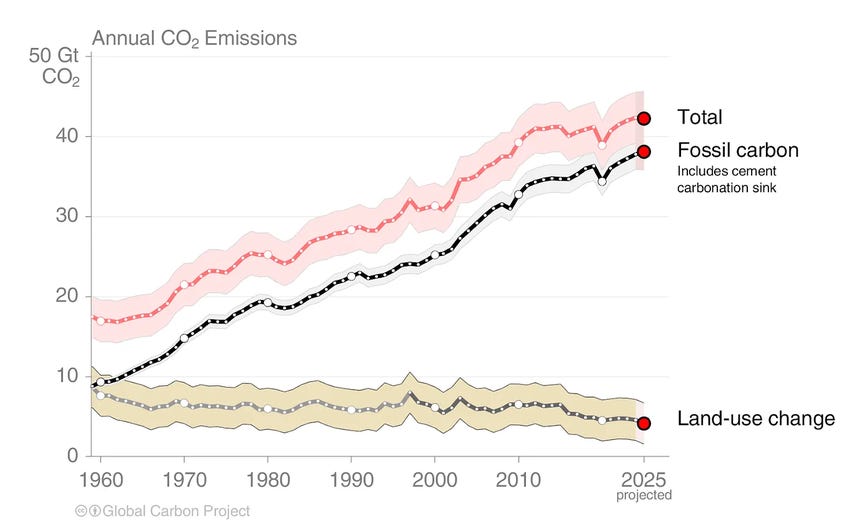
At headline level, we’ve got the projected temperature rise down from the IPCC’s worst case scenario RCP 8.5 (up to 4-6C of warming over pre-industrial levels; likely to be very bad) to 2.6C, of which about 1.5C has already happened. We’ve invested a tremendous amount of R&D and capital spending to converting our generating capacity and transport networks into low carbon equivalents. As a result, global carbon emissions are levelling off and are already well below peak in almost all developed countries - with countries from the USA, UK to China installing vast quantities of renewables and storage. Electric vehicle sales are climbing worldwide.
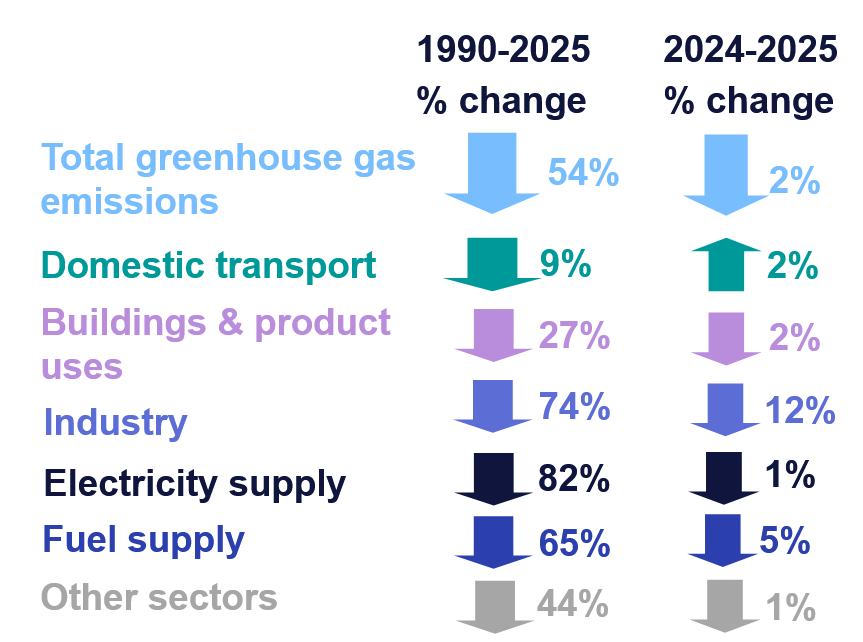
And here’s the UK contribution - halving emissions over the last 25 years. And yes, some of this is off-shoring heavy industry, but a lot of it is real:
Now, 2.6C would still be a big deal - and isn’t baked in. If we went really hard, globally, maybe that figure could get closer to 2C; if we slack off, it could be more like 3C. But while neither is easy, anything in that 2-3C range won’t cause anything like a global ecosystem collapse10 or pose an existential threat to civilisation.
One thing that can be confusing about the forecasts is that when the IPCC, or other body, says rising temperatures will cost us XXX by 2050 (2080, 2100), where XXX is a large number, the comparison they’re using isn’t today - but how wealthy we would have been in 2050, in a world without temperature rise, after many years of economic growth.11 Under almost the projections for the trend we’re now on, the world - both developed and developing countries - continues to get richer. Climate change isn’t on track to make us poorer, just less rich than we would have otherwise been.
I don’t want to minimise the impacts, but equally we shouldn’t overstate them. Over the last few decades, as temperatures have risen to c. 1.5C above pre-industrial levels, life has got immeasurably better for humanity. And I don’t just mean for people in rich countries, but for the poorest in the world. On almost any measure - total living in extreme poverty, infant mortality, life expectancy, you name it - things have got dramatically better, fueled by economic development.
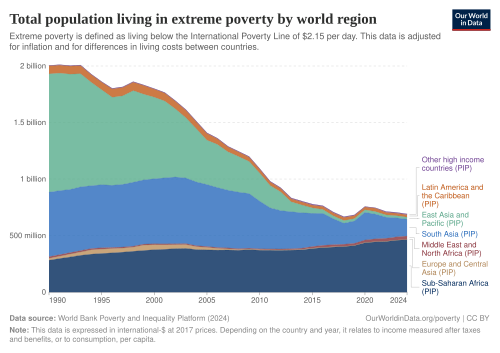
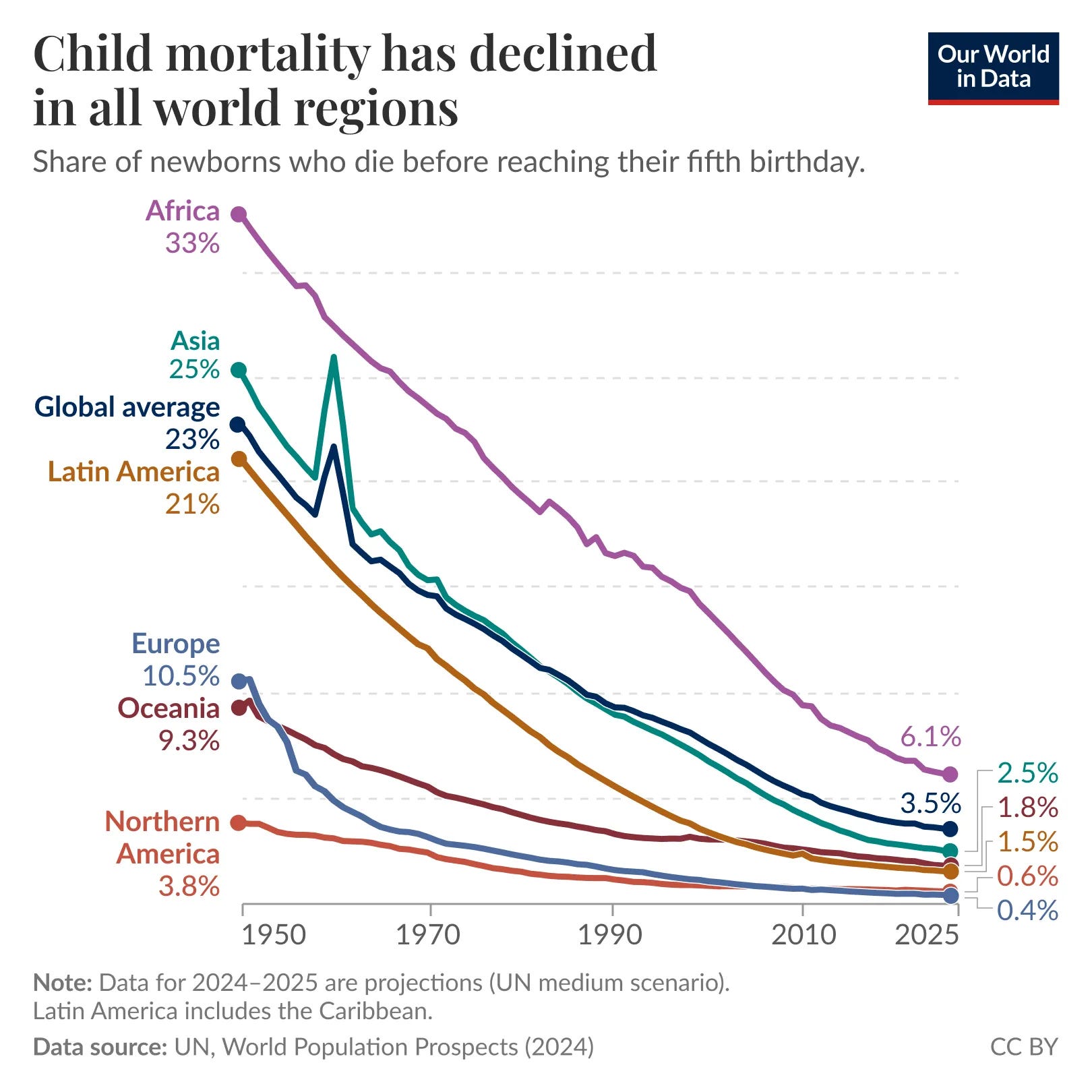
Economic development is our ultimate tool to make people’s lives better - including those who don’t have the luxury of saying it doesn’t matter. And while it’s right to see climate change as a major global challenge, it’s no longer an existential one: rather, it’s one that we’ve risen to meet, and are in the process of successfully overcoming.
Publicsectorlawyer: I was as intrigued by this Substack piece [Rod Dreher, ‘defending James Orr’] & I just wondered to what extent this view is shared by those on the Right at the moment?
I should begin by caveating that I know neither Dreher nor Orr personally, and nor can I speak for all of those on ‘the Right’. I’d add that it is quite hard to know exactly what it means to share the view of the piece, as it appears to take an inordinate number of words to obfuscate around the subject, while being careful to say it is not exculpating him of any wrong-doing he may have done.
However, let us take the title at face value: that it is a defence. My own impression is that this is not a widely shared view and that, rather, the more common view is that Orr and colleagues were foolish and wrong to have been caught in such a sting - though whether one views that with chagrin or delight depends on whether one supports Reform or the Conservatives.
Dreher’s point that this does not obviate the rest of Orr’s life is, of course, correct. If one supported his political ideas, no doubt one would still do so, nor do I imagine it is the sort of crime that would cause a personal friend to terminate all contact. But those in senior roles at the highest levels of national politics are expected to conduct themselves with probity - and to recognise that not doing so will damage both them and their party.
And there is no doubt that the financial scandals over the summer have damaged Reform, who’ve dropped four percentage points in the poll of polls since May.12 People can sometimes see politicians as teflon, but in reality a politician can be immune to one sort of scandal, but badly damaged by another - because it damages their image. Trump often seemed untouchable, but the Iran War has hurt him, both directly with people who voted for ‘no forever wars in the Middle East’ and indirectly, with inflation. People could forgive Boris for infidelity or curtain-gate, but not breaking his own rules during lockdown. And in the same way, people who would shrug off stories about what Farage said in school may still look askance at financial scandals - because it dents Reform’s narrative that they’re ‘not like other politicians’.
Luke: Are there any UK Government Departments you'd get rid of or significantly reduce the remit of?
People love planning to get rid of Government departments - my former department, DTI aka BERR aka BIS aka BEIS aka DBT aka DBIST was often first in line for the chop - but it solves less than people think it does. The functions will still be there - and no matter how you rearrange the deckchairs, there will always be odd bedfellows and awkward splits.
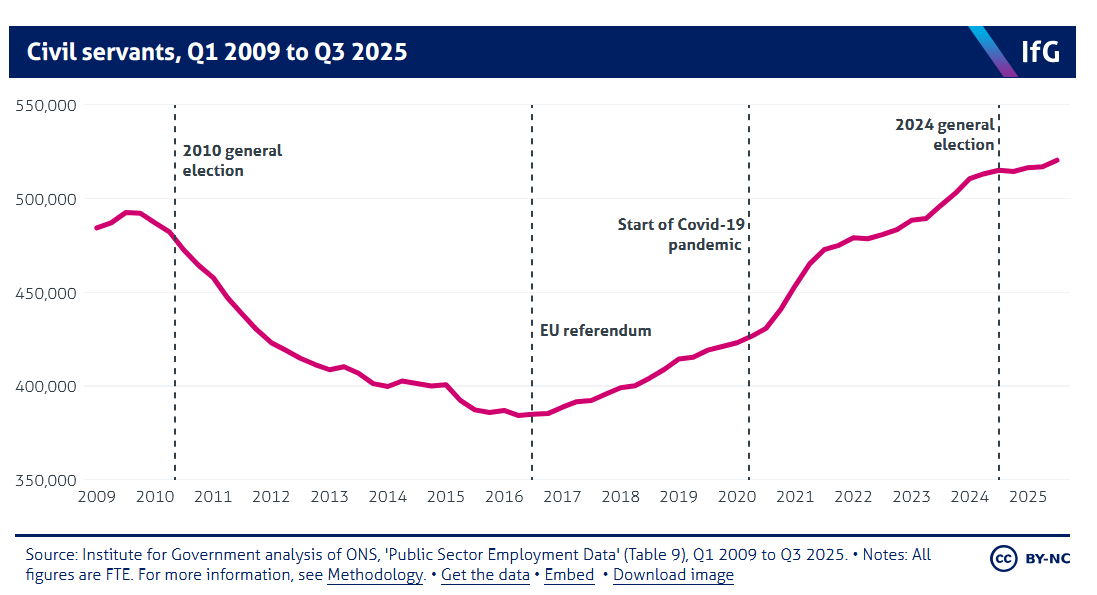
Far more important is stripping back the size of the state - the civil service has grown every year since 2016 - which involves directly eliminating functions, improving productivity, and legal changes to strip back various duties that require endless paperwork and ‘consultations’ to show that one has ‘considered’ something enough to fend off legal challenge.
Where there is more room to get rid of entire entities is arm’s length bodies, often known as quangos - many of which have also grown substantially in headcount, budget and regulatory output (which puts a direct burden on both business and public services). Some are needed - Ofsted, the Bank of England, the Competition and Markets Authority - but many of those that exist could have their powers seriously pruned back (either ended altogether, or absorbed into Government), and there are plenty of smaller bodies - and a few larger ones - which could simply be abolished.
Heinrich Hyser: What is your ratio of paid to non-paid subscribers? Just curious how that transition is going for you and the substack!
Substack estimates you should be able to convert 5-10% of your free subscribers to paid. I’m currently on about 3%, haven’t been pushing monetisation that hard - and did things like give away c. 60 complimentary subscriptions (not included in the 3%) to close friends and family, which probably wasn’t the most commercially minded decision!
Overall, I’m pretty happy with it:13
I’m still getting great readership and good growth on the free posts.
Paywalled posts feel more like the old ‘hobby blog’, with friends and paid subscribers.
I’m making enough to cover the costs of our annual UK-based holiday, which is nothing to sneeze at.
AbigailAmpersand: Why that landscape for your profile pic and why the Old English feminine name ‘Edrith’ ? Is it just because of the literal translation? I don’t know if you’re male or female but that’s not a question because it doesn’t really matter here. Does the name of your Substack relate to your love of science-fiction and are you doing a kind of ‘world-building’ here?
I did not know it was an Old English feminine name! (I’m male, as it happens).
Both picture and name have a somewhat convoluted pedigree. I originally blogged on a Wordpress site and the theme picture I used had clouds and mountains - so when I switched to Substack I wanted something similar. This particular picture was taken14 on a day in Snowdonia when a group of friends and I climbed Cadair Idris. It’s one of the ‘golden days’ of my life, and is a great picture, so was an easy choice.
The word ‘Edrith’ originated - for me - when I was a student, looking for a name for my home-brew role-playing system. For whatever reason, I landed on ‘Flame of Edrith’, with Edrith as a nonsense word. The first iteration of this website was mainly a place to put my Christmas Quizzes and the games I’d created;15 hence ‘World of Edrith’, and the name stuck.16
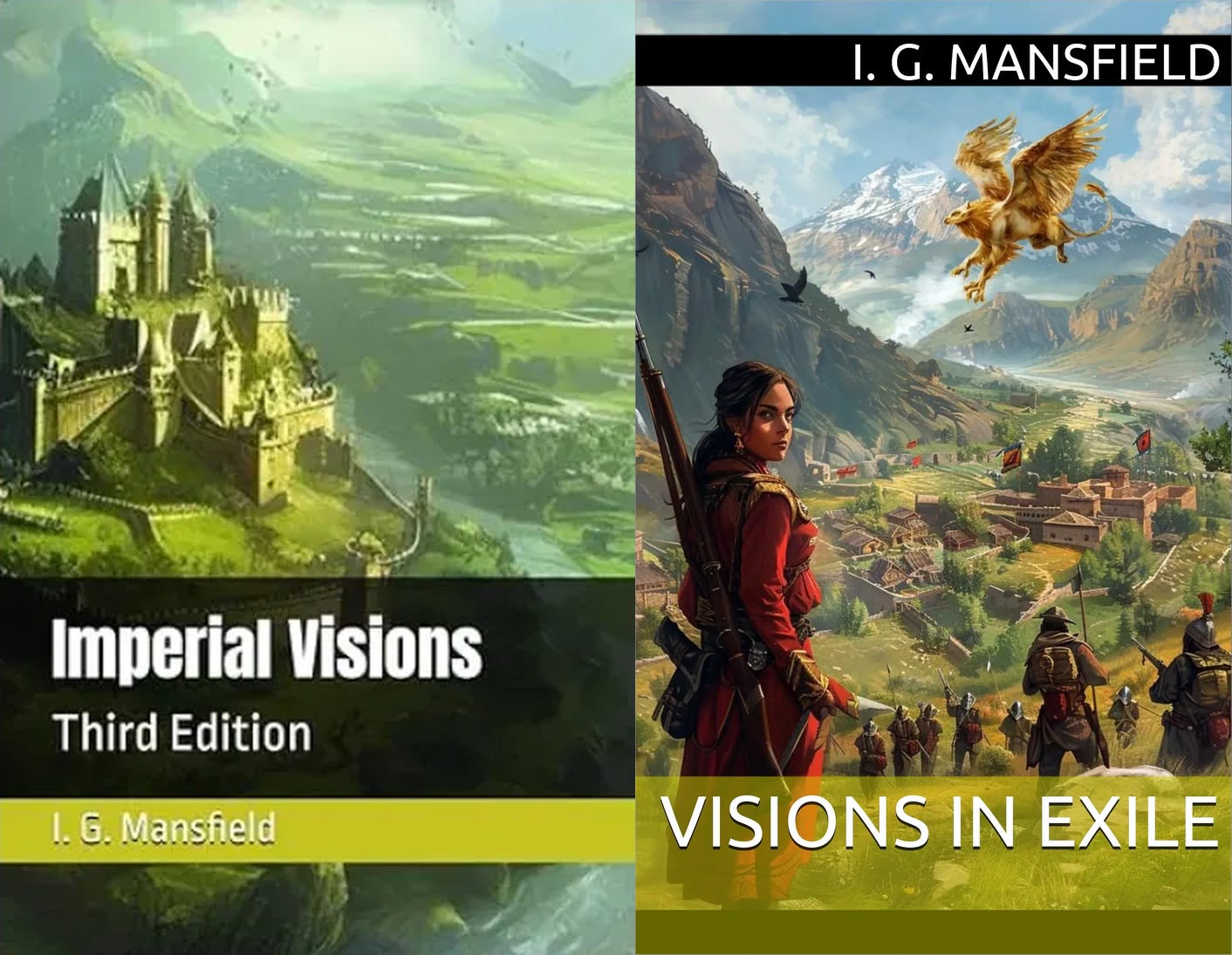
Later, I also used Edrith as the name for the world in my fantasy novel, Imperial Visions, and its sequel, Visions in Exile - two fantasy novels, set in an 18th century world. So yes, there was some world-building going on, even if not so much in the blog itself!
More details about both can be found on the Fiction page on this site, and they are available for purchase in paperback and on Kindle here and here.
Or the post on why Luthien Tinuviel should be the next Disney Princess. One day this will go viral, any day now…
The Tories made a good go at getting the deficit down from c. 10% to around 3% between 2010 and 2016 but then they got distracted by Brexit, Osborne left the Treasury, and debt plateaued at about 80% until COVID, when it shot up again.
Also, ‘other Western European countries are also in too much debt’ should not be seen as reassuring.
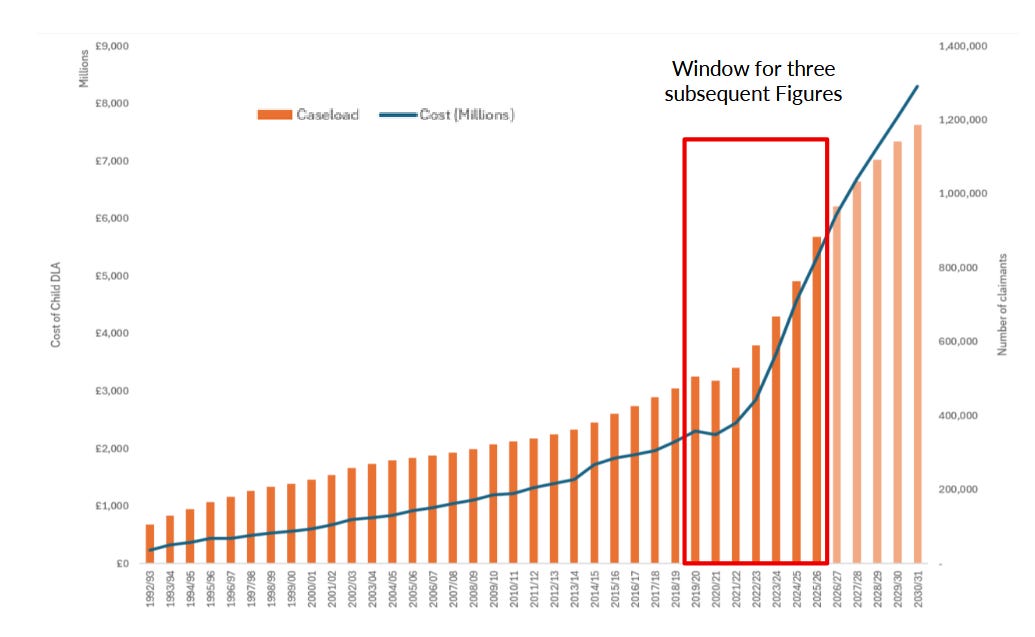
Here’s just one - Child DLA - and similar trends can be seen on PIP, SEND spending and many others.
,_OWID.svg)
.
The main exception to this would be some kind of external shock which causes us to more visibly lose control of the finances.
It may be easier for a coder to retrain as a care worker than for a miner to retrain as a coder. Though perhaps less appealing.
Just as I know individual families who’ve chosen to work less, accept a lower income and are happy with that trade-off, I believe it would be reasonable for us as a society to work less and be happy with less. But we’re definitely not, in aggregate, happy with less: whether it’s the cost of living or demands for more public services, people are very much not saying ‘we’re rich enough now’.
The village of Overton being near to Watership Down.
There is a deeply silly novel to be written about how Donald Trump and Donald Tusk are representatives of rival factions of sentient elephants, a la Cows in Action, on rival missions to infiltrate humanity and shape the future for their own faction’s benefit.
The Earth has been much hotter at various points in the last 100 million years, with very healthy ecosystems.
For the avoidance of doubt, this is a totally reasonable thing to compare us to, it’s just non-intuitive.
Though the £5m and £36m donations have cut through much more - because they’re larger, they’re simpler to understand, and they involve Farage personally, not a guy most people have never heard of.
Though if any currently free readers do want to see behind the paywall, here’s where to do it!
Which I really need to get round to putting up again.
While not anonymous - in that I link to here from other social media sites where I use my real name - for professional reasons, I also like the fact that this isn’t the first place that comes up if you type in my real name.