

We’ll take a break from politics this week to look at Brandon Sanderson’s epic Stormlight Archive: its depiction of realistic, if very different to our own, class, race and sex relations; its take on redemption and on morality;1 its depiction of mental health and, of course, whether it stands up as a series of fantasy novels. I will speculate wildly on the impact of Sanderson’s Mormon faith on the series, and set out my theory that, in the history of Roshar, Sanderson has created an allegory2 for the Old Testament history of Israel, with Honor in place of the Law.3 Contains major spoilers.
The Stormlight Archive is big. Really big. You just won’t believe how vastly hugely mindbogglingly big it is.
Sorry, that’s space. Let’s try again.
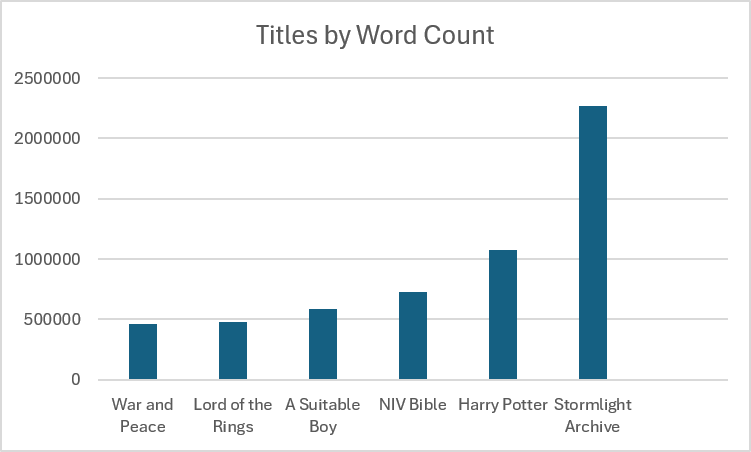
The Stormlight Archive is big. Really big. At 2.3 million words across the five main books and two novellas, it’s almost five times longer than War and Peace or the Lord of the Rings trilogy, almost four times longer than A Suitable Boy, three times as long as the New International Version of the Bible and twice as long as all seven Harry Potter books put together, not to mention 500 times longer than this review.4 If written out in a single line, it would stretch 15-18 miles long, or about as far from Reading to Windsor; if each letter was made from lead moveable type, the assembled pile would weigh the same as four African bull elephants.5
And technically speaking, this is simply the ‘first arc’ - a complete and distinct story line - with another, of similar size, planned for the 2030s.
It’s also very good.
Sanderson is one of the masters of modern fantasy and this is his magnum opus: in his own words, “The Stormlight Archive is intended as a love letter to the epic fantasy genre.” World building, characterisation and epic battle scenes are executed with tremendous aplomb, with me regularly staying up into the early hours of the morning to finish a section. He does a particularly good job in gradually ramping up the powers of both the protagonists and the threat, such that the conflict always appears to be in doubt.
The magic system, Sanderson’s speciality, is one of his best: the Knights Radiant, and their enemies, can manipulate ‘surges’ - physical forces, such as gravitation, adhesion, illumination, tension - with powerful effect; with each order of knights having access to two of the surges, this gives considerable variation in how the powers can be combined. There is also a more ‘technological’ element, with stormlight used in ‘fabrials’ that can be researched, developed and used by anyone. Though the initial focus of the books is on combat by means of the ultra-powerful Shardblades, various indications suggest that the society is actually on the brink of the Enlightenment and a Stormlight-based Industrial revolution, elements that become more prominent as the series progresses.
Two things - beyond the core action - particularly stand out for me:
The world-building. Roshar is a deeply strange world, with the surface wracked by storms, grass that withdraws into the ground when you approach, crustacean-esque fauna, and ‘spren’, spirit-like objects that briefly appear around natural (rain, wind, fire) and emotional (fear, glory, creativity) phenomena. Societally, it also feels like a real world, with a large variety of genuinely different and original nations, cultures and religions, many of which have little contact with each other beyond distant trade.6 This is gradually built up through the series, as well as via ‘interludes’ - short 5-10 page sections about entirely different characters - which are interspersed through each novel.
The history and foreshadowing. What you are first told about Roshar only scratches the surface - with a tremendous amount later revealed, or initial beliefs subverted. Through means including ‘death rattles’ included at the beginning of chapters, historical fragments and visions, almost all of this is foreshadowed and suggested from the very first book: even if one doesn’t understand it then, on a second reading it fits together as a coherent whole.7
Unsurprisingly, there are flaws. Though its length is part of its strength, there are a few places where things drag: books 3-5 could have benefited from tighter editing, cutting 10-20% off each. At times it becomes preachy on mental health.8 The sudden transition from a war in the balance in Book 4, to losing on all fronts in Book 5 was implausible,9 even if the subsequent execution was done well. I initially thought the ending was also flawed - but we will return to this below.
Overall though, the strengths far outweigh the flaws. It’s a fantastic series, which I would highly recommend to any fan of epic fantasy with a couple of hundred hours to spare.
Battle of the sexes?
Most fantasy takes one of two positions: either male/female dynamics and class hierarchies strongly model those of an existing historical society (typically Mediaeval Europe); or, more recently, they are assumed to largely mirror 21st century progressive values, despite this being implausible for the society and technology depicted.
The Stormlight Archive does something different: Sanderson depicts plausible highly stratified male/female roles, and a rigid class/race hierarchy, but along entirely different lines to any in Earth’s history.10 He also shows these beginning to buckle, realistically, during the cataclysmic events of the series.11
Vorinism - the religion followed by the nation of the main protagonists and its neighbours - sets out strictly defined roles for men and women. It is a highly martial society, where war is the most honoured pursuit, and is reserved for men, as are disciplines such as politics, commerce and carpentry. Womanly arts include art, music, literature, mathematics and science. Only women are permitted to read (men have a much more limited system of ‘glyphs’), and army officers travel with their wives, who act as their scribes and aides.12
For modesty, women are required to fully cover their left hands. For the upper classes, this involves it being fully bound up in a form of sling; most women, for whom this would not be practical, make do with covering it with a glove.13 Similarly, men and women are required to eat separate foods, with men’s food being spicy and women’s sweet. In wealthier households, this may involve the elaborate production of entirely separate meals; for poorer households, it is more likely to simply involve the addition of a different sauce after cooking.
A strict caste system exists based not on skin colour, but on eye-colour. Lighteyes sit at the top of the hierarchy, with dark-eyes never given authority over them. Within both lighteyes and darkeyes their are ten sub-castes'; movement within these is difficult, but not impossible. Slavery also exists, used for those convicted of certain crimes or prisoners of war as well as the non-human parshmen; ardents (priests) are also technically slaves, but in practice hold significant power.
Someone really, really, really doesn’t like utilitarianism
More than any other of Sanderson’s books,14 morality is a major theme of the Stormlight Archive. Characters debate morality with each other. Major climaxes are resolved as often by moral choices as by physical combat,15 with a character’s decision to return to save one he had no reason to, to reject temptation or to fulfil an oath being the crucial element that turned the tide.
The Knights Radiant themselves gain their powers through an ascending series of oaths - the first for each order being the title of this piece - such as ‘I will protect those who cannot protect themselves’, ‘I will remember those who have been forgotten,’ or ‘I will seek freedom for those in bondage.’ The protagonists struggle to follow codes of conduct, and to adapt and to do what is right in the light of new revelations about their history and their world.