

A few weeks ago I had a debate with a friend on whether a scheme in which the rich pay more was the same as one where the poor pay less. While a lot of this turned on semantics,1 it had at its root a more meaningful point: there are very different philosophies on how one should define public sector spending schemes, all of which can be described as ‘progressive’, and yet which have very different outcomes and impacts on those involved.
This isn’t just an academic question: we use all of these in the UK in numerous places. And while I spoke of ‘philosophies’, in practice they are often the way they are because of vibes, political calculation or historical accident. Nevertheless, thinking explicitly about the different design options for schemes, and their pros and cons, is useful for anyone wanting to reform them - or to design future schemes.2
We’ll look here a three of the principal options for designing a scheme, and then look at five other variants which are also used, some more than others.
Universalism
The poor get more
The rich get less
Sinners pay more
Saints get more
Contributors get more
The favoured get more
Those in a hurry pay more
Universalism
A universal service or benefit is provided to everyone, regardless of their income.3 Some of the UK’s largest and most strongly supported spending programmes are provided on a universal basis, including schools, the NHS and the state pension, as are many public amenities, such as libraries and free museums.
There are strong arguments that appeal to all parts of the political spectrum for universalism4 - including the not-to-be-overlooked benefits of simplicity and cost of administration. For the right, universalism avoids the trap wherein those with savings, or who have worked hard, are penalised for their prudence or success; for the left, there is strong evidence that programmes which are used by all remain higher quality and enjoy stronger support than those which become ‘ghettoes’ for the poor.5 Given that all programmes or benefits are ultimately funded out of general taxation, to the extent that taxation is progressive - which it is in most countries, including the UK - a universal scheme is progressive.
One objection to universalism is that it may lead to services used by the middle classes or the wealthy more than the poor, who could be considered to need them most - middle class people use public libraries more, for example.6 As someone who believes in individual agency, I don’t see this as a problem7, however, this is a problem for Social Calvinists8, as well as for those who believe the principal purpose of government is to ‘close gaps’ rather than to provide opportunity for all.
However, the biggest disadvantage of universalism is that it is incredibly expensive - and that is disadvantage enough to place severe limits on its use. It is no coincidence that the the programmes mentioned above cost, between them, over £400 billion a year, or around a third of state spending. To make every social programme in the UK universal would have a prohibitive cost9 - so with resources scarce, it is understandstandable that people seek approaches that target scarce resources more narrowly.
In the next sections, we’ll be talking about ‘the poor’ and ‘the rich’. It’s well-established that no-one agrees who is poor and who is rich, but fortunately we will not need exact definitions here. Almost all of us would agree that the dividing line for ‘the rich’ is in the top half of the population by affluence, and similarly that for ‘the poor’ is in the bottom half, and that is the only intuition we need here.10
The Poor Get More
In Poor Get More (or pay less) schemes, some benefit or service is given only to a subgroup of people at the bottom of the income distribution11, with others either not receiving it or having to pay. This is frequently based on the concept of a ‘safety net’, where the state steps in for those who have fallen on hard times.
Free School Meals, free prescriptions and most benefits, including child tax credits, and housing benefit, are based on this principle. Universal Credit is means-tested, such that those with £16,000 or more in savings cannot claim it. Plan 1 and Plan 5 student loans are also a Poor Get More scheme, in that most people will repay their loans in full, but the bottom third by income will not, and see all or part of their debt written off.
The principle benefit of Poor Get More schemes is that the benefit is only given to those most in need, making it significantly more affordable to the taxpayer than if delivered on a universal basis. It keeps the size of the state to a minimum, keeping it out of most people’s lives, and in most cases has a clear philosophical underpinning, in that we are saying that no-one in society should go without certain necessities.
Disadvantages include that such means-testing inevitably creates circumstances where people on the edge of eligibility for such benefits can face very high effective marginal tax rates - or even lose income - as they lose eligibility, reducing incentives to work. The administration of eligibity can be costly, with some deserving people falling through the cracks. And with the middle classes and those with influence in society having no stake in them, programmes for the poor can often become poor quality programmes - repeatedly cut and then eliminated.
The Rich Get Less
In Rich Get Less (or pay more) schemes, the majority of the population receives a benefit or free access to a service, but a subset of people at the top of the income spectrum do not.
Child benefit is an example of such a scheme, as is free childcare and the final version of means-tested Winter Fuel Allowance.12 Plan 2 student loans are an example too, with the wealthiest graduates paying back far more than they borrowed in real terms, as well as being simultaneously a Poor Get More scheme, with the lowest earners not repaying.13 The withdrawal of various tax allowances for high earners could also be characterised as Rich Get Less schemes. Schemes such as Finland’s approach to driving penalties, where the level of your fine is based on your income, could also be considered to fall into this category.
The advantage of Rich Get Less schemes is that they are popular - it is easy to whip up dislike for anything that can be charaterised as giving benefits to millionaires. As the majority of the population continue to benefit from the programme it is easier to maintain public support. They are a little cheaper than Universal programmes and those who don’t get it are usually those who don’t actually need it.
The disadvantage is that compared to Poor Get More schemes, they save comparatively little - but bring with them all of the same disadvantages of additional cost and complexity in administering and high marginal rates of taxation.14 Whatever you think the top rate of tax should be, it is surely ridiculous that someone with two children under five is better off earning £99,999 than they would be earning £149,999 - an effect that you can literally see showing up in the stats.
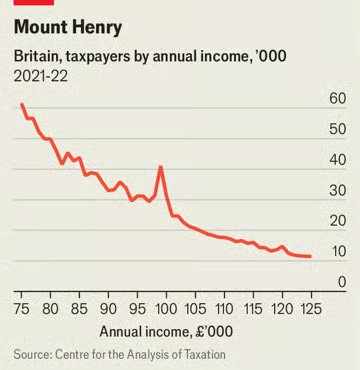
We should not be sorry for those on the verge of earning six figure salaries - but that spike represents NHS consultants cutting back to 4 day weeks; programmers, lawyers and other professionals working and earning less - and millions of pounds in foregone tax due to the inefficiency.15
As you may be able to tell, I tend to think that where means-testing is necessary (and it often is), it makes more sense from a fiscal, moral and economic perspective to focus those scarse resources on those who genuinely need it, using the Poor Get More schemes. Sadly, due to politics, we all too often end up with Rich Get Less schemes instead (as the Winter Fuel Allowance row so aptly demonstrated).
The above three schemes represent the most common ways of determining who gets what based upon income or wealth. But there are other approaches, which use entirely separate criteria to determine who gains and who pays.
Sinners Pay More
Such schemes make the price of something we think is bad more expensive - either because we think it is bad for the individual or to price in negative externalities that the activity has on others.
It’s not hard to think of examples: taxes on alcohol, tobacco or sugar, carbon taxes, or fuel duty. A dynamic road tax would be a way of pricing in the externalities caused by congestion, by altering the price depending on what road, and at what time, someone was driving. Schemes which raise money from wrongdoers - such as speeding violations or library fines - are also applying this principle.
The advantages to such schemes is that deterring the activity is part of the point - if the tax causes fewer people to do the activity, that’s a benefit. This does cause a trade-off between money raised and amount of activity deterred.16 The main disadvantage is that such schemes tend to be regressive, with the heaviest burden falling upon the poor.17
The reverse of the above, where government seeks to encourage a behaviour they value by rewarding or subsidising those who take part in it. Subsidies for solar panels or electric cars, the (miniscule, limited) transferrable tax allowance for married couples and Hungary’s lifetime income tax exemption for women who have four or more children are all good examples.20
The advantage to such schemes is that they are a straightforward way of government incentivising something it thinks there should be more of while still permitting free choice. The disadvantages are that such schemes typically carry a large amount of deadweight loss - paying people who would have done it anyway - and as such can be very expensive, particularly if one wants to pay enough to significantly shift behaviour. There is also a question over how effective such schemes are compared to overall cultural effects - or whether they need to combined with a much broader societal movement to have much impact.21
Contributors Get More
In Contributors Get More schemes, a person’s eligibility - and often how much they get - is determined by the extent of their contribution, or a proxy that is considered to measure it. The UK is an outlier in how little we make use of such schemes, with the principal one being the state pension - and that being quite loosely based.22 New Style Job Seeker’s Allowance is also a contributory benefit, paid to unemployed people who’ve paid Class 1 NI contributions in recent years.
The advantage of such schemes is that they tap into many people’s sense of fairness: that it is right that those who have made more of a contribution to society receive more back when they need it. Most people would be happy for a person who had worked in a factory for twenty years and lost their job when the factory closed to receive more unemployment benefit than someone who has never worked a day in their life. By linking benefits to contributions, it can also provide additional incentives to work, and reduce the circumstances where those who have done the right thing by society get the same as those who have shirked.
One disadvantage is that they can reinforce existing wealth differentials - though this can be mitigated if benefits are based upon years of contribution, rather than the actual amount paid. They can be more costly to administer than a simpler scheme - and more subject to fraud. A further disadvantage is that either the level is set such that some people (the contributors) end up getting more than they really need, increasing the cost, or some people (the non-contributors) get less, or nothing, which may be something that society is not willing to stomach.
The favoured get more
In such a scheme, only those who are in a certain identity category are able to access the scheme. Examples include those over a certain age receiving free TV licenses, ethnic-minority only internship schemes, or Reform’s proposals that only British citizens should be able to claim benefits.
Importantly, and distinguishing this approach from other entries, these categories are not directly connected with either affluence or need.23 They may be correlated - for example, someone might argue that British citizens are more likely to contributed, or that pensioners are more likely to be poor24 - but in such schemes someone is explicitly prioritising the identity category, otherwise it would be possible simply to make eligibility dependent on income, or on contribution, or whatever the supposedly relevant category is.
A scheme of this sort can be combined with other categories: for example, the modified Winter Fuel Allowance is both a Rich Get Less scheme (higher income pensioners do not get it) and a The Favoured Get More scheme (poor people who are not pensioners do not get it).
The advantages or disadvantages of such schemes depends entirely on how legitimate one thinks the favoured group deserves to receive differential treatment. Woke people who think we need to compensate for historic disadvantage may believe it is acceptable to establish schemes that differentially benefit ethnic minorities. Those who wish to strengthen the nation state and reduce immigration may support schemes based on citizens’ preference. Boomers may believe we should inexorably move to a situation in which every penny of GDP is given to pensioners,25 after which we should move on to converting first the solar system and then the Milky Way into more pensioner benefits. In each case, other people’s mileage may vary
Those in a Hurry Pay More
In rare cases, typically where a service is provided on a cost or near-cost basis, we allow those who wish to to pay more to get a better - typically a faster - service. An example is getting a new passport: there is a standard price to get it in the standard time, a higher price to get it within a week and a truly exorbitant price to get it within days.
The advantage of this is that it allows price differentiation: those willing to pay more can do so and the money is kept within the service, meaning that either prices can be lowered for everyone else, or the service can be improved by hiring more staff. We are used to this in the private sector, in everything from Amazon deliveries to business class travel.
The disadvantage is that it allows the wealthier to directly purchase a better service - something most people are typically not comfortable with on essential services, such as health care.26 In practice, what tends to happen is that this sort of scheme operates in effect outside of the core service, via the existence of a privately purchasable alternative for those who can afford it and wish to.
So, lots of possibilities, which should we prefer?
Though as in all such semantic debates I was obviously 100%, indisputably and unquestionably correct in every respect, except for the parts where I wasn’t.
Or considering who might or might not support and oppose them.
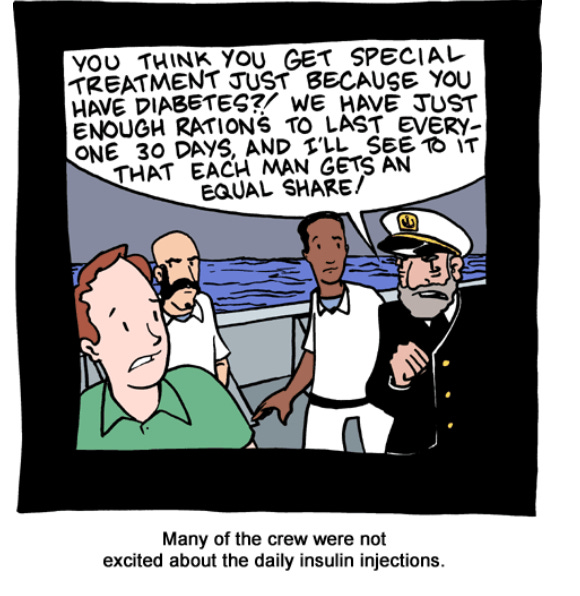
Note that it may still be provided only to people in certain circumstances. When child benefit was provided to everyone who had children, that would class as a universal benefit, even though not everyone has children. Similarly, the NHS is allowed to give insulin only to those with diabetes, not to everyone, unless you are this guy:
For more on this, see my piece on Against Means-Testing.
When I worked at the Department for Education, I regularly saw submissions that argued against particular policies because, even though they were open to everyone, the fact that they would be used more by the middle-classes was a reason not to do them.
I would if the poor genuinely couldn’t go - for example if the opening hours systematically work against certain people, or if someone can’t attend a university interview due to the rail fare. But if an opportunity is open to all and some simply don’t take it up, that’s different.
For more on Social Calvinism, see An Armininian Take on Public Services.
I’ve not calculated it, but I’m fairly sure extending all major benefit programmes including Universal Credit and every other poverty-related scheme to the whole of the population would cost more than our entire GDP - because this would basically be introducing a UBI at quite a high level.
If you do hold an idiosyncratic definition in which 90% of the population are rich, or 85% are poor, then, (a) congratulations, you have a philosophical viewpoint that would make an interesting discussion; but also (b) you are now using language is a way that is sufficiently different from the general population that the rest of us are free to ignore how you use it.
Or, less commonly, wealth.
The version Labour originally proposed was a Poor Get More scheme.
Plan 2 student loans are in fact incoherent, with some middle-high earners ultimately paying back far more than the highest earners, as they accrue more interest over a longer period of time.
A few don’t, such as higher charges for driving penalties.
Due to the declining marginal utility of money Rich Get Less schemes will typically be more prone to this sort of deadweight loss than Poor Get More schemes.
This is less of an issue if the tax is correctly pricing the costs of an externality; it is more of one if the long-term goal is to end or near-end something, but the state gets addicted to it as a revenue stream.
Interestingly, people appear to be much more comfortable with government doing this than the private sector. When banks seek to fund their activities via high levels of fines on unplanned overdrafts or similar, this is deeply unpopular. In part this is because the tax is transparent, and the cost built into purchasing, whereas the fines led to people being unexpectedly stung for large lump sums.
I suggest that anyone who thinks this is the same as the preceding category go to the social media site of their choice and announce that we should replace free childcare with a tax on childless women.
As with the ‘Poor Get More’ and ‘Rich Pay Less category’ this isn’t just vibes (although the vibes also exist, and are not irrelevant), the two approaches produce real-world meaningfully different distributional outcomes.
I’m not sure why these seem to cluster in the ‘family and children’ space compared to the sin taxes, which are much more varied.
Though it is significantly easier to incentivise through subsidies something that is essentially a consumer decision, such as which car to buy, than something which is amore fundamental lifestyle choice such as whether to get married or how many children to have.
Giving insulin only to diabetics is not an example of The Favoured Get More - non-diabetics do not benefit from insulin. In contrast, non-pensioners would gain a benefit from receiving the Winter Fuel Allowance.
They might argue this, but they would be factually incorrect.
This is the mathematically inevitable end point of the state pension triple lock.
We tend to have less objections when it is ‘can leave ordering a new passport to thr last minute’.
You'll be pleased to know that even the standard passport choice is surprisingly quick. I had mine renewed last December, submitted application digitally on Monday and got my new passport on Friday.
I considered an expedited choice but that involved taking the train to Croydon and an in-person interview. No thanks
«However, the biggest disadvantage of universalism is that it is incredibly expensive [...] so with resources scarce, it is understandstandable that people seek approaches that target scarce resources more narrowly.»
It is unfortunate that our blogger here fall victim to malicious right-wing propaganda about "affordability" because nobody has been proposing to give a free Rolls-Royce to every family whether rich or poor, but to make the entitlement universal and take it back with taxation where it is deemed to be not needed. This has happened already with universal entitlements whether for services like schooling or cash like the state pension.
«The principle benefit of Poor Get More schemes is that the benefit is only given to those most in need»
The malicious right-wing propaganda of which our blogger is victim seems indeed based on the ridiculous assumption that taxation cannot be used as a tool to balance spending.
«making it significantly more affordable to the taxpayer than if delivered on a universal basis. It keeps the size of the state to a minimum, keeping it out of most people’s lives»
Actually giving a universal benefit and then taxing it away in case where it is deemed not needed means negligible intrusion of the state: for example schools and roads are simply available to everybody and paid for by taxes and nearly everybody pays taxes (whether direct or indirect).
If one wants to target a benefit to a group it is quite simple to tax it away for everybody else and does not mean any more intrusion than the ordinary taxation system which already exists. It is just some figure in, the same figure out, nothing complicated or intrusive.
The purpose of the malicious right-wing propaganda seems to me not to keep the state activity simpler or less intrusive but to ensure that some benefits are indeed not universal but are smaller than would be otherwise.
Consider the usual claim that good state pensions are unaffordable: it is simply an argument that many workers who cannot afford to save for a good pension privately should be very poor in old age on a very small state pension, because it is "unaffordable" for other taxpayers to pay insurance against themselves being very poor in old age.
The arguments I see against universalism seem to me to be always against their potential redistributive effect (including depriving vested private interests of profits lost to the much greater efficiency of public provision, as in the case of pensions).