

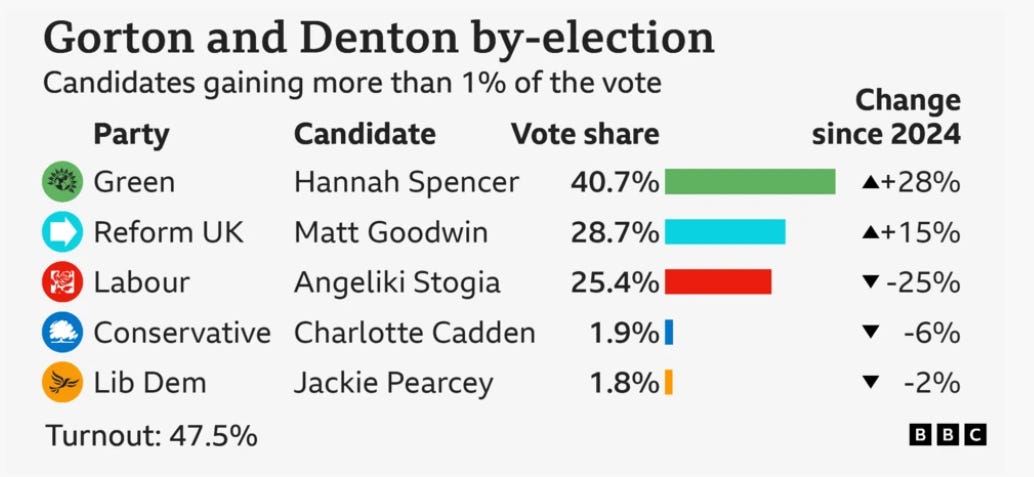
The Greens have arrived. They’ve never won a by-election before, never got over 10% in a by-election - and this time it wasn’t even close. With 41%, they’ve shown they can contest and win - and are a genuine alternative in Labour’s heartlands. This will surely boost them in the coming local elections.
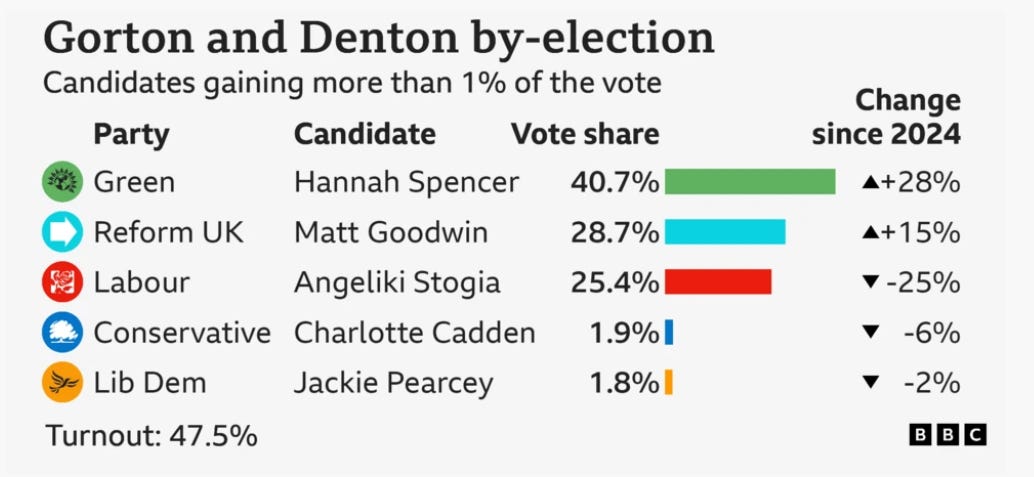
Source: BBC News Reform didn’t do so badly. This was a seat which is 30% Muslim, where in 2024 the combined left got over 75% of the vote, and the right got just 22%. On Thursday they got 31% of which 29% of went to Reform. Their only hope had been to sneak through a divided left1 - which was always a faint hope. To eat the Tories’ vote and increase the right’s share some 9% further is perfectly reasonable for the leading party on the right in such a by-election.
But it didn’t do so great, either. Getting 29% in a by-election against a deeply unpopular government isn’t a great look for the anti-establishment party. If the Greens showed Labour that they’re an alternative option for stopping Reform - they also showed Reform that they’re no longer the only option for those who want to give Labour a good kicking.
Labour is no longer the ‘anti-Reform’ party. Much of Labour’s strategy has been based on the fact that, when push comes to shove, voters on the left will come back to them. But in Caerphilly in October and this week in Gorton and Denton, voters chose otherwise. Of course, in some places Labour may remain the only option on the left, but with the Lib Dems in the Home Counties and south, the SNP in Scotland, Plaid Cymru in Wales - and now the Greens in their urban heartlands - there are going to be precious few places without alternative options.
The pressure will grow on Labour to move left. Just as the surge in Reform persuaded Labour to tack to the right, so Thursday’s result will urge them left.2 That may mean (even) more spending on welfare and public sector pay, or softening on cultural issues. Whether this is sufficient to win back voters, given the Government’s - and Starmer’s - severe unpopularity is an open question.3 There is also a possibility that Labour repositioning in an attempt to squeeze the left bloc could open up space for Reform and the Conservatives to gain some ground.
The chances of Starmer going after the May elections has increased. In January I gave him a 60% chance of lasting the year. I thought he had a number of cards still to play - in particular, sacrificing McSweeney after a bad set of local elections, just as May was forced to sacrifice her own chiefs of staff, Nick Timothy and Fiona Hill, after the 2017 general election.4 But McSweeney has already gone, they’ve had to back down on cancelling elections - which means losing more seats - and losing to the Greens in one of their safest parliamentary seats is another body blow. If he does go, he’s likely to be replaced by someone more to the left, for the reasons set out above.
Tactical voting is now alive on the right. The Conservative vote fell to below 2% - with most of that appearing to go to Reform. Not all Conservatives, of course, and it’s unclear how many Reform voters would return the feeling - but then not all people on the left vote tactically either.5 But it does look like any election model that includes tactical voting should be modelling that for both right and left.
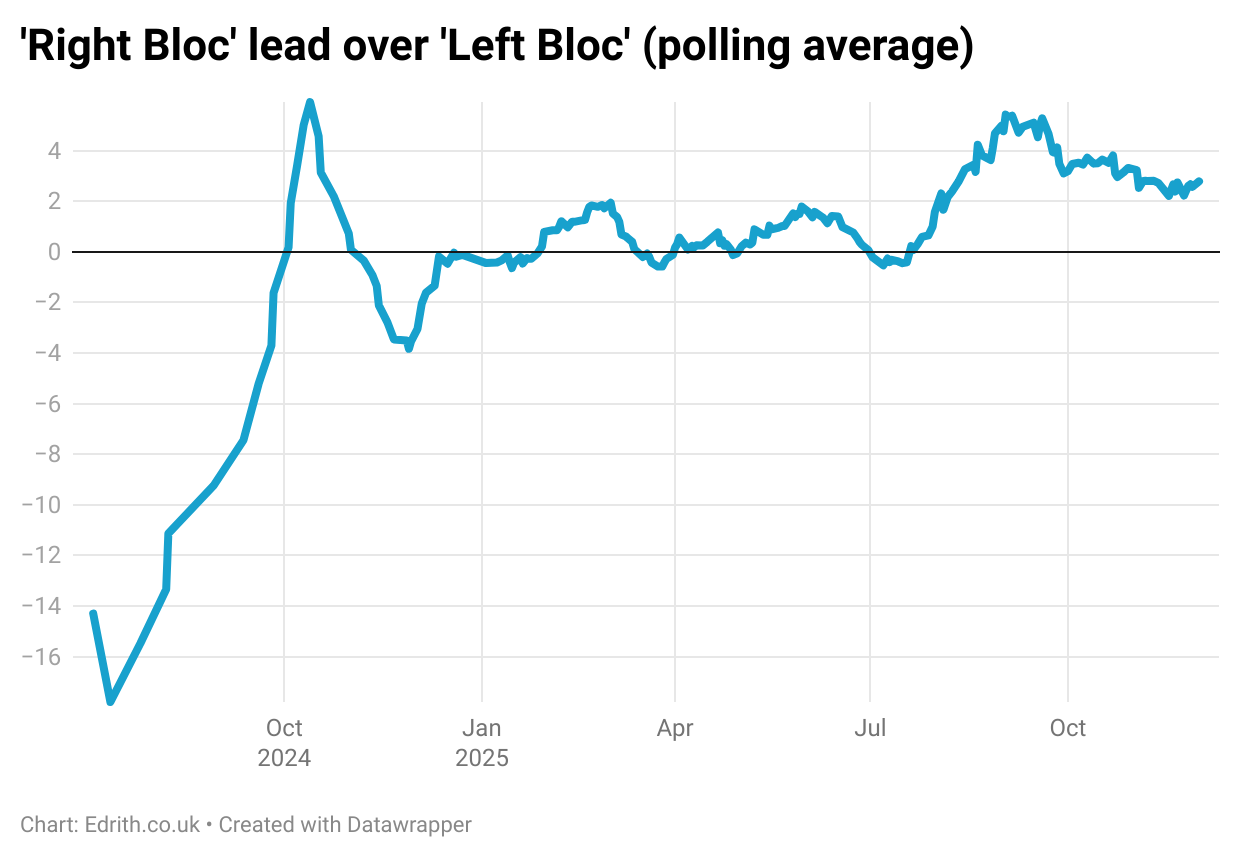
Growing your bloc matters more than ever. As I wrote before, if bloc politics is real - and it is - then growing your bloc matters more than ever. Both left and right have been stuck around 44% - 47% for the last few months - if either could break through to the 50%-55% territory, that would make a big difference party. Note that the right has an advantage here as the right vote is splitting two ways and the left three.6

Sectarianism is here to stay.7 The last General Election saw four8 Independent MPs elected on a sectarian basis, campaigning primarily on Gaza - the first sectarian candidates elected in Great Britain since the War. It also saw the rise of The Muslim Vote, an organisation explicitly committed to ‘making the Muslim vote count’. This week’s by-election showed that, despite the cease-fire in Gaza, this politics is here to stay - with The Muslim Vote endorsing the Green candidate and Palestinian and Pakistani flags appearing on election night. Labour cannot outflank the Greens (or the independents) on this issue, and it poses a grave threat to them in any seat with a sizeable Muslim population.9
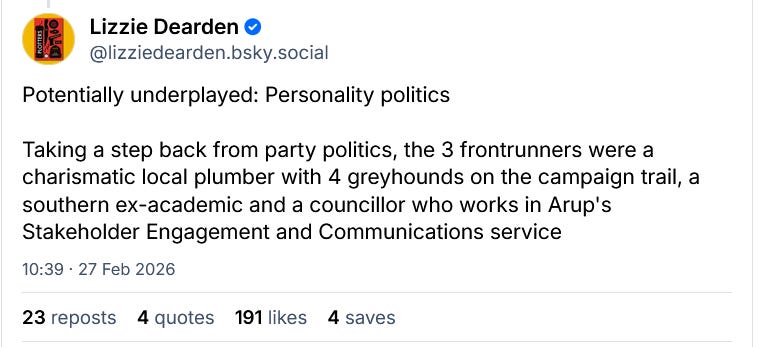
Candidates matter. Both Labour and Reform could have picked better candidates for the seat. Labour blocked the popular Andy Burnham for reasons of internal party politics10; for Reform, a genuine local who coached the local football team (for example) would have been better in a by-election than a southern academic, even if the latter has a bigger national profile.11 Meanwhile the Greens chose a local plumber who was clearly rooted in the constituency.
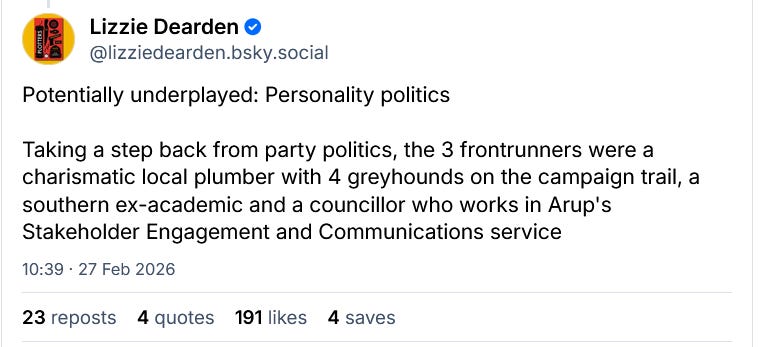
Charisma matters. Like him or not, Polanski is charismatic. So is Farage. So is Mamdani, and Trump; so was Alex Salmond. Politicians who have this charisma are rare - and finding it in combination with someone who will actually govern well is even rarer. But it matters in politics, and it’s one reason why the Greens and Reform are doing so well.
Scrutiny will increase. Reform didn’t get much scrutiny at the last general election as no-one thought they would win. That’s changing - and their candidate’s comments came under fire multiple times. Similarly, the other parties tried to focus on the Green’s less popular policies, on issues such as Nato and hard drugs - it didn’t stick for a by-election, but it’s a sign of things to come. The more both parties look like they might win, or hold the balance of power, in a general election, the more that will increase - and as opponents polish their attack lines, each party will need an answer.12
This doesn’t change much for the Conservatives. This was a seat where they got less than 8% in 2024 and has been Labour for almost a century; they largely sat it out in campaigning. The Tories are still in a very challenging place, but this result doesn’t tell us anything we didn’t know a week ago.
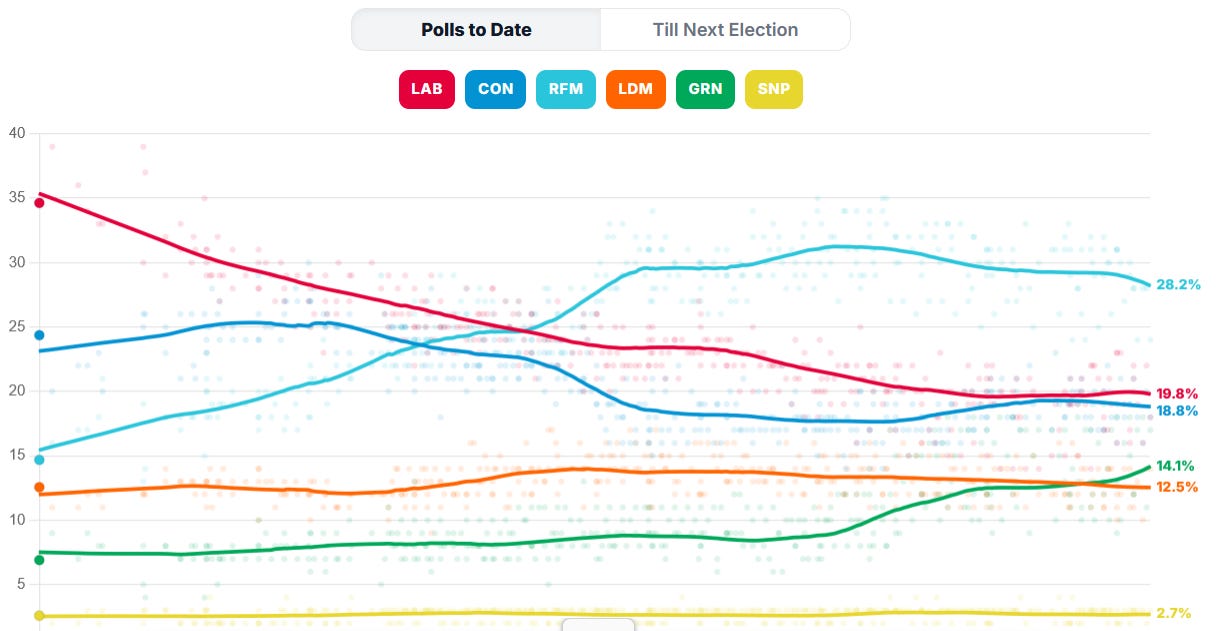
The Lib Dems should be worried. They’ve done well in by-elections, but in national polls have failed to capitalise on either Tory or Labour unpopularity, never breaking through 15% and polling the same now as at the General Election. Now the Greens are surging and have just demonstrated that they are a genuine alternative to Labour on the left - and fishing in many of the same pools. I’m sure there are plenty of ‘Blue Wall’ constituencies where the Lib Dems will continue to be the main rival to the Tories, but it wouldn’t surprise me to see the Greens start to eat the Lib Dems lunch over the next year.
Reminder, my reader survey, ‘A Question of Law: Retain, Reform or Repeal?’ is still open - a chance to say what you think of 25 of Britain’s most iconic laws - and a few others.
As it stands, even if the left had divided perfectly, Reform would have come third by about 4% of the vote.
Helped by the fact that the Prime Minister’s former Chief of Staff, Morgan McSweeney, who was seen as a principal architect of this strategy, was recently forced to depart in the wake of the Mandelson scandal.
Though I think it unlikely without a change of leader.
After which for a further two years it was always May but never Brexit.
And plenty of people have non-bloc ordered preferences: Conservative voters who prefer the Lib Dems to Reform, or anti-establishment voters who will go for either the Greens or Reform.
If you include Restore on the right then you have to include Your Party (and you’ll cry if you want to) on the left.
I’ve seen a number of progressives rejecting the description of sectarianism, presumably as a knee-jerk reaction that anything critical of an ethnic minority group is here to stay - and ignoring the fact they’d be happy to criticise the fusion of Christianity and the Republican Party in the US. It is true that the Greens - fortunately - won by enough that whatever ‘family voting’ occurred couldn’t have made a difference, and of course people who aren’t Muslims can also care about Gaza. But that doesn’t change the fact that we now have organisations explicitly mobilising on grounds of faith, in a way that is having a noticeable impact on elections.
Sectarian or ethnic voting is nothing new in the world - it happened with the Irish in the US, it still happens in Northern Ireland and it is a feature of many democracies today. It is not illegal. But neither should we pretend it is good: mobilising on the basis of faith or religion is a clear sympton of a less integrated, more divided society - and it typically leads to less scrutiny of politicians’ actual platforms or conduct, as people will vote for whoever is the one endorsed by ‘their side’.
Or five, if you include Jeremy Corbyn, which you arguable should do.
If one community votes along sectarian lines, while others split, this can have an outsize proportion on the end result, even if the community is only 15-20% of the population.
Or, if you’re being charitable, because they didn’t want to fight an expensive by-election for the Manchester Mayorality that they might well have lost.
Perhaps Matt Goodwin would have been a better national spokesperson for Reform if he’d won than an ultra-local candidate - but in by-elections, local candidates usually do best.
Over the last six months Farage has systematically been junking numerous of the more implausible economic pledges from 2024 - such as raising the personal allowance to £20,000 - much as Starmer ditched the pledges he’d won the leadership on (e.g. abolishing tuition fees) well before the election.
For all that has been written about two-bloc politics, there was clearly a lot of movement between blocs in the months immediately after the generally election, as a ten-point lead for the left bloc rapidly dwindled to nothing.
I do think the two-bloc thesis is an oversimplification. Furthermore, since it's mostly progressives that have put forward this idea, it also smells a bit of wishful thinking; if you want the government to lean further to the left, and also get re-elected, then the two-bloc model is a thesis which, if true, means you don't have to trade those two things off against each other.
Tto is overendowed with 't's.
Love the allusion in footnote 4