

Speaking politically, one of Labour’s best policies at the 2024 election was the decision to impose VAT on private schools.
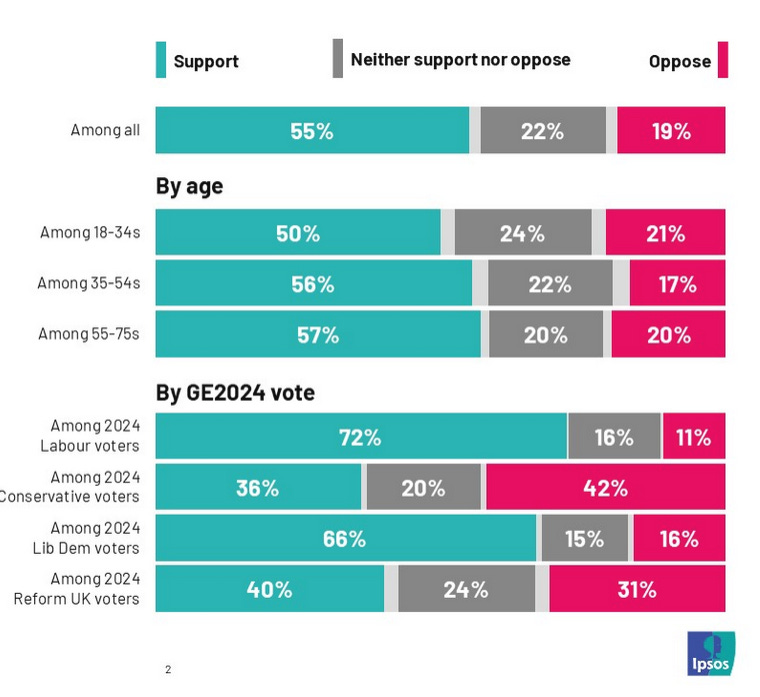
Simple to explain, it clearly communicated their values: what they stood for and who they were against.1 It was also massively popular, with even 2024 Tory voters being almost evenly split on the policy.2
Even better, the policy was absolute catnip for right-wing commentators, who simply couldn’t stop talking about it. These ranged from the comically unsympathetic Telegraph case studies, on the lines of, ‘Oh no, if this goes through we might have to give up one of our three annual ski holidays and trade in the second Ferrari for a Porsche’ to earnest analytical studies arguing that Labour had slightly overestimated the money it would raise.3
Whatever the genre of criticism, it served no purpose but to raise the salience of one of Labour’s most popular policies - plus the fact that every minute that Bridget Phillipson spent being asked about VAT on private schools was one in which she wasn’t being asked about her (non-existent) policy on tuition fees.
I deliberately avoided talking about this subject until it had happened - I had no wish to do Labour’s campaign work for them, and there was clearly no chance of averting it. But with the policy now in effect, it’s time to have a clear-eyed look at how the independent sector created an open goal for Labour - and how they could regain their lost support.
But how did it get that way?
On a purely personal basis, it’s notable that I, as a middle-class professional in the Home Counties, with a household income in the top 10% of the country and plenty of friends and acquaintances in similar situations, can think of just three families I know who are sending their children to private schools.4 Indeed, while I oppose the VAT policy, it’s out of principle - those parents are already paying twice for their education - rather than from any personal stake in the decision.
For that matter, while Phillipson’s VAT raid has now caused a rally round the flag effect, when I was a Tory SpAd, the interest in private schools amongst Conservative MPs was surprisingly low - certainly lower than it was in grammar schools, or faith schools. I’m not saying any of them were opposed to them, they just weren’t a big deal.5
So how did private schools so comprehensively lose the middle classes?
There are three principal reasons:
Fee inflation
Phasing out of full scholarships
Failure to combat university discrimination
Fee inflation
The IfS finds that average school fees have gone up, in real terms, 20% since 2010 and 55% since 2003. Longer term studies suggest that fees have gone up in nominal terms by 5% a year since the earlier ‘90s, meaning they’ve almost doubled in real terms since then.
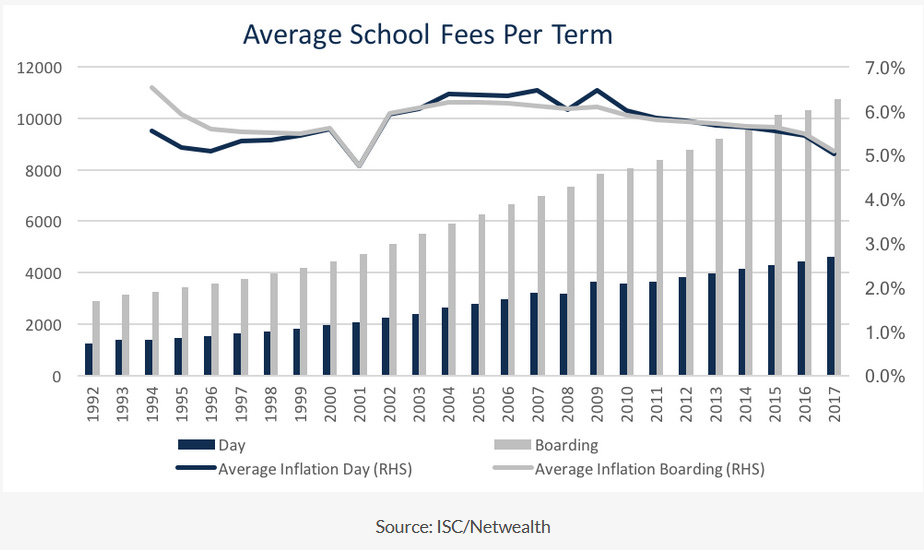
This isn’t pure greed.6 Private schools are in competition with each other, which creates a natural arms race. And the large injection of state-school funding under New Labour, followed by the improvements in quality under the Conservatives, have meant stiffer competition from the (free) competition.
But to keep fees rising above inflation year-on-year, through weak growth and a cost of living crisis, was abject folly. With average fees standing at over £15,000 per pupil - plus extras7 - the days in which a mid-ranking civil servant, a good journalist, a clergyman or an MP could consider sending their children private are long gone - unless they have private means or a high-earning spouse.
Of course, it’s not that in the past all people in these would have sent their children private.8 But the fact that they could made all the difference: people in these roles would have seen private schools as a valuable component of their options, even if they never took it up - and, as such, valued them.9
Similarly, by raising their prices so high, private schools have made themselves irrelevant to the segment of people who might not quite be able to afford it - but hope they might be able to, some day. People can be optimistic about their future earning potential - but only up to a point.
By narrowing their clientele to bankers, city lawyers and accountants, private schools may have increased their revenue - but it turns out that broad-based support for an institution can’t be built on such a narrow base.
Phasing out full scholarships
Very few private schools these days offer full academic scholarships on a non-mean-tested basis. An informal survey of a dozen or so private schools found few offering more than a 25% fee remission. Full fee remission is now overwhelmingly confined to bursaries for pupils from low-income families.

Private schools made the shift from means-blind scholarships to means-tested bursaries at the behest of social mobility charities and campaigners. Regardless of the merits of the two options, what private schools failed to recognise is that there was no amount of bursaries they could offer that would appease these campaigners, or persuade them to stand by them against attacks.10
But by removing full scholarships for the middle classes, private schools made themselves irrelevant to a huge chunk of their potential customers. Particularly with the aforesaid increase in fees, a 25% reduction still leaves them unaffordable to most in the top half of the income spectrum. But the chance to win a full scholarship, if your child is bright enough? Ah, suddenly the school enters your landscape.11
A private school wouldn’t have to offer many scholarships to have a big impact on middle class awareness. We used to (just) live in the catchment area for Dame Alice Owen, a semi-selective state school that’s regularly ranked one of the best in the country. There was endless talk about people wondering if they should apply, if their children would get in, studying for the exam, tutoring for the exam - and this for a school that offered 65 academic places in a catchment area containing upwards of half a million people. The vast majority of people who talked about Dame Alice Owen never had children who went - but they felt they might, so it was part of their landscape.12
A few means-blind scholarships from a private school would have the same effect.13
There’s a section in The Lion, the Witch and the Wardrobe after Aslan has offered his life in exchange for Edmund’s, where the White Witch says:
“Fool, did you think that by all this you would save the human traitor? Now I will kill you instead of him…but when you are dead, what will prevent me from killing him as well? And who will take him out of my hand then? Understand that you have given me Narnia forever, you have lost your own life and you have not saved his.”
Her Imperial Majesty Jadis, Queen of Narnia, Chatelaine of Cair Paravel, Empress of the Lone Islands, etc.
By switching out scholarships for bursaries, private schools lost those who might have supported them - but did not gain new friends.