

Different worlds and alien planets are a staple of fantasy and science-fiction. Sometimes they are even meant to be in Earth’s past: Middle-earth is explicitly intended to be set in our own world’s past, as was the Hyboria of Robert E. Howard’s ‘Conan stories’.1
But a few books have their setting very specifically in one of our Ice Ages, complete with (somewhat) realistic flora, fauna and geological events. This week we’ll be looking at three of them:
West of Eden by Harry Harrison (1984)
The Many-Colored Land by Julian May (1981)
The Anvil of Ice by Michael Scott Rohan (1986)2
Contains minor spoilers for all three books/series- though I have tried to avoid anything significant enough that it would prevent enjoyment.
West of Eden - Harry Harrison (1984)
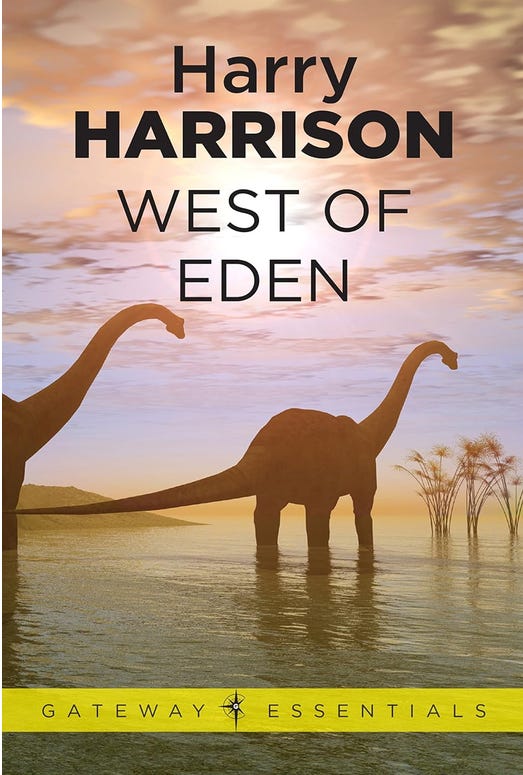
It’s cavemen vs dinosaurs - and the dinosaurs have guns!
That’s the premise of Harry Harrison’s Eden trilogy, in which the discovery and conquest of the Americas is undertaken by intelligent dinosaurs.
In Harrison’s timeline, the asteroid that destroyed the dinosaurs3 missed Earth and the dinosaurs evolved into a sapient, high-tech, bipedal species known as the Yilane.4 Except in the Americas, where mammals evolved as normal - with a New World monkey ultimately evolving into a species indistinguishable from Homo sapiens. When an incipient Ice Age causes the Yilane to seek new lands across the sea, the two species come into collision.
The Yilane have a richly rendered society that holds up well compared to most ‘alien’ races you might encounter in science-fiction. Their technology is based entirely upon genetic engineering: they don’t use fire or metal, but instead grow their cities, use modified dart-shooting monitor lizards as ‘guns’ and cross the oceans in giant, genetically modified ichthyosaurs.5
They are a fully matriarchal society: like sea-horses, after mating, the males carry the eggs and give birth to a clutch of young in a process that is not infrequently fatal. The males are accordingly kept in seclusion and considered less able, occupying their time with ‘lesser’ activities such as art or music. Meanwhile, the young begin their life entering the sea before emerging on land as ‘fargi’ - essentially lesser members of society, until they earn their name and place as full citizens. Members of the same clutch share a bond which lasts into adulthood.
Yilane language involves body motions as well as spoken language - and these motions, alongside a colour-changing skin, means they find lying and deception almost impossible. Notably, Yilane society is not monolithic: it appears to be divided into a number of city states and, within it, there are the ‘Daughters of Life’, a society who oppose the hierarchical nature of the society.
The humans, the Tanu, are stereotypical hunter-gatherers - though we later also meet the farming Sasku and the Inuit-like whale-hunters of the far north. They would have no chance against the technologically superior Yilane if it were not for the protagonist, Kerrick, who was captured for study as a child and grows up to learn their ways. As an adult he escapes and is able to teach the other humans how to resist - including how to turn the Yilane’s advanced weapons against them.
The rest of the series is essentially Cavemen vs Dinosaurs, if the dinosaurs had guns. The characters are fairly simply drawn,6 and what internal drama or character development there is is minimal. But the tension is built well and there are some good battle scenes.
As the series progresses, the Yilane deploy increasingly advanced technology against the embattled humans, who in turn must use ever greater ingenuity to resist. We meet new human cultures, and the divisions within Yilane culture become pivotal. Ultimately, the series ends with an uneasy coexistence - with the potential for both a better world, and renewed conflict left open.7
Verdict: 8/10: Great concept, adequately executed.
The Many-Colored Land - Julian May (1981)
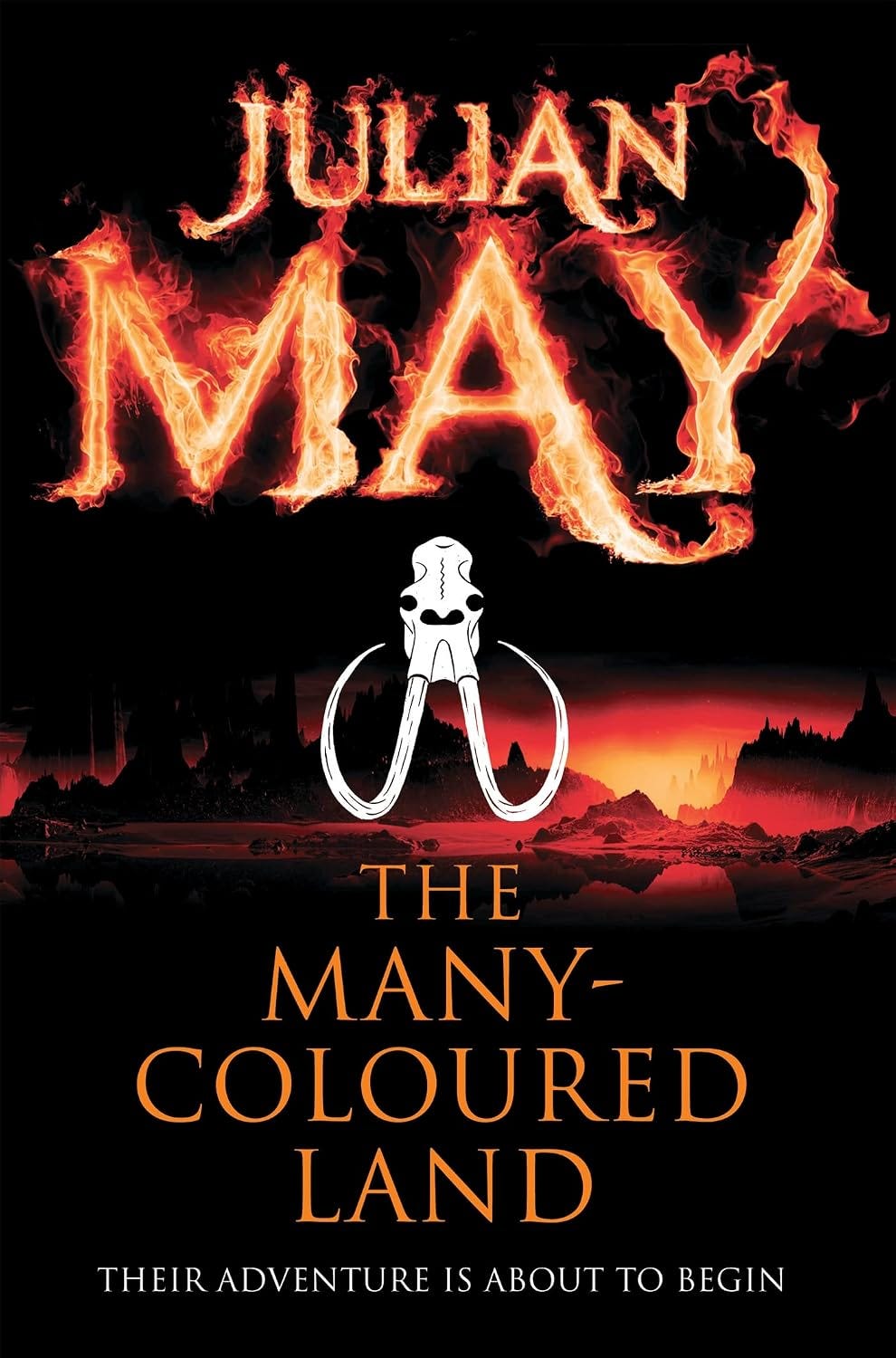
The Many-Colored Land is one of the weirder books I’ve read.
Not the weirdest - but definitely up there.