

In this edition of thoughts in brief:
Different ways the Government can help people
Missing Moral Messages
The Silliest Argument for Expanding Higher Education
Politics at its best
Different ways the Government can help people
There are two different ways in which government can help people.
One possibility it can give people things they really want. This could include tax cuts, more benefits, smaller class sizes, shorter NHS waiting lists, free stuff (childcare, TV licenses, prescriptions…), less crime or graffiti in their neighbourhood, freedom to worship, parks and libraries, integrated public transport networks or anything else that a person would be happy to receive. If the government’s stewardship of the economy causes there to be more job openings and pay rises, that should also go in this category.
Items in this category may be right-coded, left-coded, or somewhere in between. And of course, to deliver some of them a government will have to do some things that people don’t like, usually raising taxes to pay for them. But the actual deliverable is something that people genuinely want.
The other possibility is it can do things that it thinks will be good for people. This could include fining parents if they take their children out of school during term time, putting taxes on sugar/alcohol/tobacco, banning things (pornography, gay marriage, guns…), conscripting people into the army, setting out rules on who you can use as a childminder, making rules about cycle helmets or seat belts or anything else that a person wouldn’t choose for themselves, but which other people believe would be for their benefit.1
As before, items in this category may be right-coded, left-coded, or somewhere in between.
Almost everyone believes that some things in this category are necessary, but they disagree about which ones are, and which ones aren’t.2 And the fact that something is in this category doesn’t mean it won’t be popular - the British public love banning things which don’t affect them. But what really matters is their own lives getting better.
Over recent years the national government - whichever party has been in power - has appeared to spend more time focusing on policies which fall into the second category.3 In part this may be because we have been led by Prime Ministers without a strong ideology, meaning the direction is set more by civil servants and stakeholder groups, who tend to prioritise what they think will be good for people.4
This is not working in delivering the outcomes that are making people happy - hence why we are cycling through Prime Ministers faster than a Tour de France rider on steroids.
Andy Burnham, in contrast, seems to have been popular as Mayor of Greater Manchester by focusing on delivering on things that people actually wanted. He inherited a city with a good economy and maintained and continued the policies that would keep it growing; he appointed a good chief constable who cut crime; he implemented some highly visible and valued policies about buses and public transport.
But running a country is a lot harder than running a city - as our previous Mayor-turned-Prime Minister found out.5 Can Burnham repeat his success on a national level - or will it need to wait for his successor, whoever that may be?
Missing Moral Messages
I’ve written before how my problem with much of the modern mass cultural outputs is that the moral messages it conveys tend to be pretty one-dimensional: friendship is good, be kind, value others even when they’re different. Sometimes bravery, in a shallow, MCU superhero sense.
There’s nothing actively wrong with these messages - in fact, they’re pretty good! - but they’re also not very helpful when it comes to living your live well. They’re basically about how to rub along with others, rather than how to make something of yourself in an often difficult world.6
There’s another set of important messages which one can find in books such as those by Louis L’Amour, Robert Heinlein’s ‘juveniles’, Jim Butcher and David Gemmell. They include things such as:
Life’s not fair, but you should your best anyway.
If you get knocked down you get back up again.
If you make a mistake, you put it right.
You do what’s right, even if it costs you.
Nothing worth obtaining comes easily.
Self respect is everything - and it can’t be bought or gained by cheating.
In this passage from Out Law, Butcher’s latest novella, Dresden - the main character, an urban wizard - is talking to an ex-con who’s trying to go straight.7
“Life is hard, man. All of it. Nothing you can do will change that. But you can mostly choose what kind of hard stuff you want in it.”
He frowned. “Like what?”
I eyed him. Tripp was in good shape. At his age, that didn’t happen without effort, so I figured I could start simple.
“Exercising and staying in shape is hard. Not exercising and staying in shape is hard too; it just takes longer to set in. But you can pick which kind of difficulty you want.”
“Huh,” he said.
“By the time you consider everything you’ve gone through, working for Marcone is hard. Making an honest living is hard too. But they’re different kinds of hard. You don’t spend time in the pen when you play it straight. But there’s a lot of boring stuff, and most days, you’re making yourself do stuff you’d rather not do. You get to choose which kind of hard you want.”
“What about the easy life?”
“Maybe some people get that, sometimes, for a while. But people weren’t made for easy. We were made to work and scrap and struggle to make our lives into something better. We aren’t supposed to lie around, doing nothing, for very long. People who get away from that forward drive get weird fast.”
Out Law, by Jim Butcher
Although there is a strong message in these books to help others, there is not the abnegation of self that one might find in books such as What Katy Did or Little Women: characters in these books do want things - a decent life, respect, sufficient money to support themselves - though this is usually framed as things they can earn honestly, and sometimes contrasted with the greed or lust for power of their adversaries.
The main characters of these books are not always good people, either because they have not always been good people in their past, or because they lack the social niceties and graces that would fit into polite society. Being the type of books they are, the messages are also interwoven with a fair amount of action and violence - whether against outlaws, space pirates or demons, depending on genre.
Furthermore, the message ‘stand on your own two feet’ does not mean they are not helped by others - or give help themselves. In contrast, this is consistently presented as a positive thing. It is more that one does not expect handouts - that when life is unfair, one cannot sit back and expect someone to put it right for you, but that one must - while acknowledging the injustice - press forward anyway.
They are hard messages, that could come from the mouths of the Gods of the Copybook Headings. Most of us don’t live up to them all, or even most of the time. But we could perhaps do with more fiction that conveyed these messages, rather than platitudes.
The Silliest Argument for Expanding Higher Education
The silliest argument for expanding higher education runs like this:
‘You went to university and you want your children to go to university, so how can you suggest restricting it for anyone else?’
It has a certain rhetorical effect, so I can understand why those who care more about persuasion than truth use it, but anyone who truly believes it should know better.
Must a concert violinist, who attended the Royal Academy of Music and hopes their children do too, believe that the Academy should drop its standards and let more people in - so they too can benefit?
Must a Premiership footballer, who attended his club’s youth team, and hopes and dreams that his two-year-old son will follow in his footsteps, believe that the youth team should let in anyone who wants to play - even if there is almost no chance they will go on to make it professionally?
Or we could choose an example closer to home. I went to Cambridge, and hope that my children will go.8 Am I a hypocrite, unless I believe that Cambridge should lower its standards and double the number of places it offers, so more people can benefit?9
Obviously not.
In each case, the value of the institution in question is in its high standards. That is core to what the person who attended them values. And our hope for our children to also attend is a hope that our children will also attain highly - not a wish that the institution degrade itself just to give them a higher chance of attending.
As with Cambridge or the Royal Academy of Music, so with higher education as a whole. The clue is in the name: HIGHER education, providing an academically rigorous education for those who are highly academically qualified. Of course there should be second chances - retakes, the OU, progression from FE - for those who did not achieve their potential the first time, but these should be pathways to allow people to demonstrate attainment of the necessary standards - not ones that remove those standards. And of course there should be other high quality routes for those not academically qualified.10
Those who make the silliest argument commit two fallacies:
They implicitly assume HE should be for everyone, rather than something reserved for those with high academic standards. But high academic standards are at the core of HE - the fundamental element that distinguishes it and gives it its particular value. Its degradation - with entry standards down almost across the board, 1 in 10 now going without an A-Level or BTEC equivalent, while Firsts are given out like candy11 - is fundamental to the current crisis.
They assume HE is homogeneous, with all universities the same. But why should the fact that I valued my high quality degree at Cambridge say anything about how I value a pack-'em-high, teach-'em-cheap course in business or social studies, with no entry requirements, minimal assessment standards and no currency with employers or postgraduate courses?
The fact is, I would not advise my children - or any other young person I cared about - to enroll on debt-trap courses such as those I described above. In most cases, I would advise them against going to HE at all unless they were on track for CCC or higher at A-Level - in such circumstances other routes are likely to be better. And I would wish neither Cambridge nor higher education as a whole to lower their standards to give my children, nor any other children, a better chance of getting a place at somewhere they were not qualified to attend.12
But meanwhile, the proponents of the silliest argument for expanding higher education will no doubt keep on making it.
Politics at its Best
I am not naive about politics.
The idea that things would be better if everyone would just sit down together and decide what’s best to do isn’t just wrong, but dangerous: the adversarial nature of politics is essential as a check and balance on the misuse of power.
Different people have very different views on how our society should be run, what is fair, what works and what is right and moral. The lives and livelihoods of millions can turn on these differences. Politics is how we resolve these decisions without violence - and ensure peaceful transitions of power. It must be adversarial: is a struggle for power, not a game, and the stakes are high.13
But at the same time - particularly in a week where a politician has been murdered - we should also remember the human side: that our politicians are almost all good people seeking to make a positive difference, and that they, and their families, can pay a horrendous toll in emotion, abuse, time and sacrifice.
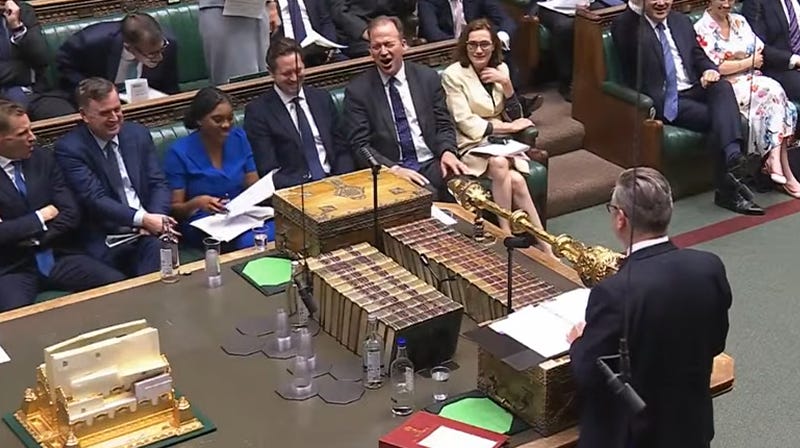
On that note, I thought the final session of Prime Minister’s Questions between Keir Starmer and Kemi Badenoch showed our politics at its best, revealing the human side of two people who, whatever one may think of their policies or track record, are both decent, well-meaning people who want the best for Britain.
There are some things that fall in the middle. Perhaps a 20mph limit is in the first category for pedestrians and cyclists but in the second category for drivers.
One interesting aspect is that people who work professionally in a category are often more inclined to support things in these areas (such as public health experts being more pro public health interventions).
At times they’ve even seemed to lose touch with the idea that the first is what people want. Sunak announcing policies to make maths compulsory to 18, or Starmer announcing a drive on ID cards, and expecting them to be big crowd pleasers are good examples. Whatever your views on the policies - and I have a fair amount of sympathy for both - they are clearly things that one does because one thinks they will benefit the country, not things that the public are crying out for.
The process whereby new policies are developed through many consultations with stakeholder groups also tilts the scales towards these groups and their agendas, which tend to be of the second category rather than of the first.
Though neither would welcome the comparison, there’s a great deal of similarity between Burnham and Boris. Both genuinely charismatic with a gift for connecting with people, both people-pleasers, both people who wear ideology lightly, both good at conveying a good vibe, but with the detail behind it often worrying light, or outright bad - as James O'Malley has written here.
As Neal Stephenson wrote way back in 1999 in In the Beginning was the Command Line:
“The global anti-culture that has been conveyed into every cranny of the world by television is a culture unto itself, and by the standards of great and ancient cultures like Islam and France, it seems grossly inferior, at least at first. The only good thing you can say about it is that it makes world wars and Holocausts less likely--and that is actually a pretty good thing!
The only real problem is that anyone who has no culture, other than this global monoculture, is completely screwed. Anyone who grows up watching TV, never sees any religion or philosophy, is raised in an atmosphere of moral relativism, learns about civics from watching bimbo eruptions on network TV news, and attends a university where postmodernists vie to outdo each other in demolishing traditional notions of truth and quality, is going to come out into the world as one pretty feckless human being. And--again--perhaps the goal of all this is to make us feckless so we won’t nuke each other.
On the other hand, if you are raised within some specific culture, you end up with a basic set of tools that you can use to think about and understand the world. You might use those tools to reject the culture you were raised in, but at least you’ve got some tools."
I mentioned Louis L’Amour earlier. Well, I wrote this section of the blog shortly after reading that passage; however, later in the book, Dresden actually recommends that the ex-con goes and read some Louis L’Amour, so clearly Butcher and I think along the same lines here!
I might just about forgive them if they went to Oxford. But not St John’s.
That would certainly increase my own children’s chances of getting in, too.
In its simplest form, for every place cut in HE, one more should be funded in FE.
The proportion of Firsts has gone from 13% to 30% in just 18 years
I do wish that no-one should be unable to attend for reasons of affordability - and one of the most heartbreaking aspects of the fetishisation of expansion at all costs is that it has come at the cost of maintenance grants for those who need it, reductions in the maintenance loan and an overdependence on the debt-funded model of financing.
I know that I am much more open than some of my readers towards tactics by politicians that seek to convince or win over the electorate, or to use Parliamentary procedures to win particular votes.
Their exchange begins around timestamp 9:02.
> Nothing worth obtaining comes easily.
Or rather, the things worth obtaining that do come easily -- you're probably already doing them. Such as eating tasty food.
I agree with you on Universities. However bizarre it might sound though I was shocked to discover that the US "Ivy League" openly promotes "Legacies" for admissions. I suspect that this is partly, if not mainly, to encourage alumni to donate. But strange to see this justified in public as maintaining the character of the institutions, which is essential to keeping them attractive for other candidates.