

“For all the ink that gets spilled on hot-button political disputes, the single most underrated thing in politics is getting the technical aspects of macroeconomic policy right.”
Inflation kills governments. The sight of incumbents around the world toppling after the post-COVID inflation rush was a helpful reminder to anyone who had forgotten. As James Carville famously said, ‘It’s the economy, stupid,’ - and one of the economic malfunctions people really, really hate is high inflation.1
What Yglesias is rightly saying is that monetary policy is hugely important to the economy - and thus to politics. He gives the obvious example of the rise of Hitler, before more speculatively arguing that had the Federal Reserve not preemptively tightened monetary policy in 2016, this might have shifted enough votes that Trump wouldn’t have won the election.
That’s a supposition - though not an implausible one. But what we can say confidently is that monetary policy matters to the economy, and the economy matters for all sorts of reasons. Which is why we should all care about the fact that for most of this decade, the Bank of England has been pretty bad at its job.
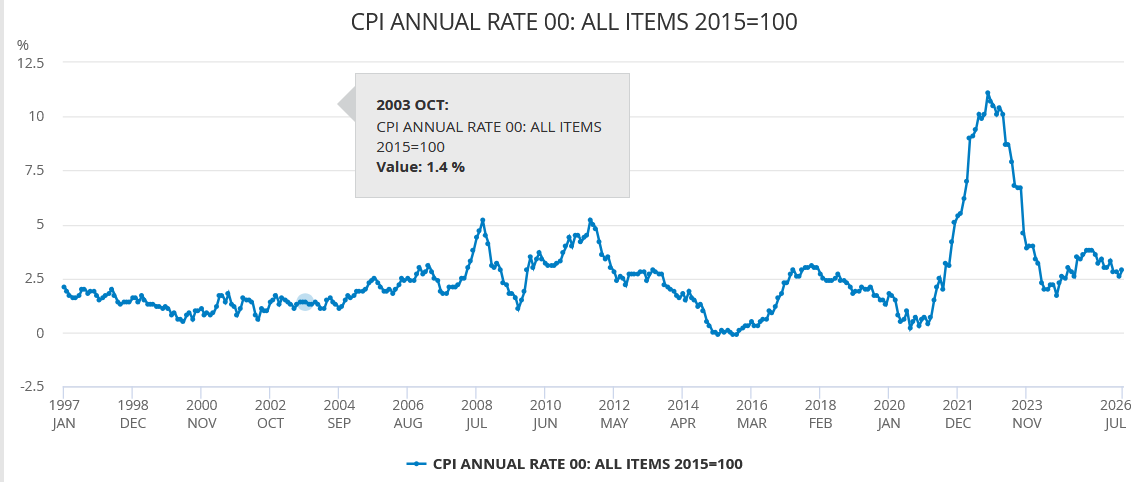
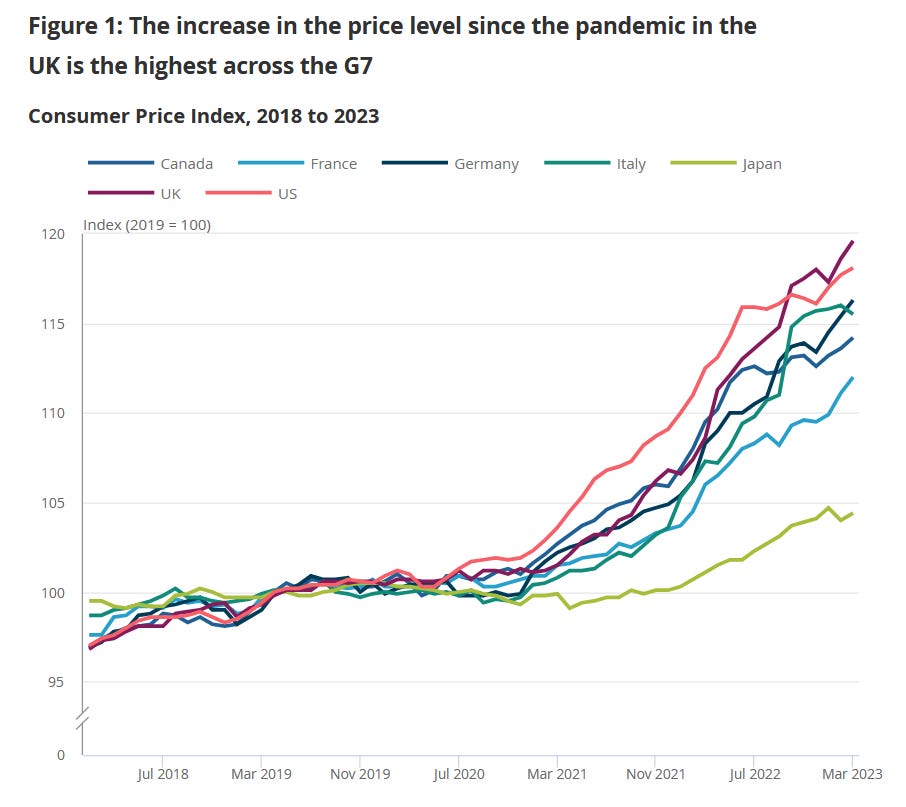
The Bank was slow to notice and react to the inflation spike - its headline inflation measure peaked at the highest level in the G7, and fell from the peak notably more slowly. Since then, it’s failed to get inflation down to its 2% target, rarely even getting it below 2%. Growth has also been lacklustre during this period. The performance is notably worse than in the first 20 years of its operation, a period which included the financial crisis.
This is the context in which we are giving the Bank of England a climate change mandate. First introduced in 2021 by Rishi Sunak, it was briefly revoked by Jeremy Hunt in 2023, before being restored by Rachel Reeves in 2024, in line with the Labour manifesto. Over that period, the Bank has published multiple reports on climate change, and recently set out how ‘it has continued to integrate the implications of climate change into the delivery of its mission, across both its policy work and its own operational resilience.’
But, you say, climate change is very important. So isn’t it reasonable for the Bank to have such a mandate?
The issue is one of locus and impact.
The Bank of England has an extraordinarily high level of impact on monetary policy. There is no other domestic institution with more impact. It is simultaneously the Bank’s principal function, and it is the principal actor.
In contrast, the Bank has a very low level of impact on climate change. And there are many, many more institutions, public and private, which have a great deal more impact.
So even if you believe climate change is more important than monetary policy, every iota of time that the Bank diverts from monetary policy to climate change is a net loss - a shift from a high impact function to a low impact function.2
Giving the Bank a climate change mandate is an example of everythingism, to use the term coined by Joe Hill. As he put it, “Everythingism is the belief that every proposal, project or policy is a means for promoting every national objective, all at the same time,” and
As Joe’s essay sets out, everythingism is endemic - and it’s a major reason why the British State is such an underperformer. From housing policy to procurement, it’s slowing things down, impairing performance and driving up costs.
So let the Bank of England stick to its knitting - and remove the climate change mandate.
Monetary policy is too important for everythingism.
There’s a logic to this in electoral terms. If unemployment goes to 10%, 1 in 10 people are very badly off, while 9 in 10 people are fine.* But if inflation goes to 10%, 10 in 10 people feel the pain every time they go to the supermarket.
*This is an oversimplification; a weak labour market means it will be harder for them to change jobs, they may get lower pay rises and other economic indicators are likely to be dragging. Or they may have friends who’ve lost their jobs. But it’s not as immediately obvious to them they’re losing out.
I can’t help suspecting that, given the excuse, all kinds of people at the Bank, from lowly staff members to the gods of the MPC, would rather spend their time about sexy saving-the-world climate change policies, than the more prosaic issue of whether inflation is 2% or 2.7%.
When Mark Carney was leaving BoE and looking around for another role he landed on environmentalism. To boost his CV he introduced ideas into BoE which got him the job but contributed to the defunding of mining and oil investments causing long term problems for Britain.
The irony as Canadian PM he has been happy to support these.
Underlying issue is regulator is now a career rather than a consolation prize to a sound clubbable man (always a pale male) who had not quite made it to the top but knew the industry and could be trusted to protect the "widows and orphans" without rocking the boat. As last job a certain independence and a gong thrown in.
Yes many issues with the above that can be addressed but far more effective and less harmful than current systems where regulators often do not know their industries and just see it as a stepping stone to something else so embrace whatever is fashionable.
Rot for BoE set in with the tripartite reforms Gordon Brown introduced so no one really knew their job. I recall chair of Lloyds bank at time of GFC saying he had only met the Governor of Bank of England once in passing at the Chelsea Flower show.
Back in 1989 the, then, ex-PM Edward Heath criticised Nigel Lawson's Budget calling him "a one-club golfer stuck in a bunker". Anyone who has played, or even watched golf, knows what he meant, that you need different economic "clubs" for different situations and that trying to use the same "club" for all is doomed to fail. In that case Heath was criticising Lawson's choice to reduce income tax in the previous Budget.
In one sense, the author is quite right. The Bank of England has a remit to stabilise inflation at 2% and their one "club" for this task is variation of short-term interest rates. The problem comes when Governments load additional responsibilities on to the BoE and ask them to control all of them with this single "club". Why they do this is quite obvious, some of the decisions that the Chancellor of the Exchequer needs to make (such as raising income tax, or VAT) makes them unpopular and so they seek to offload the opprobrium on to the unelected BoE Monetary Committee to whom they have given the single "club" of varying interest rates. And they do this, knowing that varying short-term interest rates has a delayed-action effect (e.g. all those on fixed-term mortgages are unaffected until they have to re-mortgage).
A more responsible Chancellor than any we have had, at least since Brown initially gave the BoE this responsibility, would certainly tell the public that they needed a full set of "clubs", including being able to change rates of income tax and VAT. Tying themselves to a commitment not to increase Income Tax, National Insurance, or VAT in their 2024 Election Manifesto was probably the worst decision by the Labour Party under Starmer, as it led directly to Reeves' stealth tax increases which increasingly caused distortions in the economy.