

The Government’s new social media ban is tremendously popular with the public. But amongst the politically engaged class, including a fair number of people I respect, there’s a greater level of scepticism that cuts across sections of both the right and the left.
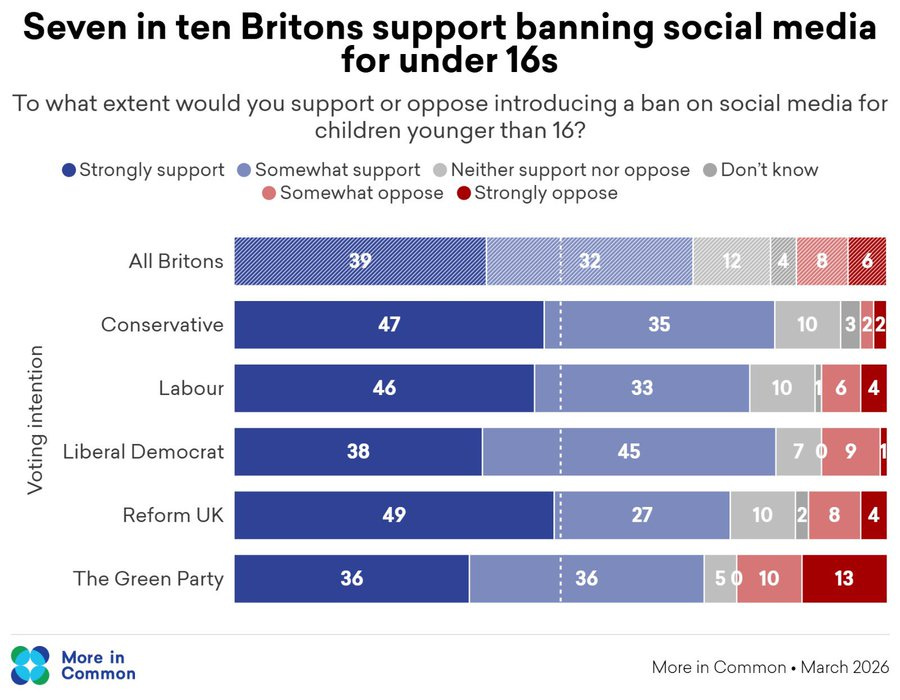
From the right, the concerns largely stem from classic right-wing views including libertarianism, personal choice and the belief that parents, not the state, should make decisions regarding what their children can do. From the left I am a little less sure as to what motivates the opposition, but it appears to be primarily motivated by concerns that it will be ineffective, that it might stop some children accessing good material, or that it distracts from what they see as more important goals, such as tackling misinformation, taking off harmful content, or getting the Government to stop posting on X.
I would like laws to have an impact. I’m also someone who is normally fairly opposed to safetyism and the nanny state, and supportive of parental choice. At the same time I’m not a full-on libertarian: I think some products should be age-gated (tobacco, gambling), regulated even for adults (cars, guns) or outright banned (drink-driving, heroin).
To put my cards on the table, I believe smartphones in general, and social media in particular, have been a deeply harmful societal innovation, at the ‘hey, let’s put lead in petrol’ scale of innovation. Their affects appear to include contributing to declining mental health, collapsing attention spans, bullying and general unhappiness, as well as contributing to broader crises such as falls in literacy, loneliness, fertility collapse and political polarisation. In some cases this is due to direct harms caused by use; in others, it is because the addictive nature crowds out other, healthier activities such as outdoor play or in-person socialising with others. For some of these, we increasingly have causal as well as correlational evidence; for others, it is simply highly indicative, when one looks at the trend lines across very many different countries going south at the same time.1
Smartphones have sufficient other positive uses such that we’re not realistically going to get rid of them - any more than we did cars, despite the deaths they cause. But the case for social media is much weaker: regulation is needed, and a social media ban for under 16s (and a properly enforced phone ban in school) is a good place to start.
So here are responses to twelve of the most common objections to the ban which set out why I think that, even if it’s not a silver bullet, it’s both necessary, and will have a positive impact.
Australia’s experience shows the ban won’t work. 40% of 12-15 year olds in Australia who had had social media accounts were no longer using it. A 40% drop in people doing a harmful thing is a big impact. The proportion not using it will increase in future cohorts as it is easier to persuade people not to start using something than to persuade existing users to stop.
This is about culture change, not legislation. Culture and legislation are mutually reinforcing. ‘It’s illegal’ is a strong signal to parents not to let their children use it - and, for some children, not to use it (or at least not regularly). Previous shifts - drink-driving, smoking - saw culture gradually change after legislation was passed.2
Parents are responsible for their children, not the state. They are, but we already age-gate many products, from alcohol and tobacco to films and video games. Social media has a particularly strong case for state intervention because it’s hard for parents to act alone. If 95% of children are on social media and use it to socialise, keeping your child off has real downsides; if only 50%, or 20% of children are on it, these downsides greatly diminish.
We should be focusing on removing bad material, not banning platforms. There is no way to have ‘harmless’ social media for children in its current form. Yes, some content is very bad, but many of the damaging impacts are caused by the nature of the medium, and repeated exposure to - in themselves - harmless content, not by specifically harmful content.3
Social media causes harms to adults, too. Yes, it does - and we can come to that. But children are more vulnerable, the civil liberty concerns are much smaller when it comes to children, and there is a much higher public consensus for action regarding children - so we should do this now. Many other harmful products where regulation for adults followed began by limiting access for children.
Children will still be able to see this material by other means. No doubt they will - but fewer will, and those that do will see it less often. The availability and frequency matter a lot. In the old days, a 14 year old could sneak his older brother’s top-shelf magazine, or watch an 18 when his parents were out; this is far less harmful than an endless stream of porn or violent content delivered via social media or short-form video.
These sites are useful for study / other purposes. The ban is on social media, not the internet. Many other sites for study and other purposes exist and can be easily found and accessed by those who want to use them for this purpose.
Without social media, children who feel isolated/bullied/have abusive parents won’t be able to find others to support them. Again, we’re banning social media, not the internet. The kids who really need it can find other routes.4 Ultimately, this is a trade-off: overall, social media is a major vector of cyber-bullying and abuse, as well as a source for radicalisation into all sorts of extreme cults - far more kids are being exposed to or being drawn into harms than are using it for escape.
Enforcing this will require IDing every adult. Many sites already carry out age-verification without using ID.5 They do it by face-scans, or by scanning documents which are then deleted after verification. Plus unless you’re very unusual you already give your identity online to your bank, multiple online retailers and dozens of other sites, so let’s get real about the added risk here.
This will reduce the pressure to act against social media in other ways. Possibly - but this is an argument of the form ‘accepting civil partnerships will make gay marriage less likely to happen’ or ‘if we tax cigarettes we won’t get an advertising ban’. Those arguments were wrong - and this one is likely to be too. If the harms caused by social media to adults are as significant as you think they are - and they are - then it won’t prevent further regulation.
The objective of the ban isn’t to stop every under 16 year old from using social media - an unrealistic goal - but to stop most of them using it, and for those of them who are using it to use it less.6 And for both of these numbers to improve, over time, just as was the case with under age smoking or drink-driving.
As an addendum, I’m aware that there are people who think the entire focus on children is a right-wing plot to deflect from wider social media regulation. I set out in (5) why it makes sense to start with children.
But to demonstrate good faith, I’ll say here that yes, I agree that regulation of social media more broadly would be desirable, and give some examples of measures I think would be worth considering.
I am, it is true, deeply sceptical that the answer lies in giving a regulator a duty to (or mandating tech barons to) censor certain materials, not because, as one person said, I ‘can’t tell the difference between pro-ana material and political discussion’ but because I don’t trust the regulator - or tech company - to rapidly move from the first into the second.7 I also believe it is the innate harms of the platforms, rather than the content, which cause the most harm, so these measures focus there.
These are all initial thoughts rather than fully fledged out ideas; they are not intended to be an exclusive or comprehensive list; furthermore, some may not work in practice, or be less useful than they seem as we gain a greater understanding of how social media causes harms. But they are a set of starting suggestions.
Ban continuous scroll. Appears to one of the most addictive features with no downside in banning it.
Require a 20s delay before playing any video. Would make essentially no difference to watching TV episodes or films, but would effectively nuke short-form video.8
Require all platforms to have the default feed as people you follow, in chronological order. Reduces algorithmic effects.
Any platform that uses an algorithm more complex than ‘people you follow in chronological order’ to be treated as a publisher, and held to account for content. As above, but more robustly.
Require users to use real names. Much of the worst content is produced by anons; it would also make it easier to hold people to account for things that are banned in real life, such as libel or incitement to violence.
Require all platforms to provide a suite of user tools. This might include hard blocks, ability to detag yourself or restrict ‘quote tweets’, and community notes.
Plus most of us can feel the negative effects use can have on ourselves, or observe negative effects in others we know.
I'm currently rereading James Herriot. Drink driving laws were passed in the ‘20s and ‘30s, but it is clear no-one then thought anything of drinking 4 pints and driving home. Culture change takes time.
For example, it is not wrong to have a report about a crime; if the algorithm feeds you endless crimes, that can cause problems. It’s not wrong for a beautiful person to post holiday pictures; if the algorithm shows you endless pictures of this, that can cause problems. This applies to mental health, self-image, political polarisation and other aspects of harm.
As they did in the ‘90s.
For example, to use the Direct Messaging function on BlueSky you have to be age-verified, for some reason.
In terms of crowding out other healthy activity the sheer amount of usage is highly important.
In the Jack Dorsey era, neither Facebook nor Twitter covered themselves in glory here. Nor have the police on ‘non-crime hate incidents.’
The spawn of the devil.
Banning social media for kids has pros and cons; I'm on the fence. But banning *YouTube* seems bad. It's more like TV than it is like Instagram, Facebook, X, etc. Schools, and edtech platforms used by schools, often require YouTube for homework and in-class learning. Kids at bad schools or who've missed school rely on it to supplement learning. And lots of kids use it to learn hobbies and extracurricular subjects, like niche languages, arts and crafts, or musical instruments. I guess it's OK if they're just going to ban reading/writing comments on YouTube, i.e. the actual social-media-y aspect of it, and allow watching videos; but everything I've seen (including BBC and gov.uk) just says "YouTube" and/or suggests teens up to 15 will be limited to watching YouTube Kids.
I'm also not convinced by the 8:30pm curfew for 16-17yos (people who might have full-time jobs, or be away at uni, or live with a partner and kids, and who may soon be able to vote).
And I don't like the ID thing: it greatly increases the risk of data breaches / identity theft, and also increases the (actual or perceived) risk of posting politically dissenting material.
I asked Google what pro-ana material was but instead of telling me it told me help was available, so I'm guessing it's something pretty bad! (Searching 'pro-ana meaning' allowed me to discover it's pro-anorexia material. Yeah, that sounds like something we could do without.)