

The results of the 2025 Forecasting Contest are out!
This year there were a record 374 valid entries. Of these:
238 (64%) did better than would be expected by random chance.
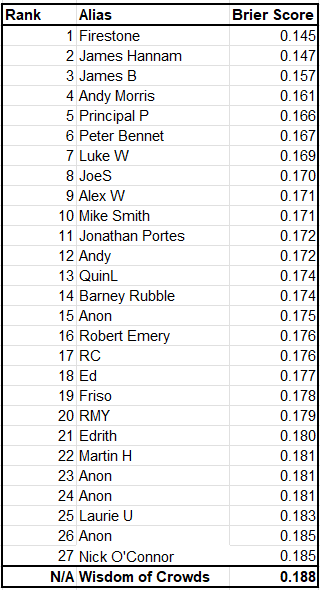
27 (7%) did better than the wisdom of crowds.1
We’ll look below at the overall results, at some of the detailed breakdowns by sex and profession, and at how my own forecasting went this year. The full results for everyone who did better than random chance are also included at the end of the post.
But first, a massive congratulations to this year’s winner, ‘Firestone’, real name Christopher Flint, a former missionary and first class physics graduate from Oxford, who currently works as an Operations Manager at Transport for London.
Chris not only decisively beat the wisdom of crowds, he outdid more than 100 entrants who work in public policy / politics / journalism / similar fields for a living. Given he also beat the wisdom of crowds in 2024 and 2023, coming 6th in both previous years,2 that would suggest his forecasting success is no fluke!
Next year’s contest will open this Sunday 4th January and be open for two weeks.
To be notified when it opens, subscribe here (free).
I’d encourage everyone who took part this year to have another go, regardless of how well you did, suggest that everyone else to give it a shot - and would ask all to share widely once out, to get the pool of entries as big as possible!
How did each question resolve?
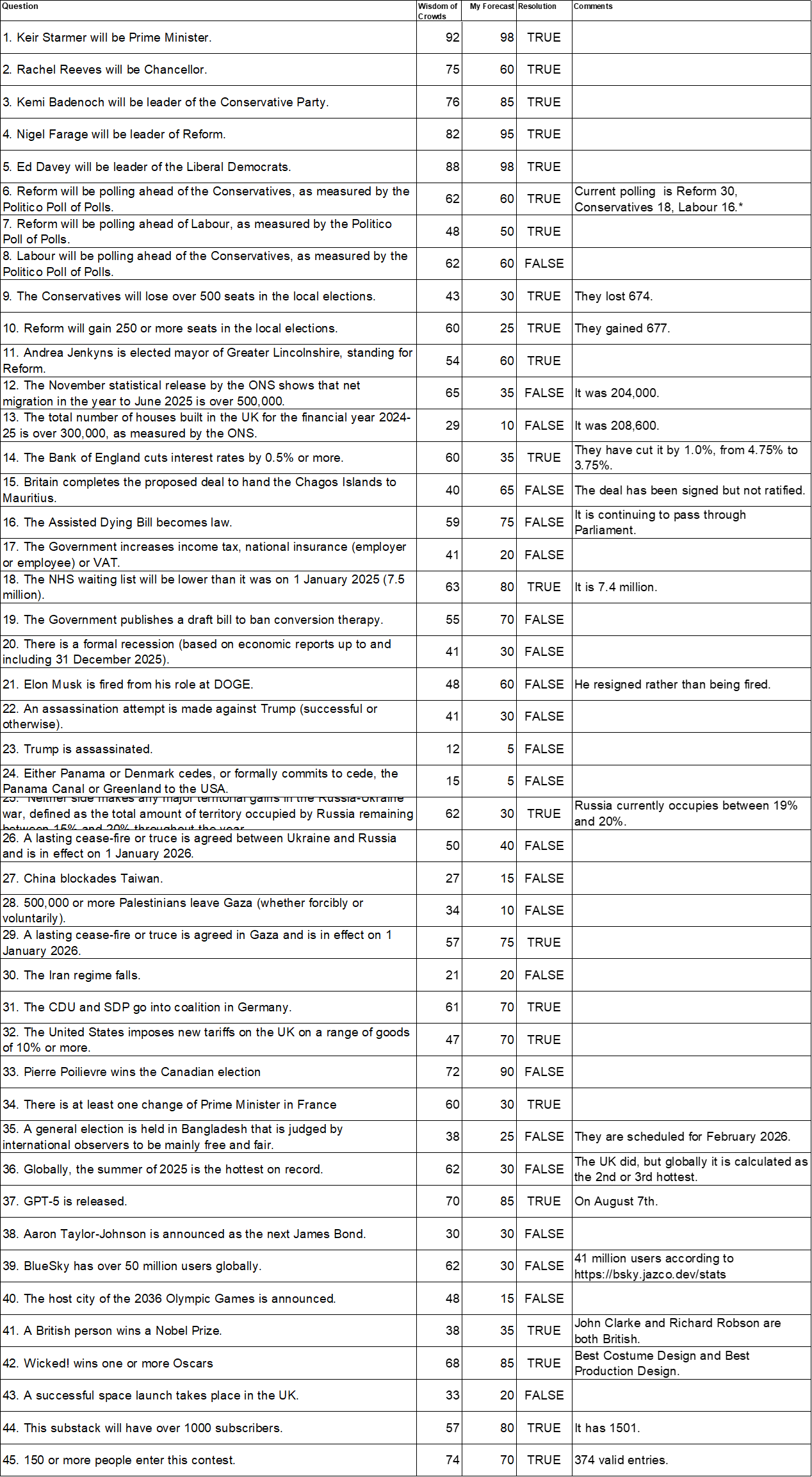
*The Politico Poll of Polls has done some odd things a couple of times this year and is only up to date as of 17 December. It’s the one I said we’d go by, so we’re going by it; however, for what it’s worth, I think the averages on electionmaps.uk are closer to what the polls actually say - fortunately, it doesn’t make any difference to how these three questions resolve.
Overall, the results this year were considerably better than last year: the wisdom of crowds was better by 0.27 and the winning score beat last year’s by 0.32. A smaller percentage of entries (7% vs 13%) beat the wisdom of crowds: the higher number of entrants should make it more accurate, and it appears it has.3
The question that, on average, people did worst on (as measured by total average contribution to final Brier score) was Q33, on the Canadian election, followed by Q12 on immigration numbers and Q16 on the Assisted Dying Bill. The question that, on average, people did best on was Q5, Ed Davey remaining as Lib Dem leader, followed by Q1, Keir Starmer remaining as Prime Minister and Q23, Trump not being assassinated.
The overall mean Brier score was 0.242; the median was 0.235.
29% of people said they worked in ‘politics, public policy, media or current affairs (broadly defined)’. These people had a slightly better mean Brier score (0.237, vs 0.244 for those who didn’t) but interestingly were under-represented in the top 27 who beat the wisdom of crowds, making up only 6, or 22%, of that number. First, second and third place were taken by people who didn’t work in these fields.
82% of entries were male and 16% female, with 2% preferring not to say. Men had only a slightly higher mean Brier score (0.240 vs 0.252 for women) but dominated those who beat the wisdom of crowds, making up 26 out of the top 27. The highest scoring woman came 17th and the second highest 33rd.4 The lowest 13 scores, however, were also all men.
Reader Chris last year asked Deepseek’s AI model Perplexity to answer the questions, first explaining to it in some detail how to make good predictions and how Brier scoring was (you can read his prompts, and the AI’s predictions and reasoning, here). It got a score of 0.222, which would have put it 136th: better than the median human, but still a long way off the top performers!
How about my own forecasting?
I felt my own forecasting was worse than usual this year, and was relieved I managed to scrape in above the wisdom of crowds in 21st place, with a score of 0.180.5 I’m pleased to have beaten the wisdom of crowds three years in a row, but definitely feel I could have done better.
In particular, I did poorly on the local elections, underestimating the level of swing.6 I also underestimated just how inexplicably long it would take this Government - despite its massive majority - to get legislation through Parliament, which lost me points on three questions. I also made a silly error on interest rates, where I’m really not sure what I was thinking at the time.
More positively, I got the set of domestic policy focused questions (on immigration, NHS waiting lists and house building right) and was suitably cautious about predicting who would be where in the polls, in a year of massive fluctuation. I did well on the international section, including correctly calling that there would be a cease-fire in Gaza but not in Ukraine, although, like many people, I called the Canadian election incorrectly.7
Overall, not bad, could have been better, and in particular I’m going to work harder on the local elections section next year.
The Full Results
I’m publishing here the full rankings of everyone who did better than chance, using the names or pseudonyms they indicated they would be happy to see appear on the internet. If you don’t see your alias here, then sadly, this year you did not do better than chance8 - though I hope you still had fun and will enter again in 2026!
1. Firestone: 0.145
2. James Hannam: 0.147
3. James B: 0.157
4. Andy Morris: 0.161
5. Principal P: 0.166
6. Peter Bennet: 0.167
7. Luke W: 0.169
8. JoeS: 0.170
9. Alex W: 0.171
10. Mike Smith: 0.171
11. Jonathan Portes: 0.172
12. Andy : 0.172
13. QuinL: 0.174
14. Barney Rubble: 0.174
15. Anon: 0.175
16. Robert Emery: 0.176
17. RC: 0.176
18. Ed: 0.177
19. Friso: 0.178
20. RMY: 0.179
21. Edrith: 0.180
22. Martin H: 0.181
23. Anon: 0.181
24. Anon: 0.181
25. Laurie U: 0.183
26. Anon: 0.185
27. Nick O’Connor: 0.185
[Wisdom of Crowds: 0.1878]
28. Eric Rees: 0.188
29. Anon: 0.188
30. Noble: 0.189
31. Westmorland 9: 0.189
32. JGWHerts: 0.189
33. Venetia: 0.189
34. Richard Vadon: 0.189
35. Will Bickford Smith: 0.190
36. Anon: 0.191
37. JO’L: 0.192
38. Andrew B: 0.192
39. Andy Hewitt: 0.193
40. rogerthomasyork: 0.193
41. Claretta: 0.194
42. MIchael Cluff: 0.194
43. Anon: 0.195
44. Rory: 0.195
45. Johnny Rich: 0.196
46. Anon: 0.197
47. Satis: 0.197
48. dodiscimus: 0.197
49. Anon: 0.197
50. Paul Jenkins: 0.198
51. HeatherS : 0.198
52. euanjs: 0.198
53. Mark Cannon: 0.198
54. Richard Arnold: 0.200
55. Bruce G: 0.200
56. Anon: 0.200
57. Alistair B: 0.200
58. MadDad38: 0.201
59. antifrank: 0.202
60. Anon: 0.202
61. Lesley Boorman: 0.202
62. Edward R: 0.203
63. Jake B: 0.203
64. Anon: 0.203
65. Shahid: 0.203
66. rb: 0.204
67. Anon: 0.204
68. Katie T: 0.204
69. Alan Williams: 0.204
70. Matt T: 0.204
71. TangerineSushi : 0.205
72. Wattsgoingon: 0.205
73. GBRChrisA: 0.205
74. alric8: 0.205
75. Anon: 0.206
76. Anon: 0.206
77. Anon: 0.206
78. Anon: 0.207
79. Oscar Bicket: 0.207
80. DrPauli: 0.207
81. Jo Pellereau : 0.207
82. Anon: 0.208
83. Coco: 0.208
84. PaulGG: 0.208
85. PV2005: 0.208
86. Anon: 0.209
87. Henry: 0.210
88. Rajasaur: 0.210
89. Ryan Turner: 0.210
90. Nick: 0.210
91. Anon: 0.210
92. Anon: 0.211
93. Daniel Cremin : 0.211
94. Paul Kearney: 0.211
95. Phil Newton: 0.211
96. Whazell: 0.211
97. Max Rothbarth: 0.211
98. Sam M : 0.213
99. Diaboth: 0.213
100. Robbo S: 0.213
101. Pooch: 0.213
102. Will McLean: 0.213
103. Ben R: 0.214
104. Anon: 0.214
105. Reabank: 0.214
106. John Purvis: 0.214
107. Gommo: 0.214
108. MusterTheSquirrels: 0.214
109. Tino: 0.215
110. Shoeshine: 0.215
111. JPod: 0.215
112. Anon: 0.215
113. Hugo Gye: 0.215
114. Mike Sharp: 0.215
115. Neil R: 0.215
116. Andrew Brook: 0.216
117. Sam R: 0.216
118. A Metcalfe: 0.216
119. Simon Pearce: 0.216
120. Alex Baynham: 0.216
121. Sean S C: 0.217
122. Anon: 0.217
123. Mahoney: 0.217
124. DParks: 0.218
125. NMacck: 0.218
126. Sue Julians: 0.219
127. Nick L: 0.219
128. Alistair MacDonald: 0.219
129. Alice W: 0.219
130. Andrew P Smith: 0.219
131. Anon: 0.220
132. Anon: 0.220
133. Anon: 0.220
134. CleptoMarcus: 0.221
135. Alan Stokes: 0.221
136. RolandW: 0.222
137. Moo: 0.222
138. Anon: 0.223
139. Nic: 0.223
140. literally_Chad: 0.223
141. Ollie RT: 0.224
142. OscarDaBosca : 0.225
143. David: 0.225
144. Bollieboy: 0.225
145. atreic : 0.225
146. Shiv5468: 0.225
147. The Absent Minded Professor: 0.226
148. Cannygeezer: 0.226
149. Daniel: 0.226
150. Timothy Lamb: 0.226
151. Rob C: 0.227
152. Brian: 0.227
153. AlexCM: 0.227
154. RV81: 0.227
155. Aldridge: 0.227
156. Anon: 0.227
157. Josh: 0.227
158. Anon: 0.228
159. Steve Broach: 0.228
160. 0UR0-13: 0.228
161. Anon: 0.229
162. Anon: 0.229
163. Greenfield Gibbons: 0.229
164. wisewizard: 0.229
165. markyboy: 0.229
166. Fcfmc: 0.229
167. ServiceKid74: 0.231
168. Adele Barnett-Ward: 0.231
169. Saddler: 0.231
170. Anon: 0.231
171. Em: 0.231
172. SpongeBrainBob1: 0.232
173. Anon: 0.232
174. Nick Hart: 0.232
175. alan chaplin: 0.232
176. deeharvey: 0.233
177. Ben V: 0.233
178. Ofjmx on Twitter: 0.233
179. Josh: 0.234
180. Joseph: 0.234
181. Matt: 0.234
182. Pmr : 0.234
183. Ian holmes : 0.234
184. BenA : 0.235
185. Jenna Cunningham: 0.235
186. Stephen: 0.235
187. Anon: 0.235
188. Rachel M: 0.235
189. Arj Singh: 0.235
190. RudyH: 0.235
191. Gasman: 0.236
192. Gatehouse123: 0.236
193. John Adams: 0.236
194. Matt N: 0.236
195. Boaly66: 0.237
196. Anon: 0.237
197. Clearlier: 0.238
198. Michael Barge: 0.239
199. Abhishek S: 0.239
200. Mr: 0.239
201. lord satan: 0.239
202. Anon: 0.240
203. Laura Spence: 0.240
204. From the Right Side: 0.240
205. Anon: 0.240
206. JutC.Predict: 0.241
207. siphuncle: 0.241
208. Anon: 0.241
209. MirandaJ: 0.241
210. Sandy Fyfe : 0.242
211. Dan S R: 0.242
212. Hugh Jones: 0.242
213. Phil C: 0.242
214. Ben P: 0.242
215. Steve Rowse: 0.243
216. wallaceme: 0.243
217. Anon: 0.243
218. Zoe Jardiniere: 0.243
219. Andrew21: 0.244
220. Tora Bora: 0.244
221. Anon: 0.244
222. Anon: 0.244
223. Anon: 0.244
224. A Garrido: 0.245
225. Niko: 0.245
226. Anon: 0.245
227. Gannister : 0.246
228. Rachael: 0.246
229. Anon: 0.247
230. Anon: 0.247
231. Anouschka Rajah: 0.247
232. derry: 0.248
233. Majician2000: 0.248
234. Austin platt: 0.249
235. Anon: 0.249
236. Pete Ford: 0.249
237. Rhiannon : 0.250
238. 2029d: 0.250
[+136 other entries]
Appendix: Brier Scores and the Wisdom of Crowds
So what’s a Brier score then, anyway?
A Brier score is a way of scoring predictions that rewards both getting the prediction right and being accurate about how confident you were about that prediction. It has the advantage that it is hard to game: if you genuinely think the probability of something happening is 80%, you should guess 80%.
The Brier score is calculated as the average mean square error across all the questions. For example, if you predicted something had an 80% chance of happening, if it does happen your score for that question will be 0.04 (i.e. (1 - 0.8)2) and if it doesn’t happen your score will be 0.64 (i.e. 0.82). The score for every question is added up and then divided by the number of questions, giving a score between 0 and 1, where lower scores are better. You can therefore improve your Brier score both by getting more things right and by being more realistic (’better correlated’) about how likely you are to be right, because you accrue a better score by getting something you were only weakly confident about wrong, than by getting something you were very confident about wrong.
Putting 50% for a probability guarantees a score for that question of 0.25. In this prediction contest I therefore awarded 0.25 for any question that participants skipped, as this was equivalent to them saying they thought it was as likely as not to happen. Someone could ensure they got no higher than 0.25 overall by putting 50% for every question; in theory, therefore, if people are correct about their confidence levels, no-one should get a higher Brier score than 0.25 - though in practice, that’s not the case.
I find Brier scores slightly counter-intuitive, so below are set out some hypothetical scenarios and the associated scores:

What about the Wisdom of Crowds?
There’s a theory which says that if you average predictions, the average will be better than most individual sets of predictions. Different people have different information; positive and negative random errors cancel out, and so on. The Wisdom of Crowds score is found by taking the mean of everyone’s forecast for each question and then scoring those means as if they were an entry in its own right.
When we look at the Wisdom of Crowds score, it had a Brier score of 0.188 - or better than 93% of contestants! Which is pretty good! It means that in most cases you are much better off trusting the average than any single individual (including many people who are specialists in the field). On the other hand, there are a few people who did significantly better - including some people who’ve done so multiple years runnning - which also shows it is very much possible to do better in predicting things than just averaging our guesses. It is, however, something which does not automatically come with domain knowledge (though it can be helped by it), but rather is its own skill.
There is the usual detailed section on Brier Scoring and the Wisdom of Crowds in an appendix at the end of this piece.
Albeit in a smaller field.
Though one can never tell; maybe the questions were easier.
Any women who are unhappy about this, you know what to do: encourage your female friends to enter next year to defend the honour of your sex!
Though was one place ahead of last year’s winner!
And placing too high a consideration on the fact that some elections were postponed, meaning that fewer seats were being contested.
Though even with hindsight, think my 90% prediction was reasonable at the time - 1 in 10 chances do happen.
Or potentially you have forgotten the alias under which you entered!
Thank you.
I think the AI entry did 0.298 so humans win :-) Might try it again this year
who would be wear in the polls - should be where.
sadly, this [year] you did not do better than chance
I would be fascinated to know whether the geometric mean wisdom of the crowds outperformed the arithmetic mean this year (and also previous years).