

Every civil servant worth his salt believes that he could, at any time, move to the private sector and earn 50% more money. It’s only the love of public service1 that’s keeping them where they are.
Back in 2016, as a recently minted Senior Civil Servant,2 I certainly believed this. And, what is more, I had evidence for this belief:
Lots of data showed that, comparing like-for-like, people in the private sector earned more, particularly at senior levels.
Peers of mine who had gone into the private sector, and seemed to have progresses as far in their careers as I had, were typically earning 25% - 200% more than I was.
Over previous years I’d seen a number of former colleagues, who seemed to be about as capable as I was, move into lucrative and desirable private sector roles.
So when I decided to leave the civil service, I assumed that finding a new berth would be a doddle.
Over the next 15 months, I applied to around 40 roles, in a variety of types of organisations, getting rejected for each one of them.3 For 6-8, I got through to the interview stage, which involved its own travails - travel, preparation and so on4 - only to ultimately be rejected. As one might imagine, this was not just gruelling in terms of time, but dispiriting, particularly as the process went on, and on, with no end in sight.5
To my relief, after 15 months, I did succeed in getting offered a job: a good one, paying about 25% more than my current salary, with private health insurance6 and involving regular international business-class travel to exotic locations. I duly handed in my notice and departed.
Of course, to my former colleagues - most of whom had not even been aware I’d been searching - I simply joined the ranks of those who had swanned off from the civil service into a higher paying job outside.
It’s well known that social media presents a false view of the world. People naturally post their best moments: holidays, triumphs, pictures of happy times with friends and families.7 Scrolling through your feed, it is all too easy to wonder why everyone else’s life seems to be better than yours.
In the same way, when one looks at other’s lives, it is easy to see what they’ve achieved. It is far less easy to see the failures and knock-backs on the path that took them there - and to assume that one’s own setbacks mean more than they do.
We all know the famous cases. J.K. Rowling’s rejection by 12 publishers before finding one that would publish Harry Potter. Edison’s multiple failed patents. Andy Burnham’s two unsuccessful runs at becoming Labour leader, before landing the top job. But the truth is that almost anyone you see, at almost any stage in their career, will have only got there by overcoming repeated rejections.
There are, of course, lucky breaks - such as when I got the first overseas job I applied to,8 or when the Minister I’d been closest to as a civil servant got appointed to Boris’s government, and needed a SpAd - giving me my ‘break in’ to the political world. But leaving the civil service was hardly the only time success came after a stream of rejections. Whether applying for internships in university holidays, or moving up the greasy pole, success shows its face to the world, but failure is invisible.
Outside career, the pattern continues. We all celebrate when a friend has a baby - but few will know of the miscarriages and silent grief that may have gone before. If you’re a guy, another time you’ll likely face repeated rejection is in dating.9 Just as with applying for jobs, repeated rejections are no fun. I did online dating in that short, happy time after it stopped being weird and before it became mandatory, and was ultimately fortunate enough to meet my lovely wife of 13 years on it.10 But before that I sent hundreds of messages, went on dozens of dates and even a few second dates, all of which went nowhere, save to provide me with a handful of anecdotes.11
And of course, repeated attempts don’t guarantee success. Some people never do get that promotion / dream job / partner. Before I decided being an MP wasn’t for me, I’d never even managed to get selected for a seat, and while one could argue that I never gave it my all,12 there are many others who did, still without success.13
Nevertheless, the motivational poster is true: you miss 100% of the shots you don’t take.14 And while some people have it easier - whether by talent, luck, hard work or connections - very few get to where they want to be in life without exposing themselves to regular, repeated rejection.15
I’ve known too many people who have allowed themselves to be paralysed by the fear of rejection. A brilliant musician in university who wouldn’t go for any (amateur) orchestra which held auditions; a highly talented colleague who wouldn’t put themselves forward for an accelerated promotion scheme, in case they were rejected from it. Too many people give up after one or two rejections, thinking it shows that ‘they’re not ready for that’ - not realising that those who do get there may not have had two rejections, but twenty.
None of which is to say repeated rejection is easy. Whether in dating or career, the repeated blows to your ego can be hard to endure. Even worse, for some16, may be the growing fear, after months or years of knock-backs, that there is no light at the end of the tunnel.17
Different people have different ways of dealing with it. Some people love motivational posters, or sharing confidence-boosting memes on social media - and receiving affirming comments from their friends. For others it may be the support of family, or close friends, who they can confide in, that helps them; for others, it may be a lucky item, a routine, a work-out or ritual that they go through to get back on the horse. Whatever works for you, perhaps most important is to steel yourself for the fact that rejection will happen - and not once, but again, and again, and again - and accepting that when it does, it is not failure,18 but simply part of the pathway to success.
There are a lot of things that play a part in success in life. Hard work, intelligence, grit, social skills, good judgement and more - not to mention luck and advantages of birth. But a willingness to accept rejection is as important as any of them - for without it, even the best combination of talents is unlikely to get you where you want to be.
Or perhaps, for the slightly more aware, a passion for the job.
I.e. a deputy director, the lowest rung of the Senior Civil Service. In terms of the ability to wield PHENOMENAL COSMIC POWER it is not very senior at all; in terms of the raw numbers, it puts you in the top 1-2% of the total workforce, so the name is not unreasonable.
As it was a move of choice, I was being reasonably selective. Had I been made redundant, I would have applied for this many jobs over the course of a couple of months, and might well have been able to get one sooner - albeit at the cost of some combination of enjoyment, salary or location.
In one case, an administrative role at the University of Oxford, a frankly insane day of 6 different interviews - and that was only the first interview stage!
If any of my former team are reading this, I owe them an apology, as one way in which I dealt with this was by driving both them - and myself - harder than I really should have done.
Which I did not take up.
There is nothing malicious about this - most people are much more comfortable sharing their joy with the world and keeping their sorrows and struggles to themselves, or those they are closest to.
This ended up with me having to say that I couldn’t actually make the start date, as it was a week before our wedding - I had assumed I was so unlikely to get the first one I applied for that it would just be good practice! Fortunately the existing postholder was happy to stay for an extra month.
This is not intended to be an entry into the discourse of ‘Who has it worse?’ when it comes to male and female dating. What is indisputably true is that men and women have it differently, and that one element of this is that men - in real life and on dating apps - are currently expected to make the first move, with a man who doesn’t do this severely narrowing his options. That has certain consequences, both good and bad, and one of the bad elements is more rejection.
eHarmony for the win!
If you know me in real life you will have likely heard the tale of Guinea Pig Girl.
With hindsight, that internal conflict of whether I really wanted this was visible earlier on.
I knew one guy, a former headteacher, on paper a great Conservative candidate, who’d come second in candidate selections four or five times - but never first.
This is also true of asking for pay rises: there is strong, consistent and unsurprising evidence that shows that people who ask for more pay rises get paid more. Despite knowing that fact, I consistently suck at actually doing this, demonstrating that all of this sort of advice is a lot easier to know intellectually than to act on.
Unless they are Wally:
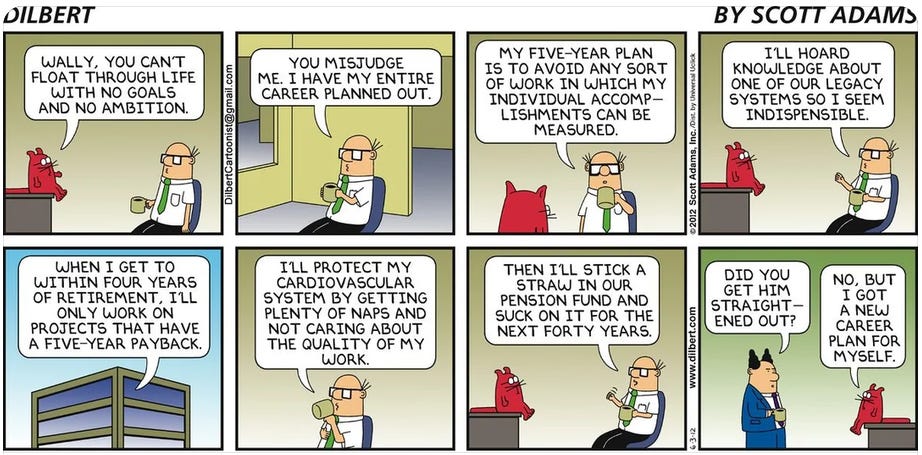
By which I mean ‘me’.
While this is a post about bracing oneself for the inevitability of rejection, it is worth saying that if you keep being rejected for something, it may be useful to examine whether there is a reason for it: are you doing something wrong? Could you do something that would improve your chances?
That’s a sensible exercise. But it’s a mistake to think that Job’s Comforters are always right: sometimes it’s really not about what you’re doing. Particularly in today’s world of mass-AI-and-online-enabled-applications, or dating apps, sometimes it really is just a numbers game, and the only way to success is over a mountain of rejections.
Even though it actually is.
Another realm of frequent rejection is scientific publishing. When at Penn as a postdoc I had a peer who had the maxim "rejection is the norm" and tried to normalise talking about the papers rejected as well as those accepted to the extent that he and some of the PhD students he worked with would post on social media when their papers were rejected to make it clear to others that it is the default. It can be very off-putting to new researchers who've slogged for years to have a string of rejections, unless you realise that tweaking, reformatting, resubmitting is absolutely the norm.
excellent. i think civil servants both have this feeling of being underpaid while also a sneaking fear they don't have transferable skills. i also suspect that people rarely take into account the pension - was your job actually a pay rise when taking that into account? I suspect it's really only the very top grades in the CS that are seriously underpaid as most others have been badly affected by grade inflation too