

Those fortunate enough not to be heavy users of social media may be blissfully unaware of the row that has erupted this week over the future of Britain's banknotes.
Following a consultation, the Bank of England announced that the practice of featuring renowned individuals was to cease, to be replaced with animals and nature scenes. Amongst the reasons for the decision they gave were that it ‘is not divisive: The theme should not involve imagery that would reasonably be offensive to, or exclude, any groups.’
This was met with an outpouring of criticism over Churchill being replaced by a badger,1 erasing Britain's history, and so forth, and a counterwave of others criticising those in the first camp for click bait and working themselves up over nothing. Kemi Badenoch, Nigel Farage and Ed Davey have all weighed in to criticise the Bank's decisions and even a few Labour MPs have, when asked, admitted that it might be nice to remember Churchill's role in defeating fascism.2
A few preliminaries. Firstly, yes, the sky will not fall in from this decision. Yes, bank notes only began featuring figures (other than the Queen) in 1970. Yes, the banknotes are updated every 10-20 years for anti-counterfeiting reasons so any current figure should be thought of as temporary, including Churchill.
Secondly, the Bank’s decision is not woke - a bit naff, perhaps, but not woke. They are not replacing the figures with lesbian trade unionists, or with Tipu Sultan and others who fought against the Empire. Badgers are not woke. The British countryside is not woke.3 Some of us are old enough to remember the Conservative Party Conference in which Boris Johnson bellowed ‘Build Back Beaver’ to the resounding cheers of the faithful.
But nevertheless it matters, both in itself, and as a symptom of a wider malaise.
As Ed West has written, “Banknotes are a little window into a country’s soul, and instructive…and that is precisely why states with weak or fractured identities tend to feature animals and natural objects.” He goes on to say, “It’s not the most important thing in the world, but bank notes do signify a great deal about a country’s prospects. Nature-currency is a bear signal, because if the ethnic groups comprising a state cannot unify around shared historical figures it’s an indicator that they won’t easily co-operate in the country’s political system.”
Indeed, the Bank itself has spoken repeatedly of the importance of the figures on its banknotes, as when its Chief Cashier said, “Banknotes are more than just an important means of payment — they serve as a symbolic representation of our collective national identity and an opportunity to celebrate the UK.” And those who campaigned in 2013 for a woman to be represented on a bank note, or in 2018 for an ethnic minority figure to be represented, certainly thought it mattered.
The Bank’s decision may not have been woke, but it was timorous at a time when we require leadership. By using the public consultation as an excuse to retreat to nature designs, it sought to avoid a public row over any particular choice - a decision which, on that criteria alone, has clearly backfired.4
Cohesive, confident societies do not simply arise - they must be built. And in a nation such as Britain’s today - multi-ethnic, multi-faith, with high levels of inward migration, growing ethnic tensions and low economic growth - an active approach to integration and cohesion is more important than ever. Contrary to the beliefs of some liberals, a set of deracinated values that could belong to anywhere is not enough to anchor that integration: it must be rooted in specific history, specific people, specific landmarks, heritage, places, sports teams and culture, an attachment to which binds and unites.5
I myself would not have signed the petition to put an ethnic minority person on a banknote. This is because while Britain has many ethnic minority people in its history who did inspiring things6, who deserve to be honoured with statues and blue plaques, it has - due to the relative recency of mass demographic change - none who stand in the first rank of national significance that marks others on our bank notes - though I have no doubt it will do in time. They are, to use my terminology, ‘Heroes’ rather than ‘Giants’ - and thus placing them on a bank note would be, and would be clearly seen to be, tokenistic.7
(I would note that this is not the case for women (Austen, Nightingale, Franklin, Pankhurst…), gay people (Turing, Wilde…) or disabled people (Nelson, Hawking…) where multiple individuals who are very clearly of that first rank of significance exist).
But while it would not be my first choice, nor would it distress me to see Khan, Equiano or Seacole appear on a banknote - and if that were part of securing broad-based support, alongside other, clearly deserving figures, then so be it. Sunder Katwala, who writes from the left on patriotism and cohesion, has suggested adding one ethnic minority figure, keeping Churchill, and then having two others. He understands that symbols matter - and while I may not agree with him fully on this, if push came to shove, I would stand shoulder to shoulder with him against a legion of badger apologists.
Rather than timidly retreating from the fray, the Bank should have found the courage to identify four figures which, together, could symbolise and celebrate our nation. Perhaps that would have meant facing down those campaigning for an ethnic minority figure, by finding an alternative impeccable candidate, as they did in 2019 with Turing - or perhaps it would have meant facing down sceptical voices on the right, and including one. Either way, Britain’s history is rich enought hat it would not have been beyond the wit of man to find a combination that could command broad-based public support - and to make that case to the nation.8
As our society fractures, public authorities must find the courage to lead. Bank notes may not be the be-all and end-all of national identity, but they play their part - and they are the only part for which the Bank of England is responsible. Only a nation that is confident in celebrating itself, its history and its heritage, that is patriotic, proud and inclusive, can hope to maintain its cohesion in these times. And if our public bodies and civic institutions will not take the field, they simply leave it open to the far-right ethno-nationalists, sectarian Islamists, and others who would rip our society to shreds.
To end on a lighter note, there is, of course, a solution.9 Just as the polar vessel RRS David Attenborough used the publicly voted name ‘Boaty McBoatface’ for its autonomous underwater vessel, so the Bank could acknowledge the public’s love of nature by combining both nature AND famous people, by filling the borders with woodland animals peeking through foliage, like the marginalia in Mediaeval manuscripts.
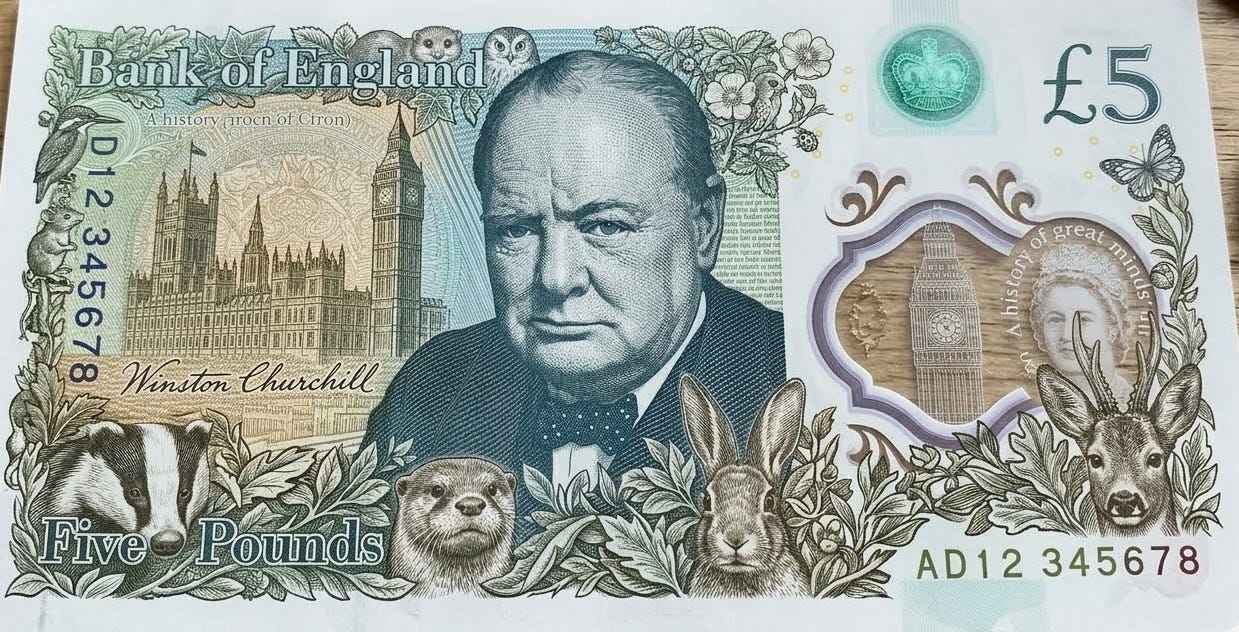
Or, for those who prefer the work of the great Quentin Blake, perhaps this, too, might find a spot on a banknote, at some point in the future:
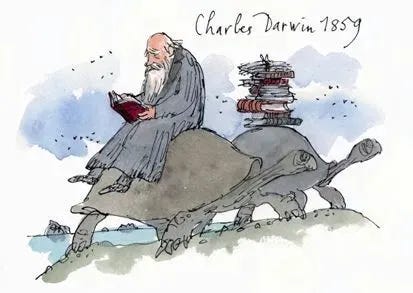
Otter, beaver, adder…
There has also been a smaller number of criticisms from the left, arguing that the Bank has made the decision to avoid having to think about diversity, and specifically to duck the decision over whether to put an ethnic minority Briton on it.
Once again proving that wolves are never quite the solution that George Monbiot thinks they will be.
Not every person will care about every item in that list - some people care nothing for sport, others nothing for monuments. And precisely which people, which events and how heritage is expressed can evolve, as it always has. But it must be specific, and specifically British - not simply abstract values such as ‘democracy’ or ‘tolerance’, good as those things are. And no, ‘badgers’ or ‘squirrels’ are not specific enough here.
The 2018 campaign suggested individuals such as Noor Inayat Khan, Olaudah Equiano, Mary Seacole or Samuel Coleridge-Taylor. While all lived far more inspiring lives than me, or I suspect most of you, dear readers, none had a national or global impact in any way similar to the current or former figures on our bank notes. Khan, for example, was an incredibly brave woman, but so were many others in the Second World War; Turing, in contrast, was both instrumental to an absolutely critical element of the war (Bletchley Park) and a global pioneer in the field. It is no disrespect to one to say that these are not comparable.
Do I think that the fact that Turing was gay was a factor in him getting picked? Undoubtedly yes. Is it also the case that, regardless of his sexuality, he is indisputably worthy of such a place? Also undoubtedly yes.
Once again, the Bank did precisely this with Turing, with great success.
No, not wolves.
I think the issue they’ve run into is there just aren’t enough denominations to divvy up the monumental allocation between the identity groups with sufficient granularity. Bears comparison with the London Overground renaming where they’ve done one for black people (windrush), one for gay people (mildmay), two for women, one for immigrant communities generally, etc etc. The whole exercise seems rather silly and transactional but I think it’s obviously what liberal institutions are comfortable with at the moment. Any attempt at unifying is suspect.
Or the squirrels could go on the back.
RBS banknotes...
https://www.natwestgroup.com/heritage/subjects/banknotes/current-issue-banknotes.html