

At the end of this month, over a million parents in England will be submitting their choices for their children’s secondary schools. For many of them, it will be a decision they have been thinking about for years - in some cases moving house, attending a church they don’t believe in or putting aside money for school fees to get their children into the school they believe will be best for them.
But what makes a good secondary school? What’s important - and what is meaningless fluff?
This guide is a systematic breakdown of the quantitative and qualitative factors that are worth considering in choosing a secondary school.1 We’ll look at metrics such as Progress 8 and Attainment 8 and what they really mean, as well as what to look at in Ofsted results. And at the end we’ll briefly consider three of the big ‘category’ choices - private schools, grammar schools and single-sex schools - while recognising that these are not feasible options for all or most parents. In doing this, we’ll be making extensive use of the Government’s ‘Compare School and College Performance’ site - which not only contains a wealth of data, but also links to other useful information sites.2
As this is often a blog about education policy, I want to clarify that this piece is explicitly not about policy, but about making good choices as parents. For example, we might think the Government should not penalise a school for having a challenging intake - but as a parent, you might absolutely wish to take this into account. Similarly, when I discuss grammar schools or private schools, this is without prejudice as to whether or not they should exist, whether they should be taxed, and so on.
What the right choice is will be different for different families - but some choices are better than others, and knowing how to make the best use of the information available can help you make the choice for you, whatever it is you value.
Meta-Issues
Know what you want. Every child is different. By the time you’re choosing a secondary school you’ll have a good sense whether you most need a school that will stretch the brightest - or one that supports the less able.3 Are sports - or music - something which you value as fun, or something you want the school to enable at a very high level of capability? Does your child have a disability? No school is perfect, and it’s good to be clear on what factors you care most about.
Know what you are prepared to do. Are you willing to move? Within your town? Within your county? Between counties? Are you able - or willing - to pay school fees? To prep a child for an entrance exam? To attend a church to gain access to a faith school? There are no right answers here - but the more you are willing or able to do, the greater your choices are.
Quantitative factors
Within this section, factors are presented in rough order of descending importance.
Progress 8. Progress 8 is the single best measure of how ‘good’ a school is, academically. It measures the average progress made by each child between entry and GCSE, taking into account the prior attainment of those children on entry, and considering 8 GCSEs.4 Because Progress 8 takes into account almost all children in the school, it is more resistant than most measures to ‘gaming’ (eg focusing on children at a ‘pass’ boundary, as the old % gaining five GCSEs at A*-C did), taking into account the performance of children throughout the ability spectrum.
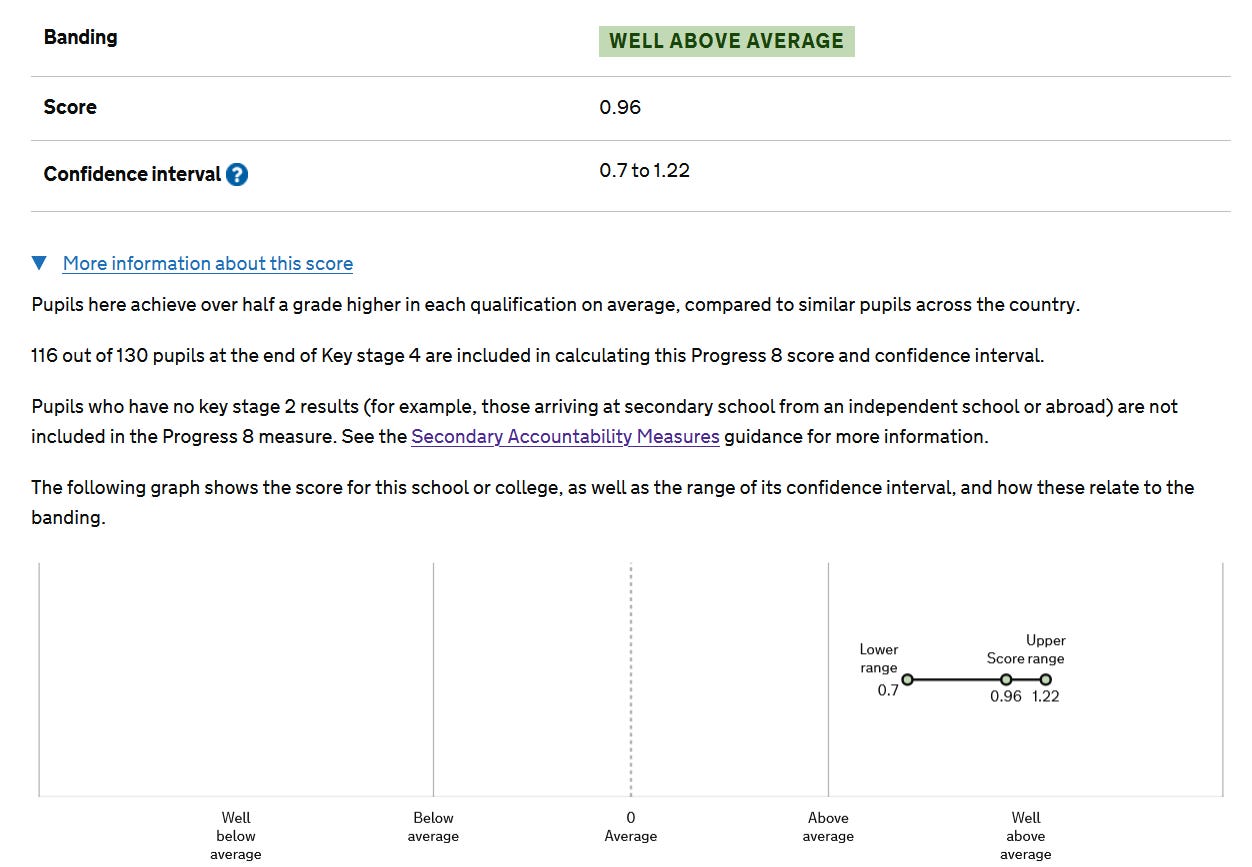
2023-24 Progress 8, West London Free School A Progress 8 score of 0 means pupils make exactly the progress you would expect them to. A Progress 8 score of 1 means they make on average 1 grade more progress in every GCSE (so a child who would have got eight 6s at a perfectly average school would get eight 7s).5 A Progress 8 score of -0.5 means they make on average half a grade less progress in every GCSE (so a child who would have got eight 6s at a perfectly average school would get four 6s and four 5s).6 Around 1 in 6 schools have a Progress 8 of 0.5 or higher; around 1 in 30 have a Progress 8 of 1.0 or higher.
Note that because Progress 8 is calculated on the basis of SATs, which were cancelled during COVID, the most recent Progress 8 score is from 2023-24 (which requires clicking through from the main page). It is still very much worth looking at, despite being two years out of date - though worth double checking there haven’t been major changes at the school since then.
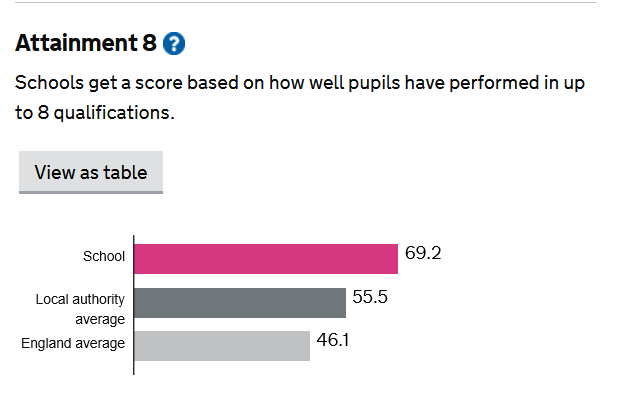
Attainment 8. Attainment 8 tells you how well the children do academically, on an absolute scale. It is based on performance in up to 8 GCSEs: English and Maths (counted double); three subjects from a bucket of sciences, computer science, history, geography and modern languages; and three ‘wild’ subjects (including vocational equivalents). You get told how well a school does compared to its local authority and to the national average.
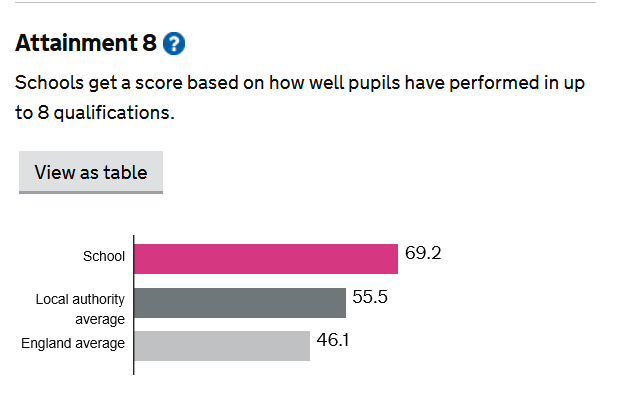
Attainment 8, West London Free School For any given level of Progress 8, you’d ideally want your child to be in a high performing cohort. A brighter cohort can learn faster and make more progress, finishing at a higher place.7 High attainment is correlated with better behaviour, which means less disruption in the class, more learning, and less bullying.
Travel time. Don’t underestimate how much a long travel time takes out of your child’s life. Choosing a school half an hour away means 190 hours less per year for your child: time that comes out of study, play, extra-curricular activities, (later on) part-time work - or simply sleep.8
There are additional benefits to a school in easy walking or cycling distance. Your child will be able to go to any after-school activities they want, regardless of the commitments of other members of the family, and their friends are more likely to also live within easy distance.Stretching the top and supporting the bottom. Progress 8 and Attainment 8 are averages - and can conceal weaknesses at either the top or the bottom. Some schools don’t stretch the top, feeling ‘a 7 is enough’; others don’t do enough to support those who are struggling.
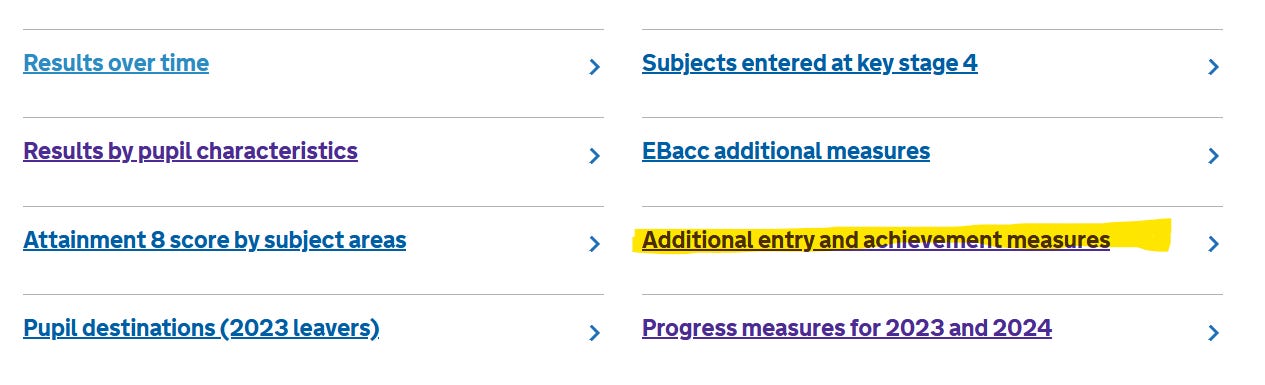
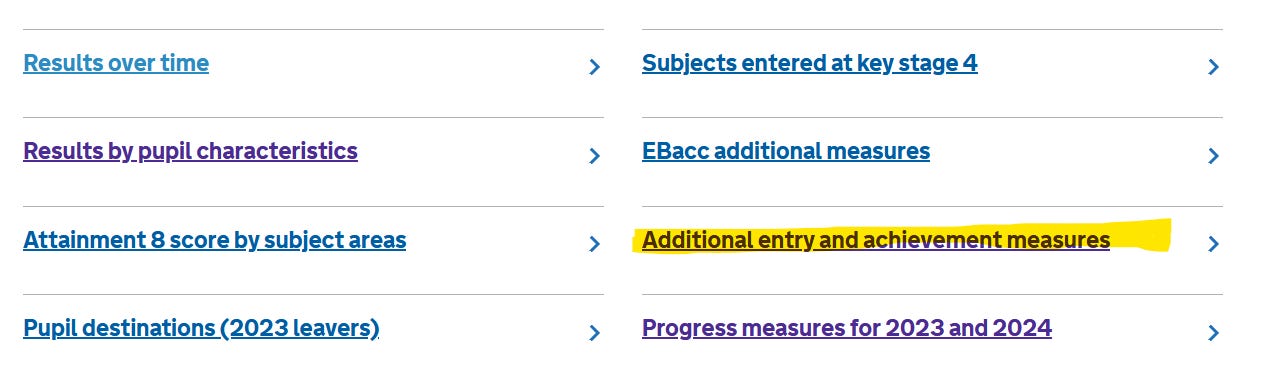
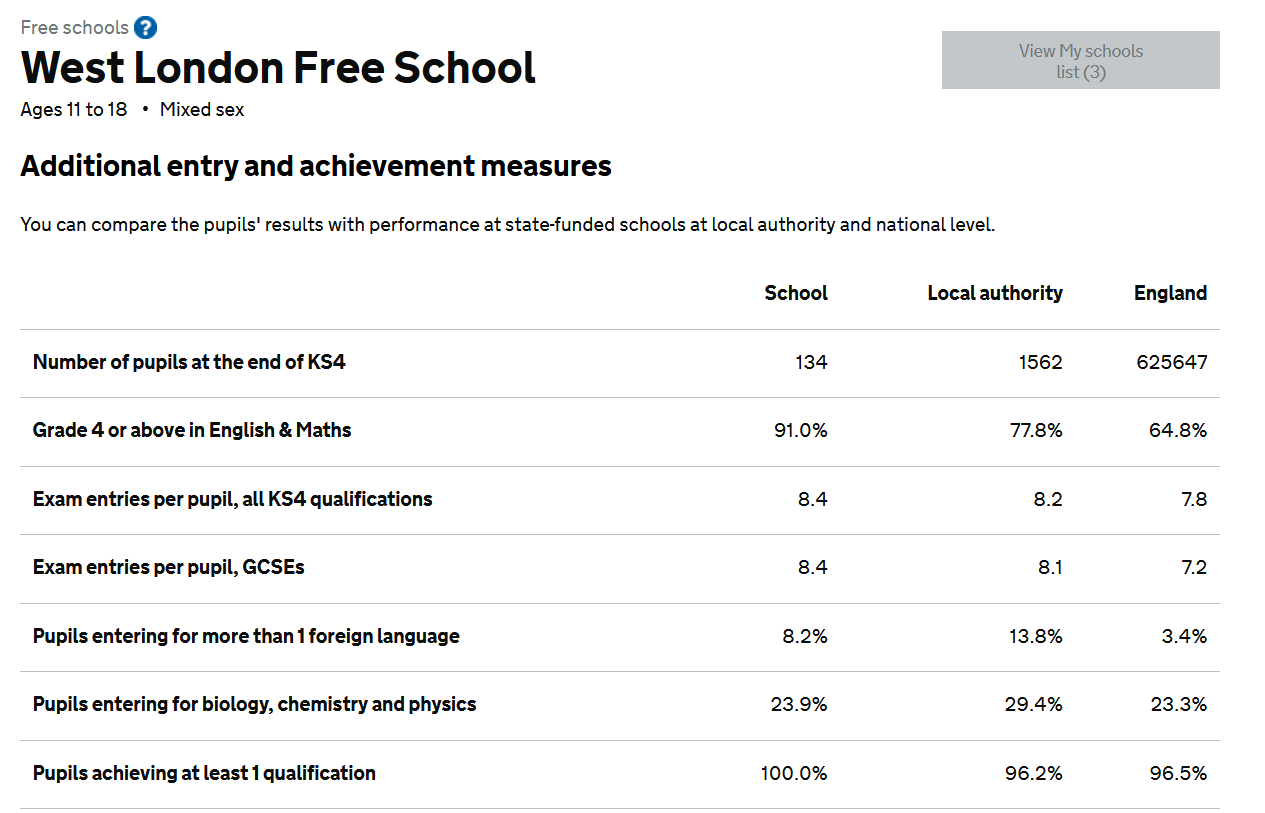
Grade 4 or above in English and Maths is a key indicator for how the school supports weaker pupils. You can find it under ‘Additional entry and achievement measures’ at the bottom of the main secondary page. Nationally, 65% of children achieve this.
Number of pupils getting into Oxbridge is the best universal proxy for really stretching the top. Not because Oxbridge is the be-all and end-all (and some pupils who could get in might choose not to apply), but because it’s an indicator that a school can’t really hide from.9 As part of its crusade to cut down tall poppies, the Government has now removed this indicator from the performance tables, but most schools boast about it (and will certainly tell you if you ask). A large secondary school which gets no-one into Oxbridge year after year is failing its top performers - and most likely those just below that level too.
Attendance. At an individual level, school attendance is highly correlated to academic performance. While your own child’s attendance is largely up to you (and them!), at a school level, poor average attendance either suggests the school is doing something wrong, or that it has a particularly troubled intake. Neither is something you want for your child.
There’s a plethora of additional data available on the performance site (see below), but unless there’s something very specifically you care about - languages, say - there’s a danger of losing the wood for the trees. The headline indicators above are your most reliable quantitative guides.
Qualitative factors
As with the quantitative factors, within this section, factors are presented in rough order of descending importance.
Ofsted Inspections are your single best source of rich, qualitative information about a school’s strengths and weaknesses. The major caveat is that the longer ago one occurred, the greater the risk that it is no longer accurate - particularly if the head teacher, or something else significant, has changed, during that time.
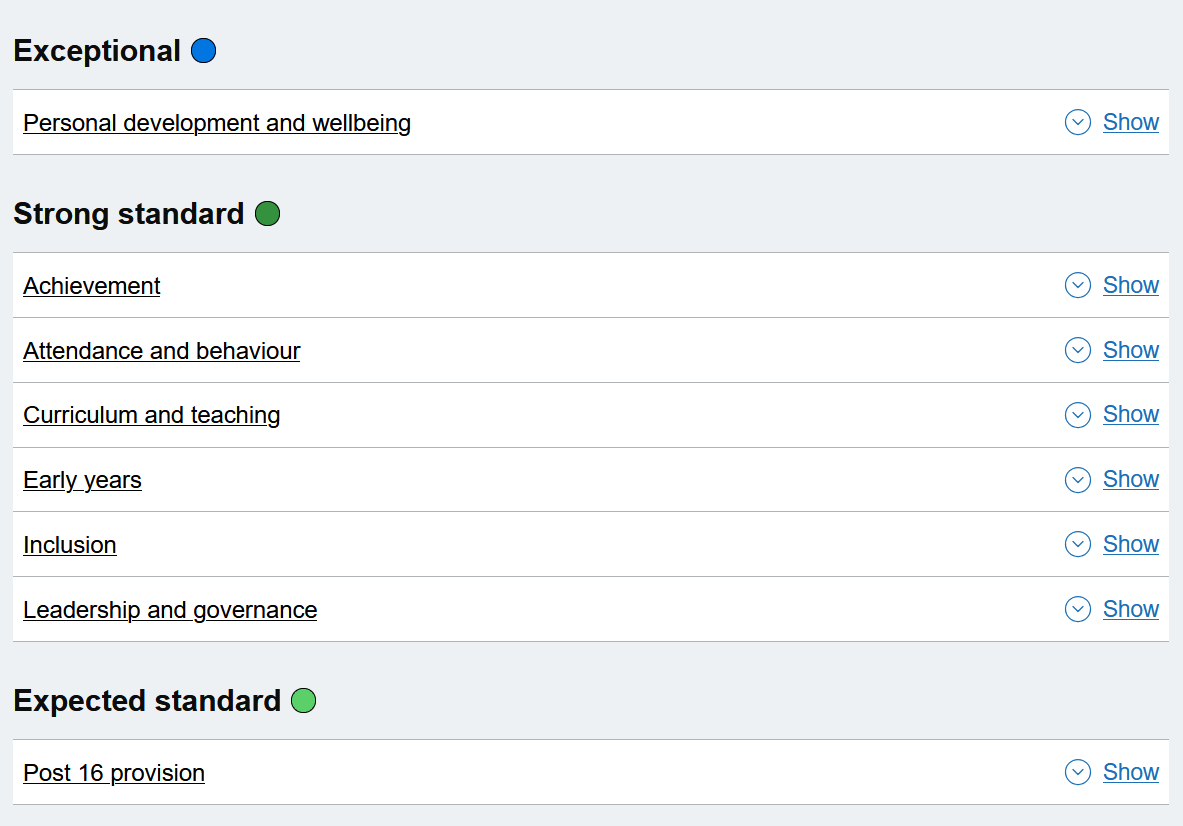
Prior to summer 2024, Ofsted inspections gave an overall rating and ratings in five sub-areas10, each of which can be Outstanding, Good, Requires Improvement or Inadequate.
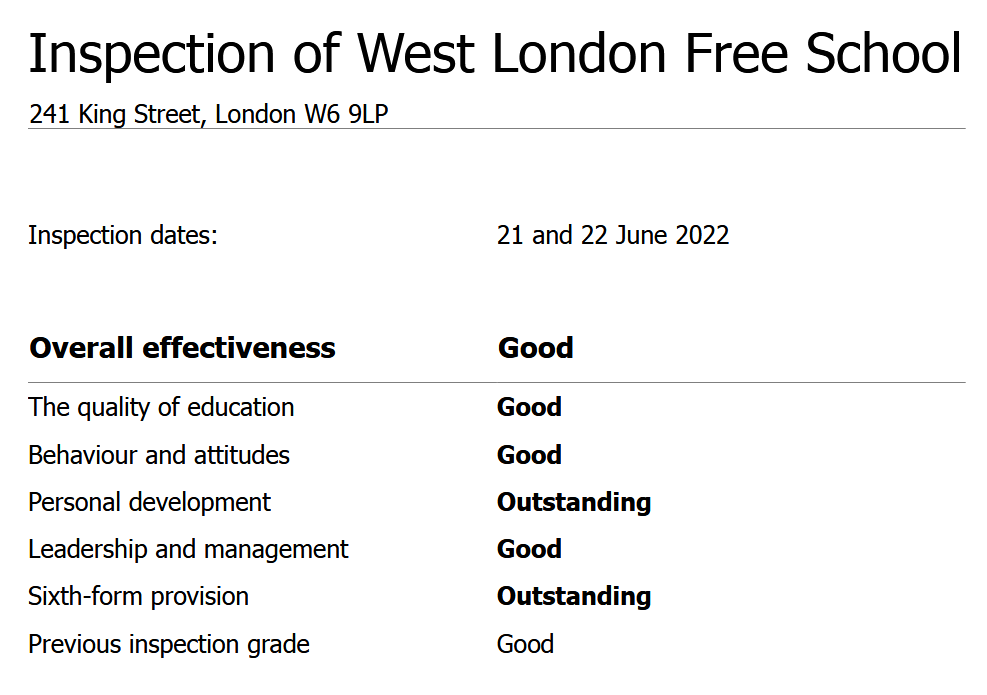
Ofsted report, West London Free School More recent inspections give ratings in seven different sub-areas, each of which can be graded Exceptional, Strong, Expected, Needs Attention or Urgent Improvement Required.
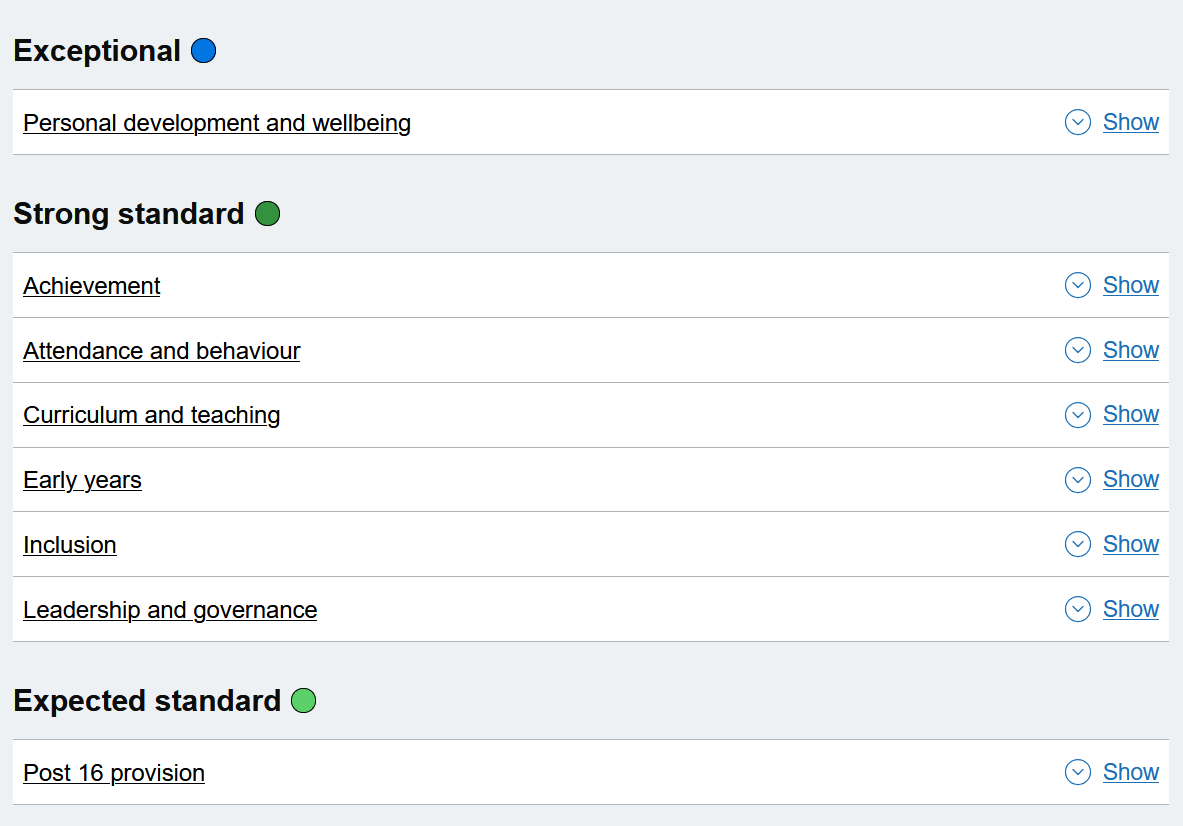
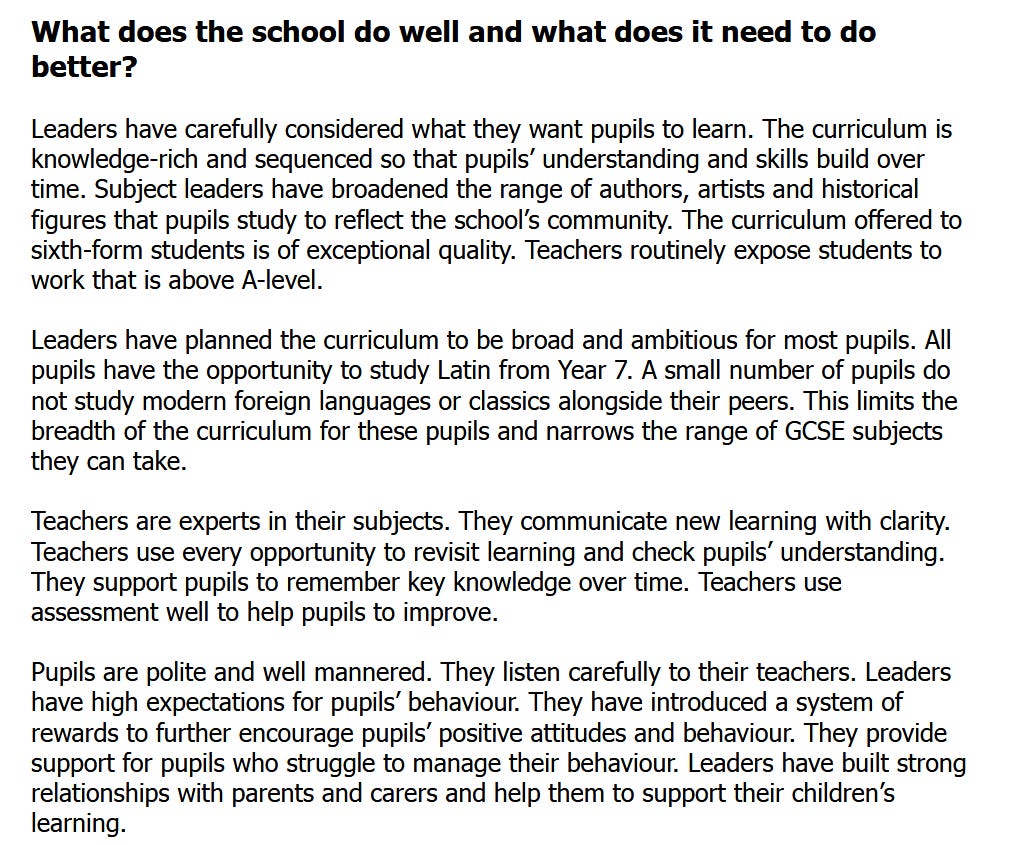
Ofsted Report, The Sydney Russell School In both cases, however, I would value Ofsted reports less for the precise rating,11 and more for the detailed information they give you about the school’s strength and weaknesses. This is presented in plain English over 2-3 pages, and is highly accessible:
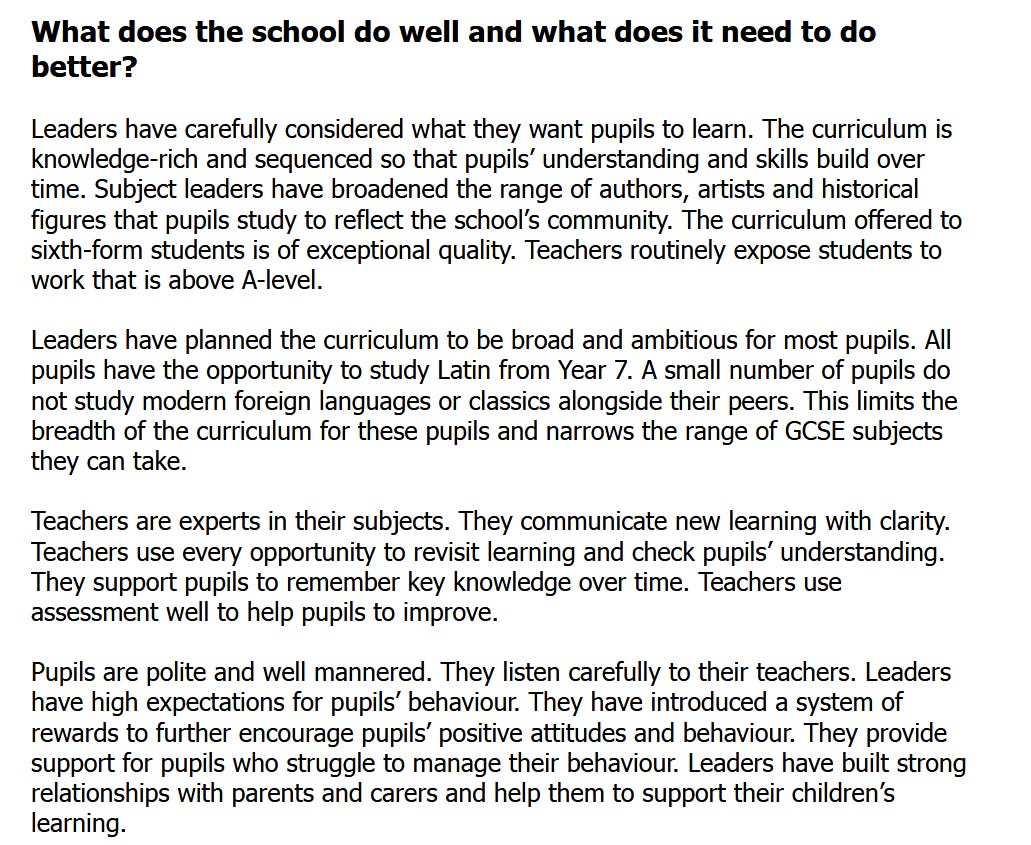
Excerpt from the West London Free School Ofsted report Behaviour. Good behaviour is the key to almost everything else in a school. Without it, children cannot learn well as lessons are disrupted. Bullying increases and children are less happy - or in the worst cases, unsafe. Teachers switch from being educators to crowd control.
Don’t rely on what a school says - almost no school will admit to being lax on behaviour.12 Ofsted directly inspects behaviour (combined with ‘attitudes’ in the old inspections and ‘attendance’ in the new) and you should take what the report says seriously.
Ask teachers and senior leadership13 what their approach is to low-level disruption, lateness, and missed homework14, and whether there is a consistent approach to behaviour across the whole school. A clear, consistent and enforced uniform policy is a good indicator the school also takes behaviour seriously. And finally, ask parents whose children already attend, who will be able to give first-hand insights as to what it is really like.15
Minimising highly disruptive pupils. A single highly disruptive child can seriously damage the learning of every other child in the class - and in the worst case endanger their safety. Although Government policy systematically prioritises the ‘rights’ of that child over the rights of the 29 who wish to learn, a good school will do its best to mitigate the impact on other children.
This is difficult to determine, for obvious reasons. Beyond strong evidence of good behaviour, helpful indicators to look for include a lower than average proportion of SEND pupils, a school that is willing to permanently exclude children, and policies (and practices) of removing highly disruptive children from classrooms where necessary. If the school has been accused of ‘off-rolling’,16 this should also be taken as a positive rather than a negative indicator.
Visiting the school. Don’t be misled by snazzy equipment and shiny buildings - these make very little difference to learning progress. Instead, use the visit to ask the questions that have been raised by your consideration of the data and reports. How does it actually handle missed homework? Does it set or stream - and if so, in which subjects, from what years? Whether it’s SEND, homework, behaviour, music or anything else, this is your chance to dig beneath the surface - and find out the things that can’t be boiled down to stats. One rule of thumb is that if a school can’t explain clearly what its approach to something is - whether that’s stretching high attainers or tackling bullying - then it’s probably not a strong point for it.17
Ethos. A child doesn’t spend 6,000 hours in a school without it shaping character. Most schools promote widely shared values such as perseverance, hard work and kindness, but in other areas they may vary. Faith schools - C of E, Catholic, Muslim, Jewish - will of course emphasise their faith, to a greater or lesser extent. Due to the actions of the last Conservative government, all schools are required to promote equality, diversity and LGBTQ+, but how they do this can vary greatly, from broad-based tolerance and respect for others, to a much more ‘woke’ approach; depending on your own values, you may have a strong preference for one stance or the other. Then there are Welsh-medium schools, international schools…the list goes on.
Extra-curricular. Far more than a generation ago, good schools will have a wealth of extra-curricular activities they put on, at lunchtime and after school. Most good academic schools will be strong here - but inevitably, some schools will be stronger in some areas than others. If your child has a particular talent, or passion, for a particular area - music, football, drama, coding - then you may wish to take this into account.
Private Schools, Grammar Schools, Single-Sex Schools
I recognise these options are not available to everyone. Private schools typically require a certain level of wealth;18 grammar schools only exist in parts of the country and the prevalence of single-sex schools - certainly in the state sector - also varies dramatically depending on geography. Nevertheless, many people will have at least one of these options available to them, and it is worth considering how to weigh them up.
Private schools
Private schools do not publish Progress 8 scores. However, based on the statistics we do know - GCSE and A-Level results, Oxbridge entries, etc - and taking into account the differential intake, we can be confident that top state schools are now comparable with private schools in terms of educational attainment and progress.
There are some areas where private schools still typically have the edge:19
More money spent per child, which means better facilities - sports, swimming pools, science equipment and more. That doesn’t make much difference to learning, but we should acknowledge it is fun and cool.20
More focus and time spent on sport and other extra-curricular activities (public speaking, etc.).
Much easier to exclude highly disruptive children, meaning you are simply unlikely to get lessons repeatedly disturbed in the way that can occur in the state sector.21
Greater willingness to tailor things to an individual child; for example running a GCSE class for 1, or only a very small number, of children.
Social contacts and connections, particularly in an ultra-elite school such as Eton.
But going private also has significant disadvantages.
Most obviously, the cost. Average secondary school fees are £24,000 a year, including VAT - that’s around £170k over 7 years for one child or around £340k for two. Even if you can afford it, it’s worth thinking what else you could do for your child with that money - such as investing it to help buy their first home. For comparison, estimates of the premium to live in an Outstanding state school catchment area range from £40,000 - £120,000 - and with that money you are building up equity.
Universities now systematically and overtly discriminate against private school students, in part due to government pressure on access targets. This means an offer - if one is received at all - may be for higher grades, and fewer options in clearing. Some employers have also started to do this. Your child will also be excluded from other opportunities, such as programmes to find out whether they want to do a subject,22 the otherwise brilliant Axiom programme for high potential mathematicians, and educational opportunities at other institutions - the Bank of England, for example, bars private schools from its educational programmes.
Impact on family life. Many private schools have half or full days of school on Saturdays - a massive impact. Boarding school, obviously, whether weekly or termly, is an even greater intrusion into family life, which one should be very sure one wants.
There are a number of circumstances where it may be adviseable - if you can afford it - to go private:
There are no good state schools near you and, for whatever reason, you are unable or unwilling to move.
Your child is being horribly bullied in a state school and going private is the best way to get them out first.
Your child has a genuine SEND need which is not being met in the state sector.
You are moving countries regularly, for example in the armed forces or diplomatic services.
You are paying for the connections or networks of an ultra-elite private school, such as Eton or Winchester.
In most cases, however, you’ll be better off buying a house in the catchment area of a top state school, saving some money and avoiding the systematic exclusion/discrimination.
Grammar Schools
This is a much easier question. Unless you are an MP who campaigns against grammar schools, then if you live near a grammar school and your child passes the 11+ you should probably send them there.23
Few people dispute that children - from all backgrounds24 - who attend grammar schools on average do better. The policy debate centres over whether this makes up for the fact that the children who go to secondary moderns on average do worse - as well as whether or not it is socially divisive to split children at 11.
So perhaps more interesting questions here are:
Should I move to be near a grammar school? Maybe - if you’re confident all your children will pass the 11+. But it’s a school-by-school decision; a lot of grammar schools are very good, but you may also be able to find an equally good comprehensive that is closer.
Should I move out of a grammar school area, if I think my child is unlikely to get in? Again, maybe. Certainly it’s a risk factor, and you should look carefully at the school where your child will go, and whether you’re happy with that. Importantly though, you don’t have to go on averages: you can look at the actual school. In Bourne, Lincolnshire, for example, the grammar school (where I went) currently has a Progress 8 of 0.68 and is rated Good; the secondary modern has a Progress 8 of 0.58 and is rated Outstanding. In a case like that, both schools are very good, so you don’t need to worry.
Should I put my child through lots of tutoring to get in? Making sure a child is familiar with the format of the test and has a couple of practices is certainly a good idea - whether you do that in the home or via tutoring; however, my own view is that if a child needs a lot of tutoring to get in, the school probably isn’t going to suit them.25 I’ve no actual evidence for that though, and in reality I guess it’s heavily swayed by what your other options are.
Single-sex schools
Statistically, girls do slightly better academically at single-sex schools,26 while boys do slightly better academically at mixed schools. Again, though, this is a time not to worry about the averages: you will presumably be looking at specific mixed and single-sex schools, so you should just go ahead and compare their Progress 8s, Attainment 8s, Ofsted reports and so on as you would for any other two schools.
More important is the social choice. What are the advantages and disadvantages you see to them spending their formative years in a single-sex environment vs a mixed-sex one? Whichever way you land, how important is this compared to academic and other factors? In addition, if your children are not all the same sex, there is an obvious advantage - in terms of travel, sports days, parents’ evenings, etc - in them going to the same school.
Personally, I come down to a moderate preference for mixed-sex: we live in a fully integrated society, and it’s best for children to grow up in such an environment; however, this isn’t a sufficiently large factor that I’d send my children to a bad mixed-sex school over a good single-sex one.27
What did we do?
This is not primarily a post about me. But after sounding off about what I think is best, it is not unreasonable, dear reader, for you to ask whether I put my money where my mouth is, or whether the above is simply advice for Other People’s Children.
When we began looking seriously at secondary schools we discovered the local state schools we could get into nearby were fairly mediocre (’Good’, Progress 8s of 0 to -0.5), which we were not happy with. The principal options we considered were:
There were a number of excellent state comprehensives within the county, to which we could move to - the absolute best being some distance away, with other good options being closer.
We lived (just - a 45 min drive away) within the catchment area of Dame Alice Owen, a top semi-selective school, which we thought Eldest would have a decent chance of getting into.
We also could have afforded to go private, though it would have involved making various sacrifices.
After some agonising, we rejected Dame Alice Owen on the basis of travel time, and had a preference against going private for the reasons set out above. We ultimately chose to move to the neighbouring town, where we already had some community links, to be 2 minutes’ walk from an Outstanding rated mixed comprehensive, with a Progress 8 of around 0.5, and good performance on the other major metrics.
In other words, not out-and-out schoolsmaxxing, but making a decision that balanced a good school with other relevant family factors. With Eldest having just started Year 8 it is still early days, but to date we are very happy with our choice.
For my readers outside the UK, some of the things I’ll be looking at are specific to this country - for example metrics such as Progress 8 - whereas others will be widely applicable factors, such as behaviour and attendance.
Illustrative screenshots will primarily be taken from pages for the West London Free School, a high-performing mixed state comprehensive in…uh, west London. For the avoidance of doubt, this is not where my own children go, nor do I or any member of my family have any formal connection to it.
These are not uncorrelated: many schools are good - or bad - at both! But every school has strengths and weaknesses, and knowing your own children will mean you can judge which weak areas matter to you and which you can ignore.
English and Maths have double-weighting.
Unlike most other countries, in England GCSEs are graded from 9 to 1, with 9 being the highest and 1 the lowest. A 7 is equal to an A in old money; a 4 is equal to a C.
And can we just pause for a minute to reflect on how lucky we are to have a government that publishes all this information, openly, with error bars and confidence intervals, for anyone to look at. This is a case of a government that is treating its citizenry like grown-ups.
At a school level, higher Progress 8 is correlated with higher average attainment at entry.
If you are taking your child to school and back, even a 15 minute journey means an hour a day out of one parent’s day.
The proportions of pupils achieving a 7-9 at GCSE, or A/A* at A-Level, definitely tell you something useful, but don’t tell you whether it’s a school that lets children coast once they get to 7/A. More qualitatively, you can ask a school whether it sets, how and in what subjects; what it does differently to stretch the children in top sets; and what it does in terms of Maths Challenges, Olympiads and other activities to actively stretch children at the very top of the ability spectrum.
There never was ‘only a single rating’.
Though, you know, Outstanding is, 99 times out of 100, going to be better than Inadequate.
Though a school that talks about how ‘all misbehaviour is a form of communication’, emphasises ‘conversations’ as the principal tool of behaviour management or has a ‘no exclusions policy’ should all be red flags. Conversely, wording that talks about ‘firm but fair’, ‘high expectations on behaviour’ and emphasises ‘consistency’ would be more encouraging.
Ask both! Don’t just rely on what the head says - but equally, in a school where behaviour is good, it will almost certainly be led by the head.
You want them to be consistently strict in enforcing it.
There will be exceptions, but I don’t think individual parents are likely to be that reliable - compared to the published statistics - when it comes to a school’s overall academic profile. I do think they’re much more likely to be reliable at spotting whether a school has a behaviour problem.
The practice of encouraging a child to leave without a formal exclusion. Schools are not permitted to do this.
And for most things, this isn’t just about senior leadership. If something is genuinely embedded through the school, any teacher will be able to talk about it.
Though full bursaries do exist for those on low incomes.
The sharp-eyed will spot that I have not put smaller class sizes in this list. Private schools do typically have smaller class sizes - but smaller class sizes have very little impact on learning. The EEF says: “The key issue appears to be whether the reduction is large enough to permit the teacher to change their teaching approach when working with a smaller class and whether, as a result, the pupils change their learning behaviours” (this makes sense!) and suggests this typically doesn’t occur unless class sizes get below 20 - which most private schools don’t get to.
In Upper Sixth, I visited Winchester as part of a Physics Olympiad training session and can remember being very jealous of the equipment and experiments they’d done in science, including measuring G (G, not g, which we had measured) - but in terms of actual learning, I don’t think the science education I received at my state grammar was any less good than theirs.
Though it is not the case that there are no behavioural issues at private schools: there are many documented cases of drugs, bullying and sexual assault being problems.
My school booked three of us, including me, into a two-day chemistry residential at Nottingham - the focus was on subject exploration, not access; i.e. did we want to study chemistry. We each found it invaluable, returning determined that we were not going to do chemistry, but instead would be going to study respectively, medicine, computer science and physics - perhaps not the result Nottingham Chemistry Department was hoping for!
Obviously you should not neglect to check the Progress 8, Ofsted, ensure they don’t ritually feed children to a giant porcupine in an annual ceremony, etc. But odds are it will be a good school.
The attainment gap between children from disadvantaged backgrounds and other backgrounds almost disappears at grammar schools.
Plus I’ve seen plenty of people give their child a tonne of tutoring only for them to fail anyway, at which point you’ve just put an 11 year old through a lot of stress and pressure for nothing. There’s a real limit to what tutoring can do.
Because they don’t have to deal with smelly boys.
What does a ‘moderate preference’ mean in practice? This is the first time I’ve tried to quantify it, so don’t hold me to it, but my gut feel says I’d probably swallow a Progress 8 differential of up to maybe 0.2 to go mixed sex, all other things being equal.