

We want our school system to do a variety of things - and not all of them can be achieved at the same time.
In particular, two goals that are at least partly in tension are:
That every academically capable child, regardless of their background, should be stretched to fulfill their full academic potential, progressing to university and beyond.
That those children who are not academically able are given the opportunity to develop other talents, so that they also can take up productive and rewarding roles in society.
Some things we might do in schools further both aims. It is important for everyone to be able to read, so phonics teaching and a focus on literacy are vital. Good behaviour policies, creating environments where children are safe and able to learn without disturbance, similarly benefit every child. The list goes on.
But there are also trade-offs.
At one level this simply involves prioritisation: where do we put our resources, whether that is money, the best teachers, or government policy focus. But there are also more hard-edged trade-offs. The longer you force every child to take an academically focused curriculum, the more likely you are to ensure no children in the first camp fall through the net. But the more likely, also, you are to have less academically capable children become disengaged with the system entirely, go off the rails and set themselves on the path to long-term unemployment, addiction, homelessness or criminality.1
There is no perfect answer here, only choices.
An academic success story
Since 2010, under the school reforms spearheaded by Michael Gove, we’ve done a tremendous amount to improve English schools in terms of the first objective. The curriculum was revised to become more knowledge-rich; assessments were made more rigorous, including by reducing the dependence on easily-gamed coursework; and a system of school autonomy paired with tough accountability fostered innovation and then spread it throughout the system.
The results have been impressive. The UK has shot up the international school performance tables (PISA, TIMSS) - and while, like other countries, performance was impacted by COVID, it fell less far and appears to be rebounding more quickly. Importantly, this progress was spread broadly across socio-economic groups, with children on Free School Meals seeing attainment rise at a similar rate to more advantaged groups.2 At the top end, an increasing number of state schools see Oxbridge success rates comparable to those of private schools.3
These are fantastic achievements which must be treasured and preserved.
But at the same time, they did comparatively little for the ‘forgotten third’: those whose talents do not lie in the academic sphere, but still have a tremendous amount to give to society.
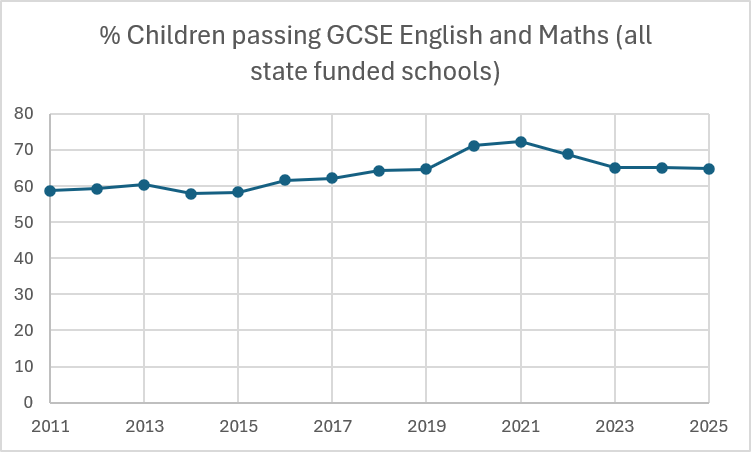
While there are a whole bunch of issues in displaying this statistic in a continuous time series,4 we can see that pretty consistently, 35-40% of children in state schools fail to achieve a pass - a C in old money or a 4 today - in both GCSE English and Maths. Given that schools are - rightly - incentivised to try very hard to get children to pass these subjects, for many children this statistic will also represent worse performance in other subjects also.
We can see that this number is also very sticky - over time and across regions.5 Over the last 15 years, despite the massive focus on this issue, it’s fallen by about 5%. That is not nothing: it represents tens of thousands of children per year. But at that rate of improvement, we’ll still be talking about the ‘forgotten quarter’ in the 2050s and the ‘forgotten fifth’ in about 2070.6
That can’t be a reasonable solution to this issue.7
In addition to neglecting this cohort in school, decisions by both parties have also made it worse for them in other ways.
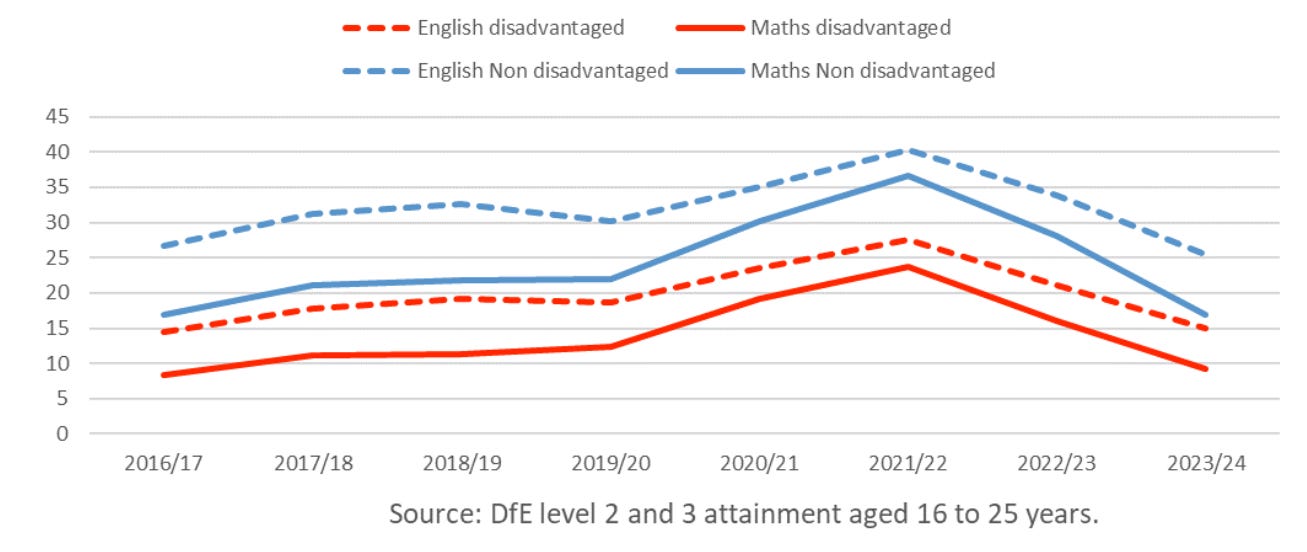
Further Education was systematically cut between 2002 and 2020, with funding falling by over a third in real terms. Well-meaning reforms to the apprenticeship system in 2017 resulted in the number of apprentices for younger people, and at lower levels, collapsing as employers shifted funding towards older, established and more highly skilled workers. The number of vocational qualifications offered was allowed to proliferate and overlap in a confusing way, and (in the ‘00s) false ‘equivalences’ were declared which led to many young people being steered by schools into taking them to game the school performance tables. And more recently, a too-blunt policy meant that young people who had failed their English and Maths GCSE, and had little prospect of ever passing them, were forced into repeated futile and humiliating retakes, rather than being supported into gaining more practical qualifications in numeracy and literacy.8

To try to disguise this, the entry and awarding standards for higher education were allowed to collapse, with 1 in 10 new full-time undergraduate starters now going without a single A-Level, BTEC or equivalent, and the proportion of Firsts going from 13% to 30% in under 20 years. This facilitated a significant increase in the proportion of young people going to higher education - despite the most recent study, using highly favourable assumptions,9 demonstrating that 1 in 4 of those going see no, or negative, financial returns, and 32% showing a negative return when one considers both the returns to the individual and the Exchequer. It was a type of Potemkin social mobility, funneling youngsters into debt-trap degrees, regardless of whether they conveyed any intrinsic learning or led to better career options.
It’s time to focus on the forgotten third
Andy Burnham has pledged to give technical and vocational education the same focus that academic education has achieved, an ambition that continues from his actions as Mayor of Greater Manchester. In a recent announcement he pledged:
The Prime Minister is determined to put technical education on an equal footing with the traditional academic path and to ensure there are ‘no dead ends’ for young people coming out of the education system. This means providing high-quality technical education routes that are valued and respected by students, parents and employers. In a message directly to students, he will say ‘whether you choose construction, coding or classics, you’ll get the skills you need and be given the respect you deserve’.
From age 14 (Year 10), students will have the chance to combine core academic subjects – including English, maths and science - with a high-quality technical education that’s linked to the jobs available in their area. They will be able to spend time with employers and gain real-world experience…
…For too long in this country, students have been told that you must take the academic path to do well and to be respected. The whole school system has been built around it and that has let down young people seeking technical qualifications.
“I want an education system based on parity between academic and technical which gives all young people a clear path in life. From today, Britain will value the hard hat every bit as much as the graduation cap.
“In a fundamental change to the education system, we will introduce new technical education pathways from 14 – prestigious routes that will give students the chance to combine the core academic subjects with the skills, technical knowledge and experience they need to get quality, well-paid jobs where they live.”
As politicians are wont to do, he has talked a lot about parity of esteem. This is understandable, because voters love it and it plays into the sense many people have that everyone is equally endowed with talents, albeit different ones.10 But this is not actually a helpful framing: while highly rigorous vocational qualifications exist and are important, the policy as outlined so far appears to be more focused about providing better lives for the ‘forgotten third’ who are gaining little from the current single academic pathway.11
The blunt reality is that, in a highly technological, information-based society such as ours, outside of professional sport and entertainment, the most lucrative and prestigious jobs are predominantly going to be those that require a high level of academic ability.12 Those kids with the academic ability to become bankers, barristers and brain surgeons will predominantly follow the path that allows them to do so, not take vocational options - and seeking to alter this is folly.
Below that top level, the story is more mixed, with many highly skilled technical careers providing higher earning power than lower paid graduate jobs. Many roles require a mixture of both - such as an electrician who establishes their own business and begins employing others - as well as many other elements and attributes of a person’s personality.
But there are also a great many people who are not succeeding academically and are highly disengaged by the current structure of the education system. They may come alive in the workshop - but then again they may not. Perhaps they do not have a particularly strong natural aptitude in any areas. But nevertheless, we should want - for both their sake and that of the nation - for them to be able to play a productive role in the labour market: holding down a job, supporting themselves and their family, and doing as well as they can. That may be a job such as a hairdresser, care assistant or bricklayer; it may be as a shift supervisor in retail or hospitality; it may be simply a job on minimum wage. What matters is that they are healthily and fruitfully engaged in society.13
Real parity of esteem isn’t about trying to claim that every path is equal, or that all have equal talents. It’s about valuing and supporting everyone regardless of their endowments, supporting them to live good and fulfilling lives: not insisting that everyone must seek to cram themselves into an academic pathway - and throwing on the dung-heap those who don’t succeed.
Fundamentally, we know how to do this: it involves getting disengaged children out of the classroom and working with employers - on placements, on day-release, or on employer-led activities in a more traditional environment of a school or college. Ideally this should involve learning vocational skills, but at the very minimum it involves teaching children how to be employable - to turn up on time, to deliver in a work-based setting - to re-engage them with learning by showing them its applicability, and to take people off the road to unemployment and inactivity.
This can, and should, also involve - at least pre-16 - continued study of at least some foundational subjects, particularly English and Maths, in some form.
Children aged 14 and above could spend 1-2 days a week in FE colleges, taking vocational options where the facilities already exist, alongside a smaller set of GCSEs. This has worked before and could work again. Alternatively, they could be allowed to go on day release to employers, again for 1-2 days per week, potentially earning a (low) wage while doing so. Burnham’s own MBacc, brigading together technical qualifications and work experience, could be adapted and expanded for national use.
One other type of institution that has demonstrated it can deliver this sort of education at scale are the misleadingly named University Technical Colleges, or UTCs - which despite the name are technically-focused schools for 14-19 year olds, with a strong emphasis on working with employers.
There are currently 44 of them, with the first established in 2010. The programme faced significant teething problems - just as some of the early free schools saw incidents of mismanagement. A number of reports in 2019 found that they were underperforming - which was hardly surprising, as at the time fewer than half were rated Good or Outstanding by Ofsted.
Since then, they have improved dramatically, as they figured out how to consistently deliver high-quality employer-focused education. This has shown up in Ofsted ratings, which are now comparable with the broader state sector, as well as a recent study, which used statistical matching to compare UTCs with local schools with similar demographics, and found that UTC students were more likely to go on to apprenticeships, more likely to be in sustained employment destinations and less likely to become NEETs.14 Clearly not every school should be a UTC - but doubling the number of them, as well as establishing a similar number of UTC ‘sleeves’ - or pathways within mainstream state schools - would place a high quality vocational option within the reach of many more children.
Further Education Colleges and UTCs are far from the only option. Greater work experience, employer placements and vocational options could be delivered in mainstream schools under other auspices. The provisions in the Education and Skills Act 2008 that raised the education leaving age from 16 to 18 can and should be reversed.15 And though some Labour MPs may balk at it, cadet forces in schools could be greatly expanded - particularly in schools with high NEET outcomes. The armed forces have a great track record of providing the structure and discipline some young people need to get their life back on track - not to mention developing skills and trades useful on the return to civilian life.
And yet, it may not work
Despite what I’ve written, there remain significant reasons to be cautious.
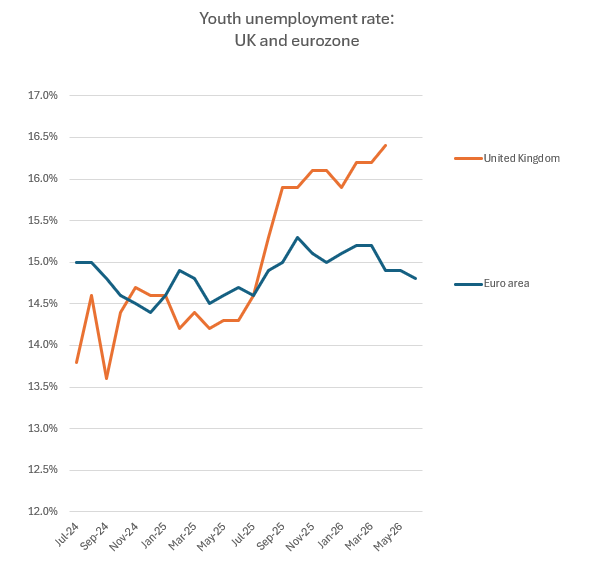
Firstly, though the ‘forgotten third’ is a long-standing challenge, the education system is not the cause of the current rise in NEETs. Rather, this has been caused by the dramatic, inflation-busting rises in the minimum wage for younger people, alongside the increase in Employer National Insurance Contribution, which together have increased the cost of employing a young person by over £4,000 in just two years - pricing young people out of the labour market.16
The dramatic increase in ‘day 1 rights’ introduced by the new Employment Rights Act will exacerbate this, making employers less willing to take a chance on anyone without a strong employment record or impeccable credentials. Ongoing aftereffects of the COVID lockdowns, and a SEND, welfare and disability system that strongly incentivises young people to take themselves out of the labour market17 complete the toxic cocktail.
If Burnham misdiagnoses what changes to education can - and cannot - achieve, this may lead the reforms down the wrong route.
Secondly, it is always easier to destroy than to build.
Rather than actually improve things for the less academically able, the Government may simply reverse the academic progress made over the last 15 years - dumbing down the curriculum, making exams easier and reducing accountability. This would return us to a system that serves no-one well - a return to the ‘bog-standard comprehensive’ condemned by Alastair Campbell. There is, lamentably, still a strong strand of thought that believes that if some children cannot pass an exam, the solution is to make it easier for everyone, even to the point of uselessness - rather than to tailor different routes to different abilities.
There is real reason to fear this. Starmer’s Government had already taken steps in this direction under Bridget Phillipson, and Burnham’s new choice of Education Secretary has a worrying track record of criticising rigorous assessments, praising coursework and scepticism towards the knowledge rich curriculum.
If the reforms tend towards this direction, they can and should be condemned.
Thirdly, even if the focus on improving vocational routes is maintained, it will not be easy to deliver this at scale. Schools do not have the funding or facilities; trained staff will be an issue.18 If employers are to deliver work placements at scale, rather than as an act of charity, they must be either compelled (as the Germans and Swiss, who are best at this do) or compensated, which again requires funding. Previous technical education initiatives, such as the previous Government’s T-Levels, or repeated aspirations to increase the number of apprenticeships, have foundered on the Treasury’s dogmatic refusal to compensate employers for providing work-place based training.19
If delivering genuine employer-based learning and release to FE colleges are put in the ‘too difficult’ bucket, it would be all too easy for the Government to fall back on delivering pseudo-vocational qualifications from the classroom, which as Daisy Christodoulou has eloquently documented, meant that ‘Between 2004 and 2010, the number of vocational qualifications taken in schools up to age 16 increased nearly 40 times - from 15,000 a year to 575,000 a year’, while ‘the government attempted to enforce equivalence by fiat using equivalence tables…In perhaps the most egregious case, 20% of pupils ended up taking the European Computer Driving Licence, a vocational qualification that was equivalent to a GCSE but that could be completed in three days.’ This, again, would be a tremendous waste of potential.
So there are plenty of ways in which this could go wrong - and good reason to be cautious, and to apply scrutiny.
But the aim, of delivering better vocational routes for the forgotten third, that will support them in to more fruitful roles in society, is one that should be given full support. It may be hard to deliver, but it is essential to do so - we cannot keep writing off 1 in 3 of our children.
In both cases, those who lose out are more likely to come from poorer and more disadvantaged households, so ‘prioritise the disadvantaged’ doesn’t help you unless you only care about one side of the equation.
The attainment gap actually narrowed slightly until 2019, though this was then derailed by COVID as poorer kids suffered worse - for a variety of reasons - from the lengthy school closures.
If I did have a criticism, it is that not enough was done systematically for the most academically able children. The best academies and free schools are outstanding (as are grammar schools) - but this is not sufficiently systematised or widespread, and the closure of New Labour’s ‘gifted and talented’ programme - flawed though it was - without replacement was a mistake. It is wonderful that a single billionaire is essentially single-handedly building the elite maths infrastructure that we should have had for decades, alongside being the UK’s second highest taxpayer, but it is depressing that it is necessary for him to do so.
Including: in 2014 the rules were changed to count only the first time someone sat the exam (hence the dip), in 2016 they were altered to count a pass in either English Language or English Literature (hence the rise), in 2017 the exams shifted to a new 1-9 grading system with a 4 comparable to a C, in 2020-2021 grades were higher due to teacher assessed grades, and in 2022 artificially kept higher as part of a ‘glide-path’ back to near-pre-pandemic standards.
We also should absolutely not expect this number to continue rising linearly, as diminishing returns will set in rapidly once the low-hanging fruit are picked - which they may already have been, and given the level of technological and societal change expected over the next 50 years, which could have all kinds of unpredictable effects.
If I am steel-manning the critics, I think they would say something along the lines of our very best schools with the highest Progress 8 scores, such as Michaela or the Ark Greenwich Free School, do have fewer than 5% of children who fail to get a pass in both English and Maths. This demonstrates that it is possible, so we just need to roll this out across the country, and so there is no contradiction between our two initial goals.
I accept that there aren’t laws of physics against (almost) everyone passing GCSE English and Maths. But in any mass system there will always be extreme outliers and saying ‘let’s just make the whole system as good as the best’ isn’t a policy solution. The most exceptional leaders, or teachers, or other facets can’t just be duplicated at scale - and it’s not as if we haven’t been trying to do this, really quite hard, across all schools!
The (state, comprehensive) school my own eldest goes to is Outstanding rated (2024), has a Progress 8 of around +0.5, putting it in the top 5-10% of schools in the country, and only c. 10% of children on FSM, and still has about 1 in 6 failing to pass both English and Maths, which gives an indication of the limits of what ‘normal’ high performance looks like.
We shouldn’t make no-one retake: English and Maths GCSE are very valuable, so there is logic in getting people who’d just missed out to retake; far less so in people who fell far below the level required. About 30% of those who failed the first time go on to ultimately pass (ignore the COVID years), and while we can’t identify those perfectly, getting 100% of students to repeatedly retake really doesn’t seem useful, and may well be counter-productive.
Using a cohort that began university almost 20 years ago, when fewer people went, academic standards were higher and the graduate premium stronger, as well as making no attempt to account for signalling effects.
This is not true. Technical and mechanical aptitude is actually positively correlated with academic ability, albeit not in my case. For that matter, being a professional sportsperson is positively correlated with above average academic ability, albeit relatively mildly.
I don’t think it is particularly helpful to get too hung up about politicians talking about ‘parity of esteem’; it is inevitable that politicians will use inaccurate terms that resonate with voters, and it is equally inevitable that policy wonks will complain about it.
Before any pedants interject, I said predominantly, not all. And even in professions such as retail, where it is common for senior managers to work their way up off the shop floor without formal qualifications, the majority of those that make it to the top by this route will be highly intelligent individuals.
Clearly the education system cannot do this alone. Other elements are required, with mass house-building to bring down the punitive cost of housing - both to buy and to rent - being one of the most important in today’s Britain.
They do underperform comparable schools at English GCSE - though not Maths - but this might be considered an acceptable trade-off.
A transparent attempt to massage the unemployment figures following the financial crisis.
We can see this clearly if we compare youth unemployment in the UK and the Eurozone. It wasn’t the education system that changed where the two lines decouple:
If you are unemployed, a mental health disability can both increase the amount of money you receive and remove the requirement to look for work - with the latter having devastating long term consequences.
Particularly if the new requirement for all teachers to have qualified teacher status is maintained.
If you wouldn’t expect a college or private training provider to deliver 35 days of training free of charge, why should you expect an employer to? Hosting a raw 15 year old for this length of time does not typically boost productivity.
I guess before getting too excited about engagement we also have to think about the value of what you are engaged with. My reading of the Wolf report was that she found that the only 14-16 qualifications with any labour market value were GCSE English and Maths. If it's the case that the GCSE-alternative in construction not only doesn't qualify you as a bricklayer but isn't even particularly valued by employers hiring trainee bricklayers then one might reasonably ask what is the point? In particular in that case it might be better to focus on (more valuable) general education even if the chance of significant progress isn't super high.
Do you have a take/evidence on this? Obviously one might say that's because the vocational qualifications in 2010 weren't vocational enough but I think there's a bit of a danger of slipping into "real socialism has never been tried"...
The distinction between genuinely vocational education and simply creating more “vocational” qualifications feels really important. From a parent perspective, what matters is whether a route gives a young person meaningful exposure to employers, real progression and a clearer line into work — not just a different label on classroom learning. If technical routes are going to have credibility, families need to be able to see where they actually lead.